The euro weakened and the Bank of Japan remained cautious, putting downward pressure on the euro against the yen.
2026-10-07 14:12:20
On Wednesday in Asian trading, the euro initially rose slightly against the yen before turning lower, trading around 177.80 and giving back the modest gains recorded in the previous session. The daily technical structure shows that the pair remains within a descending channel , with a continued bearish bias: the price continues to be capped below the cluster of moving averages formed by the 9-day and 50-day moving averages , with short-term moving averages below long-term moving averages, making any rebound more likely a correction than a reversal; the 14-day RSI is in the weak zone at 36.36 , indicating that selling pressure still dominates, despite some stabilization in the price since last week's lows.  The weakness in cross-currency pairs is a result of the combined weakness of the euro and the yen. On the euro side, French debt and political risks continue to escalate—market concerns about France's ability to control its fiscal deficit and the persistently high Franco-German interest rate differential caused the euro to fall to a 17-month low against the dollar, naturally transmitting the euro's overall weakness to the euro/yen cross-currency pair. On the yen side, the market consensus is that the Bank of Japan will hold rates steady in October, with overnight index swaps pricing in a rate hike of only about 12% this month, indicating a lack of upward catalysts for the yen on the interest rate front. These two forces offset each other, resulting in a gradual decline rather than a sharp drop in cross-currency pairs. Institutional assessments of the Bank of Japan's policy path are largely consistent with market pricing. Rabobank analysis points out that although the Bank of Japan's policy focus has shifted to stabilizing inflation near its 2% target, "the market generally believes that the Bank of Japan's situation is not yet suitable for continuous rate hikes," and any further policy normalization is more likely to proceed in a steady and gradual manner rather than with rapid, continuous actions. This assessment provides a reference for the medium-term trend of the yen: if the pace of subsequent interest rate hikes is indeed slow, the interest rate differential between the US and Japan and between Europe and Japan is unlikely to narrow significantly, and the yen will remain relatively weak, providing "bottom support" rather than "upward momentum" for the euro/yen pair. From a global perspective, the euro/yen exchange rate movement encapsulates two main themes: European fiscal risk and Japanese monetary policy. Every back-and-forth in the French budget game is transmitted to cross-currency pairs through the euro, while statements from Bank of Japan officials and inflation data determine marginal changes in the yen. Market sentiment is generally cautious, with investors focusing on three points: the upcoming FOMC meeting minutes (which indirectly affects the euro and yen through the dollar), the progress of the French budget in parliament, and the Bank of Japan's official statements before its meeting at the end of October . From a technical perspective, the euro/yen pair remains within a downward channel on the daily chart, with short-term moving averages suppressing any rebound, and the RSI weak, indicating that the bearish structure remains unchanged. On the support side, the lower channel line at 176.50 is the first support level , followed by the 11-month low of 175.70 recorded in November 2025. A break below this dense support zone would open up space for a test of the 14-month low of 169.72 . On the resistance side, the 9-day moving average at 178.25 is the first resistance level, with a break above that targeting the 50-day moving average at 181.10 . Stronger resistance lies at the upper channel line at 184.20 , and the historical high of 187.95 reached on April 17th . Looking at the 4-hour chart, the exchange rate is consolidating weakly around 177.90, with narrowing fluctuations. Short-term momentum indicators are in weak territory, indicating a lack of upward momentum. If the FOMC minutes trigger volatility in the US dollar, cross-currency pairs may test the 178.25-178.30 range. Conversely, a break below 176.50 would accelerate the downward trend.
 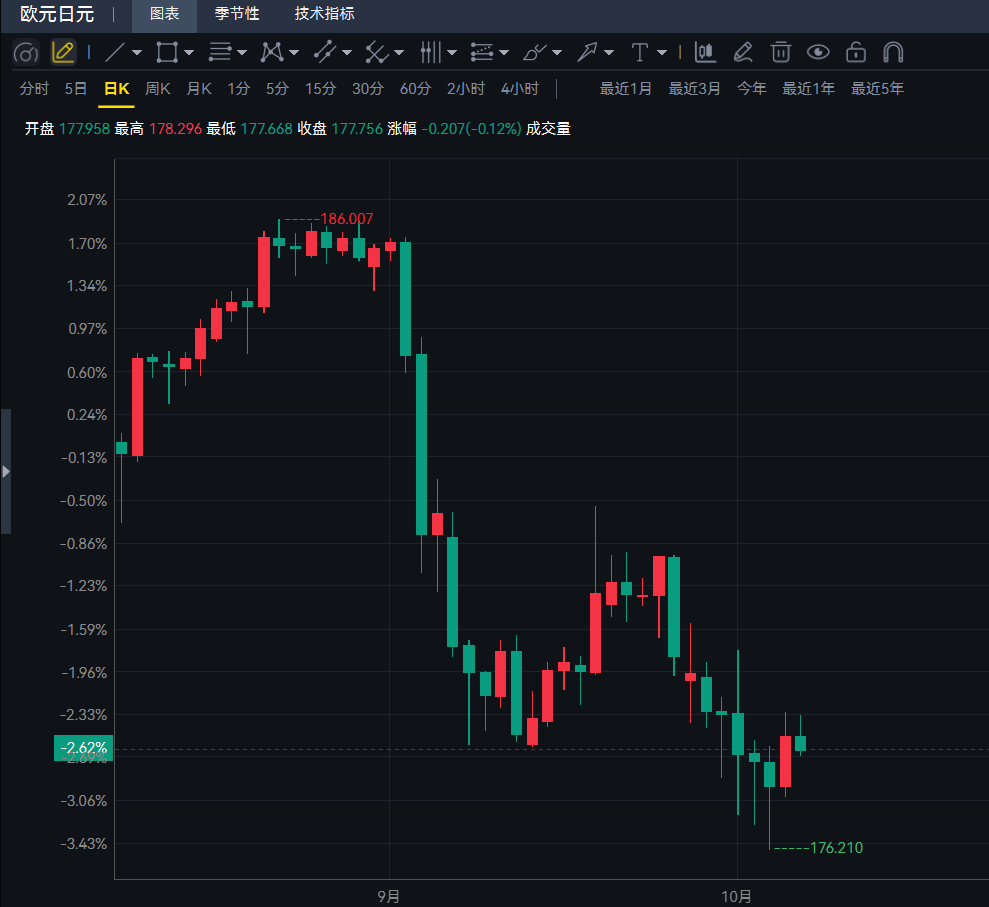 Editor's Summary : The current EUR/JPY pair exhibits a typical cross-currency pattern of "weak euro, weak yen": French fiscal risks are suppressing the euro, while the Bank of Japan's cautious stance is dragging down the yen, resulting in a tug-of-war that keeps the exchange rate trapped within a downward channel. Looking ahead, the short-term direction depends on the FOMC minutes – if the minutes are dovish, a decline in the dollar will indirectly alleviate pressure on the euro, and the cross-currency pair may recover towards 178.25 or even 181.10; if the minutes are hawkish or there are further developments in the French budget, the exchange rate will move towards the support zone of 176.50-175.70. In the medium term, the pace of the Bank of Japan's policy normalization is a decisive variable: if Rabobank's assessment of a "gradual rather than continuous" approach materializes, the yen will struggle to gain a basis for rapid appreciation, and the EUR/JPY pair is more likely to maintain range-bound trading. On the risk side, attention should be paid to French political events and unexpectedly hawkish statements from Bank of Japan officials.
The weakness in cross-currency pairs is a result of the combined weakness of the euro and the yen. On the euro side, French debt and political risks continue to escalate—market concerns about France's ability to control its fiscal deficit and the persistently high Franco-German interest rate differential caused the euro to fall to a 17-month low against the dollar, naturally transmitting the euro's overall weakness to the euro/yen cross-currency pair. On the yen side, the market consensus is that the Bank of Japan will hold rates steady in October, with overnight index swaps pricing in a rate hike of only about 12% this month, indicating a lack of upward catalysts for the yen on the interest rate front. These two forces offset each other, resulting in a gradual decline rather than a sharp drop in cross-currency pairs. Institutional assessments of the Bank of Japan's policy path are largely consistent with market pricing. Rabobank analysis points out that although the Bank of Japan's policy focus has shifted to stabilizing inflation near its 2% target, "the market generally believes that the Bank of Japan's situation is not yet suitable for continuous rate hikes," and any further policy normalization is more likely to proceed in a steady and gradual manner rather than with rapid, continuous actions. This assessment provides a reference for the medium-term trend of the yen: if the pace of subsequent interest rate hikes is indeed slow, the interest rate differential between the US and Japan and between Europe and Japan is unlikely to narrow significantly, and the yen will remain relatively weak, providing "bottom support" rather than "upward momentum" for the euro/yen pair. From a global perspective, the euro/yen exchange rate movement encapsulates two main themes: European fiscal risk and Japanese monetary policy. Every back-and-forth in the French budget game is transmitted to cross-currency pairs through the euro, while statements from Bank of Japan officials and inflation data determine marginal changes in the yen. Market sentiment is generally cautious, with investors focusing on three points: the upcoming FOMC meeting minutes (which indirectly affects the euro and yen through the dollar), the progress of the French budget in parliament, and the Bank of Japan's official statements before its meeting at the end of October . From a technical perspective, the euro/yen pair remains within a downward channel on the daily chart, with short-term moving averages suppressing any rebound, and the RSI weak, indicating that the bearish structure remains unchanged. On the support side, the lower channel line at 176.50 is the first support level , followed by the 11-month low of 175.70 recorded in November 2025. A break below this dense support zone would open up space for a test of the 14-month low of 169.72 . On the resistance side, the 9-day moving average at 178.25 is the first resistance level, with a break above that targeting the 50-day moving average at 181.10 . Stronger resistance lies at the upper channel line at 184.20 , and the historical high of 187.95 reached on April 17th . Looking at the 4-hour chart, the exchange rate is consolidating weakly around 177.90, with narrowing fluctuations. Short-term momentum indicators are in weak territory, indicating a lack of upward momentum. If the FOMC minutes trigger volatility in the US dollar, cross-currency pairs may test the 178.25-178.30 range. Conversely, a break below 176.50 would accelerate the downward trend. Editor's Summary : The current EUR/JPY pair exhibits a typical cross-currency pattern of "weak euro, weak yen": French fiscal risks are suppressing the euro, while the Bank of Japan's cautious stance is dragging down the yen, resulting in a tug-of-war that keeps the exchange rate trapped within a downward channel. Looking ahead, the short-term direction depends on the FOMC minutes – if the minutes are dovish, a decline in the dollar will indirectly alleviate pressure on the euro, and the cross-currency pair may recover towards 178.25 or even 181.10; if the minutes are hawkish or there are further developments in the French budget, the exchange rate will move towards the support zone of 176.50-175.70. In the medium term, the pace of the Bank of Japan's policy normalization is a decisive variable: if Rabobank's assessment of a "gradual rather than continuous" approach materializes, the yen will struggle to gain a basis for rapid appreciation, and the EUR/JPY pair is more likely to maintain range-bound trading. On the risk side, attention should be paid to French political events and unexpectedly hawkish statements from Bank of Japan officials.
- Risk Warning and Disclaimer
- The market involves risk, and trading may not be suitable for all investors. This article is for reference only and does not constitute personal investment advice, nor does it take into account certain users’ specific investment objectives, financial situation, or other needs. Any investment decisions made based on this information are at your own risk.