Houthi counterattack prompts EIA report of shortages; international oil prices rebound after hitting bottom.
2026-10-07 14:42:18
On Wednesday (October 7), bullish sentiment in the international crude oil market clearly rebounded for WTI crude oil, with both geopolitical and weather factors providing a solid foundation, leading to a robust bottoming-out and recovery in oil prices. However, hurricane-related weather disturbances in the Gulf of Mexico, the Houthi retaliation in Yemen's Red Sea conflict, and escalating tanker attacks in the Strait of Hormuz, along with the EIA's warning of continued tight supply for crude oil this year, have increased the global crude oil supply risk premium. 
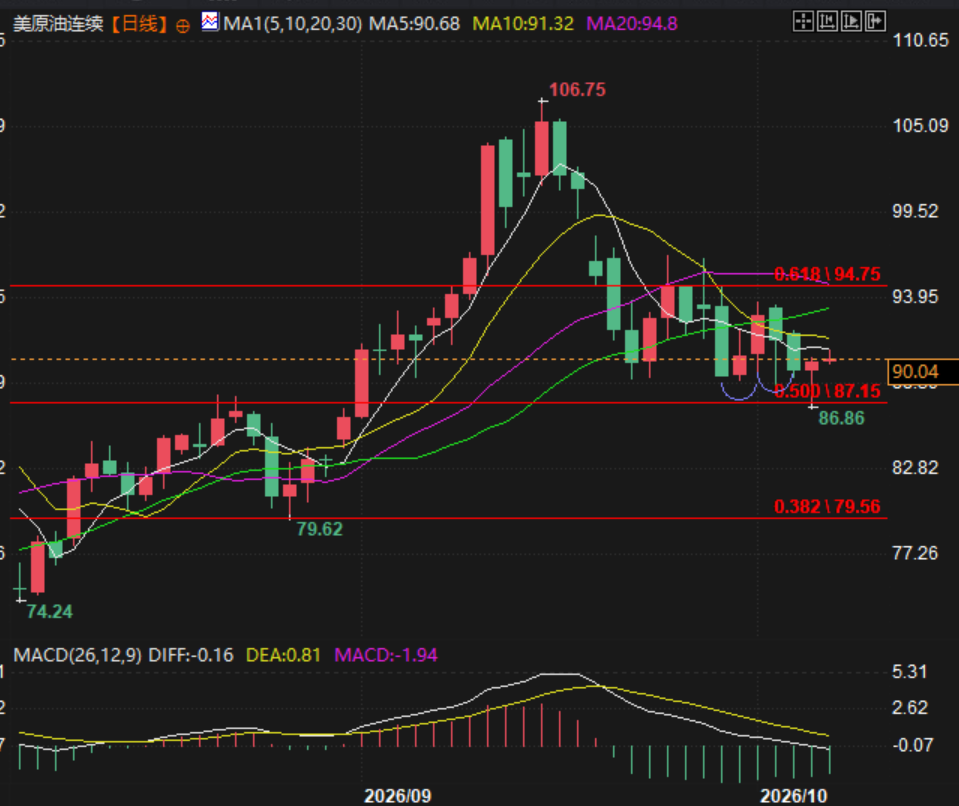 (WTI crude oil futures main contract daily chart, source: EasyTrade) At 14:36 Beijing time, WTI crude oil futures main contract was trading at $90.08 per barrel.
Weather disturbance looms: Gulf Coast hurricane threatens core U.S. energy production capacity
The immediate short-term driver of this oil price rebound is the hurricane risk escalating from a storm in the Gulf of Mexico. The storm continues its evolution into a hurricane, directly impacting offshore oil and gas production platforms and key coastal refining facilities in the Gulf of Mexico, triggering preventative shutdowns. Data shows that offshore oil and gas facilities in the Gulf of Mexico contribute 15% of total US crude oil production, while the coast accounts for 50% of the nation's refining capacity, making it the core lifeline of US energy supply. Following the hurricane warning, local oil and gas companies quickly activated their equipment shutdown and personnel evacuation plans, directly causing a short-term contraction in crude oil extraction and refined product refining supply. As the benchmark for US crude oil, WTI is highly sensitive to this regional supply shock, benefiting from the contraction in domestic supply and rising sharply. Simultaneously, the shutdown of US refining capacity has raised concerns about global refined product supply, driving a corresponding rise in Brent crude, with the weather risk premium fully realized. Although the hurricane is a short-term, impulsive event, it has effectively broken the previous weak oil price pattern against the backdrop of a fragile global energy supply chain, laying the foundation for a bottoming out and rebound.The Red Sea conflict escalates: Houthi rebels launch a strong counterattack, blocking shipping lanes.
Geopolitically, the escalating conflict in Yemen has become a core driver of oil prices, continuously increasing trade risks along the Red Sea route. Against the backdrop of heightened tensions between the US and Iran, Saudi Arabia, in conjunction with the Yemeni government forces, launched a special military operation aimed at completely expelling the Iranian-backed Houthi rebels entrenched in the Bab el-Mandeb Strait and regaining control of this crucial global energy and trade route. The Bab el-Mandeb Strait is strategically vital, connecting the Red Sea and the Gulf of Aden, handling 12% of global trade and a quarter of container freight. It is also a key alternative route for Saudi crude oil exports after the Strait of Hormuz was disrupted, directly impacting the stability of global crude oil supply. Faced with the coalition offensive, the Houthis launched a strong counterattack, successfully repelling the Saudi-led coalition's advance multiple times. They used 10 ballistic missiles to severely damage their concentrated forces, causing numerous casualties and equipment losses. Simultaneously, they continued to escalate missile and drone attacks, precisely targeting Riyadh International Airport, Aramco refineries, and multiple military bases, firmly maintaining control of the core battlefield in Taiz, western Yemen. Looking back at the situation in Yemen, the civil war began in 2014 when the Houthi rebels seized the capital, Sana'a. After the Saudi-led coalition intervened in 2015, it evolved into a protracted proxy war between Saudi Arabia and Iran, resulting in over 150,000 deaths and a global humanitarian catastrophe over more than a decade. The ceasefire agreement that took effect in 2022 completely collapsed this summer, igniting the most intense conflict in Yemen in years. Since early August, the number of displaced persons has exceeded 184,000, and the fighting has spiraled out of control. Currently, Saudi Arabia has completely lost patience and has clearly stated that only military pressure can force the Houthis back to the negotiating table. In terms of international forces, the United States is providing the Saudi-led coalition with comprehensive support, including intelligence sharing, target identification, and operational planning, but is not directly involved in the fighting for the time being. Pakistan and Turkey are deploying troops to Saudi Arabia under a new defense agreement, leveraging their combat experience and technological advantages to assist Saudi Arabia in strengthening its anti-drone defense capabilities. The long-term geopolitical game in the Red Sea is clearly evident.Pressure on the Strait of Hormuz: Escalating attacks and rising shipping costs
Beyond the Red Sea, the risks in the Strait of Hormuz, the world's primary energy route, have escalated again, becoming a significant driver of the oil price rebound. As crude oil and LNG shipments through the Strait gradually recover to pre-war levels, the pace of Iranian-led proxy attacks has accelerated significantly, disrupting global crude oil supply. Data from the UK's Office for Maritime Trade Operations shows that nine tanker attacks occurred in the Strait of Hormuz and the Persian Gulf region in October, accounting for half of the total attacks in September, indicating a sharp increase in the frequency of short-term attacks. Although these attacks have not caused large-scale transport disruptions, and shipping volumes can return to normal through short-term recovery and route replenishment, the continued instability has significantly driven up marine insurance premiums, forcing most shipping companies to choose long-distance detours. As a result, transatlantic shipping and tanker charter rates remain high, significantly increasing the delivery costs of seaborne crude oil such as Brent crude, and continuously providing a floor for international oil prices.Fundamentals provide support: EIA indicates that Middle Eastern supply will remain constrained in the fourth quarter, and US refined product inventories remain tight.
Beyond multiple favorable geopolitical and weather factors, the latest EIA energy outlook released bullish signals, further solidifying the trend of oil prices bottoming out and rebounding. The U.S. Energy Information Administration (EIA) clarified in its latest Short-Term Energy Outlook that Middle Eastern oil supply will remain constrained in the fourth quarter of 2026. Although the scale of production shutdowns in September fell to its lowest level since the conflict, and Middle Eastern crude oil exports are expected to gradually recover thanks to escort services in the Strait of Hormuz, bypass routes, and ship-to-ship transshipment, supply constraints will persist in the fourth quarter. It is projected that daily oil production shutdowns will reach 4.5 million barrels in the fourth quarter of 2026, only falling to 2.7 million barrels per day in the first quarter of 2027, making it difficult to completely eliminate the supply gap in the short term. The structural shortage of U.S. refined product inventories also provides strong support. Currently, the U.S. diesel market remains tight, with East Coast distillate fuel inventories in September 32% lower than the five-year average. The EIA projects that inventories this winter will remain about 20% lower than the five-year average, only gradually returning to historically low levels in the second half of 2027. The report includes the US plan to release 40 million barrels of strategic petroleum reserves, but does not yet account for any potential additional oil releases by the G7. Low refined product inventories provide strong support for oil prices and crack spreads.Market Outlook: Multiple risks intertwine, and the upward trend in oil prices is expected to continue.
In the short term, the weather disturbances caused by the Gulf hurricane have brought a burst of upward momentum; however, the overall trend still follows the logic outlined in previous articles: when oil prices fall, Iran will try to exert pressure. Currently, oil prices are at recent low levels, naturally increasing the likelihood of a rebound. Simultaneously, the ongoing geopolitical conflict in the Bab el-Mandeb Strait and the Strait of Hormuz, coupled with the EIA's confirmation of continued supply constraints in the Middle East in the fourth quarter and a structural shortage of US refined product inventories, create multiple positive factors supporting a price rebound. The key variables to watch going forward are: first, the actual damage caused by the Gulf hurricane; weather-related market movements have a "buy the rumor, sell the fact" characteristic, and the premium may be quickly reversed after the hurricane's impact; second, whether the Middle East situation will further spill over. Trump previously warned of a possible resumption of full-scale military action after the November US congressional elections, and Iran also has the potential to continue proxy attacks. Geopolitical risks still have room for unexpected escalation, and oil prices are expected to maintain an overall volatile but slightly upward trend. Technically, WTI oil prices rebounded after touching the key level of 87. Recently, the daily chart has formed a triple bottom pattern, which is bullish. However, the moving averages are still in a bearish alignment, indicating a bearish outlook. In the short term, both bullish and bearish forces are limited, and there is no clear direction. In the medium term, the market is still bearish, waiting for the moving averages to recover. (WTI crude oil futures main contract daily chart, source: EasyTrade) At 14:36 Beijing time, WTI crude oil futures main contract was trading at $90.08 per barrel.
- Risk Warning and Disclaimer
- The market involves risk, and trading may not be suitable for all investors. This article is for reference only and does not constitute personal investment advice, nor does it take into account certain users’ specific investment objectives, financial situation, or other needs. Any investment decisions made based on this information are at your own risk.