AI-driven narratives suppress gold prices, while US debt pressures present medium- to long-term opportunities.
2026-10-07 18:04:20
Gold prices fell throughout Wednesday (October 7th), currently trading around 4121. The bullish sentiment built up yesterday after the price rebound has been quickly refuted. Yesterday's rebound was driven by a significant drop in real interest rates and a pullback in the US dollar index due to the euro's rebound. The sharp decline in real interest rates exceeding that of nominal rates was mainly due to the market's perception that the AI investment boom and geopolitical uncertainties would lead holders of long-term government bonds to demand higher interest rate compensation. Simultaneously, the stickiness of inflation meant that money would be less valuable in the future, resulting in a greater drop in real interest rates. So why did interest rates rise again today? Besides a technical rebound, the main reason lies in the market's latest assessment of the future development of AI: AI investment will continue to expand, meaning the AI industry will continue to attract investment and push up interest rates. However, there is a risk of a future bubble burst leading to a market recession, which would increase the risk of a US debt crisis, pushing up the term premium of government bonds and thus increasing the yield on 10-year and longer-term bonds, thereby increasing the holding cost of gold. Meanwhile, the recent volatility in oil prices has continued to put pressure on the euro, pushing up the US dollar index. 
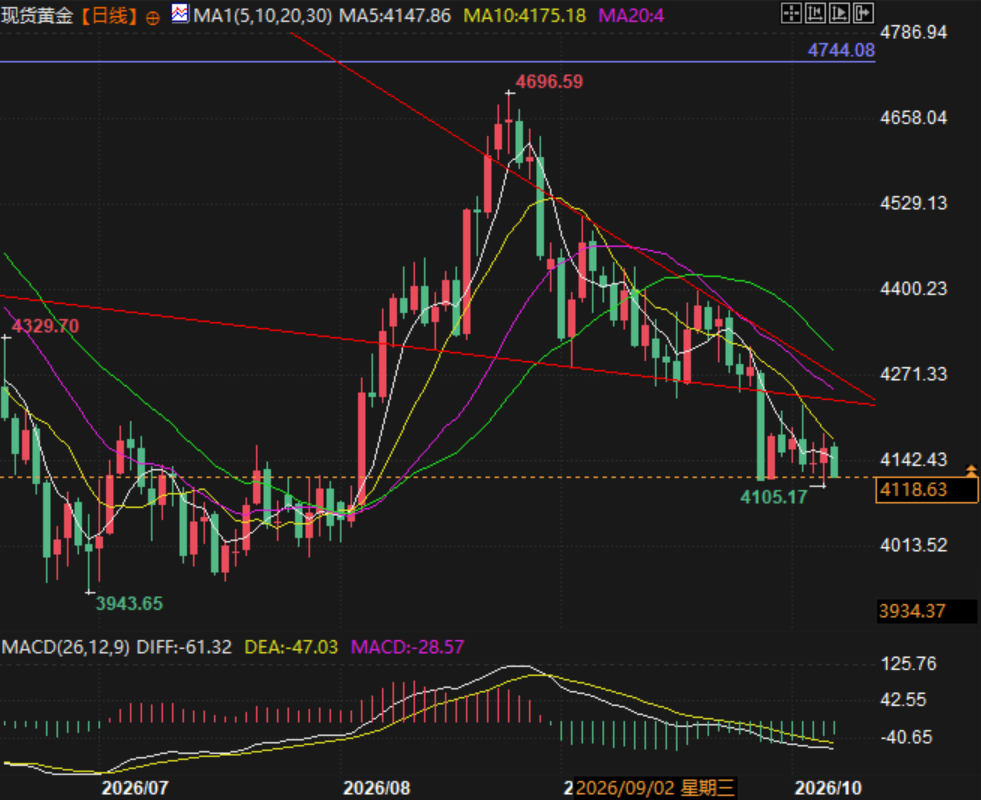 (Spot gold daily chart, source: FX678) At 18:00 Beijing time, spot gold is currently trading at $4117 per ounce.
Geopolitical and energy risks persist: pushing up the US dollar index
The recent key logic lies in the sensitive period following the sharp depreciation of the euro in European assets. Funds can flow through rising oil prices, leading to a weaker euro and ultimately pushing up the US dollar. This is due to geopolitical factors, with ongoing shipping risks in the Red Sea and the Strait of Hormuz. A Houthi spokesperson confirmed that the armed forces successfully repelled Saudi forces advancing towards the Bab el-Mandeb Strait, using ballistic missiles to block their advance and causing casualties and equipment losses. Attacks on the Strait of Hormuz are also increasing in frequency; this month, attacks on the strait have accounted for half of all attacks in the region. Although some shipping has mitigated the impact of oil supply disruptions through detours and ship-to-ship transshipment, and the EIA predicts a significant decrease in oil production shutdowns in the first quarter of 2027, Middle Eastern oil supply will remain constrained in 2026. The tight US diesel inventory problem is unlikely to be fully resolved in the short term, and East Coast distillate fuel inventories are 32% lower than the five-year average, with inventories expected to remain significantly low this winter. In short, the panic over a complete supply disruption has subsided somewhat, but the black swan risk in the Middle East shipping lanes has not disappeared. The oil market will maintain a supply shortage throughout 2026, which directly pushes the euro weaker and the dollar stronger, suppressing gold prices. However, this may still be the last gasp, and may be the euro's final drop.Key negative factor in the market: AI is reshaping the logic of long-term interest rates, suppressing gold price movements.
However, the market quickly shifted to a stronger narrative: AI capital expenditures are pushing up the long-term equilibrium real interest rate (r*), suppressing long-duration assets. A series of hawkish signals from Federal Reserve officials acted as a catalyst for this narrative. San Francisco Fed President Daly suggested that the spillover of chip demand driven by AI meant that related price pressures were not a one-off shock; if the AI, tariff, and energy shocks persist, the Fed might raise interest rates further. Kansas City Fed President Schmid was even more direct, stating that inflation remained stubborn, with AI-driven data center and semiconductor capital expenditures becoming major inflation drivers. Even with rising long-term bond yields, the Fed could not relax its efforts to combat inflation in the short term. The market further interpreted this logic: large-scale AI infrastructure construction and chip production expansion are driving a surge in investment demand across society, leading to fierce competition for long-term funds and a need to revise the long-term neutral real interest rate (r*) upwards. Simultaneously, Temasek and Bridgewater's Dalio issued risk warnings, indicating a potential bubble in the AI investment boom. He warned that substantial debt supporting AI expansion could cause the bubble to burst if interest rates continue to rise, potentially dragging down fiscal revenue. The market is simultaneously pricing in two layers of risk: short-term AI capital expenditures continue to drive up funding costs, while long-term AI bubble bursts could lead to a recession. Ultimately, the AI narrative alone can exert a double influence on US interest rates: AI investment attracts funds and pushes up interest rates, while simultaneously, the market doubts about the US's debt repayment capacity, which is based on the premise of successful AI development, thus pushing up interest rates a second time.Market trends confirm: Rising long-term interest rates put downward pressure on gold prices.
The market directly reflected this narrative: the 10-year US Treasury yield opened lower but then rose, while the 2-year yield remained relatively stable, forming a bearish steepening trend. The core contributor to the rise in yields came from the rebound in TIPS real interest rates, rather than a significant upward revision of short-term policy rate hike expectations. The upward force of real interest rates overwhelmed the support for gold prices from the tail risk of energy inflation, putting downward pressure on gold prices. Herein lies the most fundamental contradiction in the market: on the one hand, the ongoing attacks on shipping routes through the Bab el-Mandeb Strait and the Strait of Hormuz, coupled with continued constraints on oil supply, have increased the premium for long-term inflation tail risks, which is bullish for gold; on the other hand, market pricing AIs are pushing up the cost of long-term funding, leading to an increase in long-term real interest rates and raising the holding cost of gold, a non-interest-bearing asset, thus constituting a strong bearish factor.Market Outlook: High interest rates are not a permanent negative factor; the pressure on US debt may be about to reverse.
There's a common perception in the market that rising interest rates are inevitably bad for precious metals, and that gold prices may continue to fall in the near term. However, the reasons behind rising interest rates are crucial. If the increase stems from rising inflation or a sovereign debt crisis, it could actually provide positive support for gold. Currently, the Federal Reserve's efforts to combat inflation are more of a symbolic gesture. The continued expansion of US government debt will create a hard constraint, making it difficult for the Fed to maintain policy rates at sufficiently high levels. Under the pressure of massive debt, the Fed may be forced to stop raising interest rates earlier than expected, or even restart easing. If this scenario occurs, precious metals are expected to experience a significant upward trend. Technically, gold's moving averages are in a bearish alignment. We've previously indicated that gold prices are likely to fluctuate, with resistance at higher levels. While the current fluctuation is slightly bearish, the price is approaching the 4050 support level, making a rebound imminent. (Spot gold daily chart, source: FX678) At 18:00 Beijing time, spot gold is currently trading at $4117 per ounce.
- Risk Warning and Disclaimer
- The market involves risk, and trading may not be suitable for all investors. This article is for reference only and does not constitute personal investment advice, nor does it take into account certain users’ specific investment objectives, financial situation, or other needs. Any investment decisions made based on this information are at your own risk.