Gold prices have experienced a short-term pullback, but the structural support logic has not dissipated.
2026-10-07 19:06:18
On Wednesday (October 7), during the European trading session, gold prices continued their downward trend, with spot gold falling 1.12% to $4,117.07 per ounce.  The international gold market has recently experienced a significant decline, with a marked intensification of the battle between bulls and bears. The entire market's focus is on the upcoming release of the Federal Reserve's September meeting minutes, hoping to glean further guidance on monetary policy from the text. Several overseas institutions have pointed out in their latest research reports that although gold prices have faced short-term downward pressure and undergone a substantial correction, the core structural factors driving gold's medium- to long-term upward trend remain intact. Geopolitical changes, Middle East energy supply risks, fluctuations in US Treasury yields, and the strength of the US dollar index will all collectively determine the future direction of gold. The market is weakening in the short term, awaiting policy signals from the Fed meeting minutes. The Global Economics and Markets Research Team at United Overseas Bank (UOB) in Singapore analyzed in a report that many investors are choosing to remain on the sidelines, awaiting the release of the Fed's September meeting minutes on Wednesday, attempting to glean fresh clues about the Fed's future monetary policy stance. Gold itself is a non-interest-bearing asset, and a high-interest-rate environment directly increases the opportunity cost of holding gold, continuously suppressing its price. This is a significant factor currently suppressing gold's performance. Looking back at the previous trading day, gold prices briefly surged to a high of $4,180 on Tuesday, but quickly encountered selling pressure after the initial surge. Saxo Bank analysts interpreted this as a result of a rebound in international oil prices, coupled with the continued high levels of long-term US Treasury yields, triggering a new round of selling in the market. Simultaneously, the US dollar index rose 0.3%, reaching 102.19. With a stronger dollar, the cost of purchasing dollar-denominated gold for overseas buyers increased, reducing purchasing power and further pressuring gold prices. The latest data from the FedWatch tool shows that traders are betting less than 22% on a further rate hike by the Federal Reserve this month, indicating a cooling of market expectations for continued monetary tightening. Even so, market participants remain cautious, awaiting further details from the Fed meeting minutes regarding the inflation outlook and policy path. Institutional View: The pullback does not change the underlying structural driving logic of gold.
 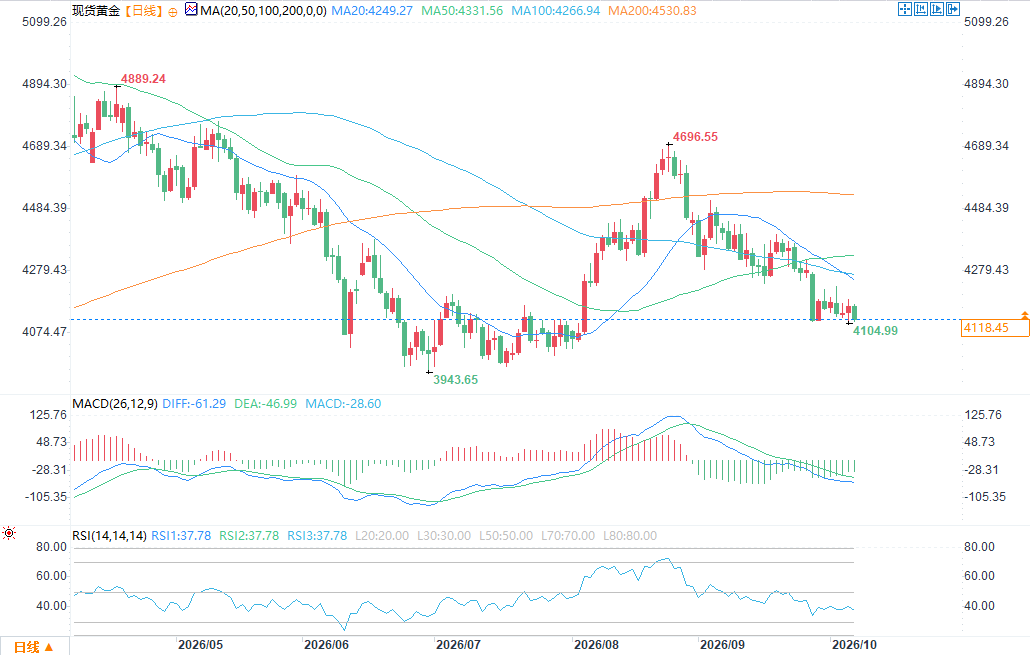 (Spot gold daily chart source: FX678) Gold experienced a significant correction this week, with prices falling back to the $4100-$4200/ounce range. The latest spot gold price is $4117.07, a 1.12% drop on the day. Even with this pullback, Phillip Nova analyst Priyanka Sahedwa emphasized in her latest research report that the structural drivers of gold have not disappeared with this short-term correction. Continued geopolitical uncertainty and the fragility of the Middle East oil supply chain continue to attract various investment funds to gold assets. Even with the short-term pullback in gold prices, the market's demand for safe-haven assets has not completely subsided. Geopolitical risks exhibit a clear transmission path: geopolitical conflicts first affect oil prices, then change market inflation expectations, and indirectly affect gold pricing. This is a crucial transmission chain affecting gold prices at this stage. Regarding key price levels, analysts consider $4000/ounce to be a very important psychological and technical support level. As long as the long-term structural bullish logic for gold remains intact, if the price of gold further approaches the $4,000 range, it is highly likely that long-term funds with strong conviction will enter the market in stages to buy on dips, providing strong support for the bottom. The analyst further summarized that the future direction of gold prices will not be simply determined by a single market factor. The actual transmission effect of geopolitical risks to oil prices and inflation expectations, coupled with changes in US Treasury yields, will be the three core variables that will jointly dominate the subsequent price trend of gold. A Critique of Gold Pricing Logic Amidst Mixed Bullish and Bearish Factors Currently, the gold market is in a contradictory situation of "short-term bearish factors suppressing the market + medium- to long-term bullish logic supporting prices," with bullish and bearish forces pulling against each other. On the bearish side: the persistently high yields on long-term US Treasury bonds and the phased rebound of the US dollar are eroding the investment appeal of gold, a non-interest-bearing asset; the entire market is trading on expectations of Federal Reserve policy, and whether the meeting minutes release hawkish or dovish statements could trigger sharp short-term price fluctuations in gold. On the positive side: geopolitical conflicts continue to occur in many parts of the world, and the Middle East energy supply chain is at risk of being disrupted at any time. If the conflict escalates and pushes up crude oil prices, it will reignite market concerns about inflation, and gold's safe-haven attributes and inflation-hedging value will be valued by funds again. At the same time, there is potential buying support from institutional investors around $4,000, which can be used to gradually build up positions.
The international gold market has recently experienced a significant decline, with a marked intensification of the battle between bulls and bears. The entire market's focus is on the upcoming release of the Federal Reserve's September meeting minutes, hoping to glean further guidance on monetary policy from the text. Several overseas institutions have pointed out in their latest research reports that although gold prices have faced short-term downward pressure and undergone a substantial correction, the core structural factors driving gold's medium- to long-term upward trend remain intact. Geopolitical changes, Middle East energy supply risks, fluctuations in US Treasury yields, and the strength of the US dollar index will all collectively determine the future direction of gold. The market is weakening in the short term, awaiting policy signals from the Fed meeting minutes. The Global Economics and Markets Research Team at United Overseas Bank (UOB) in Singapore analyzed in a report that many investors are choosing to remain on the sidelines, awaiting the release of the Fed's September meeting minutes on Wednesday, attempting to glean fresh clues about the Fed's future monetary policy stance. Gold itself is a non-interest-bearing asset, and a high-interest-rate environment directly increases the opportunity cost of holding gold, continuously suppressing its price. This is a significant factor currently suppressing gold's performance. Looking back at the previous trading day, gold prices briefly surged to a high of $4,180 on Tuesday, but quickly encountered selling pressure after the initial surge. Saxo Bank analysts interpreted this as a result of a rebound in international oil prices, coupled with the continued high levels of long-term US Treasury yields, triggering a new round of selling in the market. Simultaneously, the US dollar index rose 0.3%, reaching 102.19. With a stronger dollar, the cost of purchasing dollar-denominated gold for overseas buyers increased, reducing purchasing power and further pressuring gold prices. The latest data from the FedWatch tool shows that traders are betting less than 22% on a further rate hike by the Federal Reserve this month, indicating a cooling of market expectations for continued monetary tightening. Even so, market participants remain cautious, awaiting further details from the Fed meeting minutes regarding the inflation outlook and policy path. Institutional View: The pullback does not change the underlying structural driving logic of gold. (Spot gold daily chart source: FX678) Gold experienced a significant correction this week, with prices falling back to the $4100-$4200/ounce range. The latest spot gold price is $4117.07, a 1.12% drop on the day. Even with this pullback, Phillip Nova analyst Priyanka Sahedwa emphasized in her latest research report that the structural drivers of gold have not disappeared with this short-term correction. Continued geopolitical uncertainty and the fragility of the Middle East oil supply chain continue to attract various investment funds to gold assets. Even with the short-term pullback in gold prices, the market's demand for safe-haven assets has not completely subsided. Geopolitical risks exhibit a clear transmission path: geopolitical conflicts first affect oil prices, then change market inflation expectations, and indirectly affect gold pricing. This is a crucial transmission chain affecting gold prices at this stage. Regarding key price levels, analysts consider $4000/ounce to be a very important psychological and technical support level. As long as the long-term structural bullish logic for gold remains intact, if the price of gold further approaches the $4,000 range, it is highly likely that long-term funds with strong conviction will enter the market in stages to buy on dips, providing strong support for the bottom. The analyst further summarized that the future direction of gold prices will not be simply determined by a single market factor. The actual transmission effect of geopolitical risks to oil prices and inflation expectations, coupled with changes in US Treasury yields, will be the three core variables that will jointly dominate the subsequent price trend of gold. A Critique of Gold Pricing Logic Amidst Mixed Bullish and Bearish Factors Currently, the gold market is in a contradictory situation of "short-term bearish factors suppressing the market + medium- to long-term bullish logic supporting prices," with bullish and bearish forces pulling against each other. On the bearish side: the persistently high yields on long-term US Treasury bonds and the phased rebound of the US dollar are eroding the investment appeal of gold, a non-interest-bearing asset; the entire market is trading on expectations of Federal Reserve policy, and whether the meeting minutes release hawkish or dovish statements could trigger sharp short-term price fluctuations in gold. On the positive side: geopolitical conflicts continue to occur in many parts of the world, and the Middle East energy supply chain is at risk of being disrupted at any time. If the conflict escalates and pushes up crude oil prices, it will reignite market concerns about inflation, and gold's safe-haven attributes and inflation-hedging value will be valued by funds again. At the same time, there is potential buying support from institutional investors around $4,000, which can be used to gradually build up positions.
- Risk Warning and Disclaimer
- The market involves risk, and trading may not be suitable for all investors. This article is for reference only and does not constitute personal investment advice, nor does it take into account certain users’ specific investment objectives, financial situation, or other needs. Any investment decisions made based on this information are at your own risk.