GBP/USD Approaching Policy Window: Why the 1.32 Level is More Complex Than It Seems
2026-10-07 18:10:18
On Wednesday, October 7th, the British pound was fluctuating around 1.323 against the US dollar, having given back some of its gains from the previous day; the dollar index was around 102.2, the 10-year US Treasury yield was approximately 5.27% to 5.31%, and Brent crude oil remained above $100 per barrel. The current pricing is not driven by a single macroeconomic data point, but rather by the combined effects of interest rate expectations, energy risk premiums, and long-term yields on the dollar ahead of the release of the Fed's September meeting minutes. 
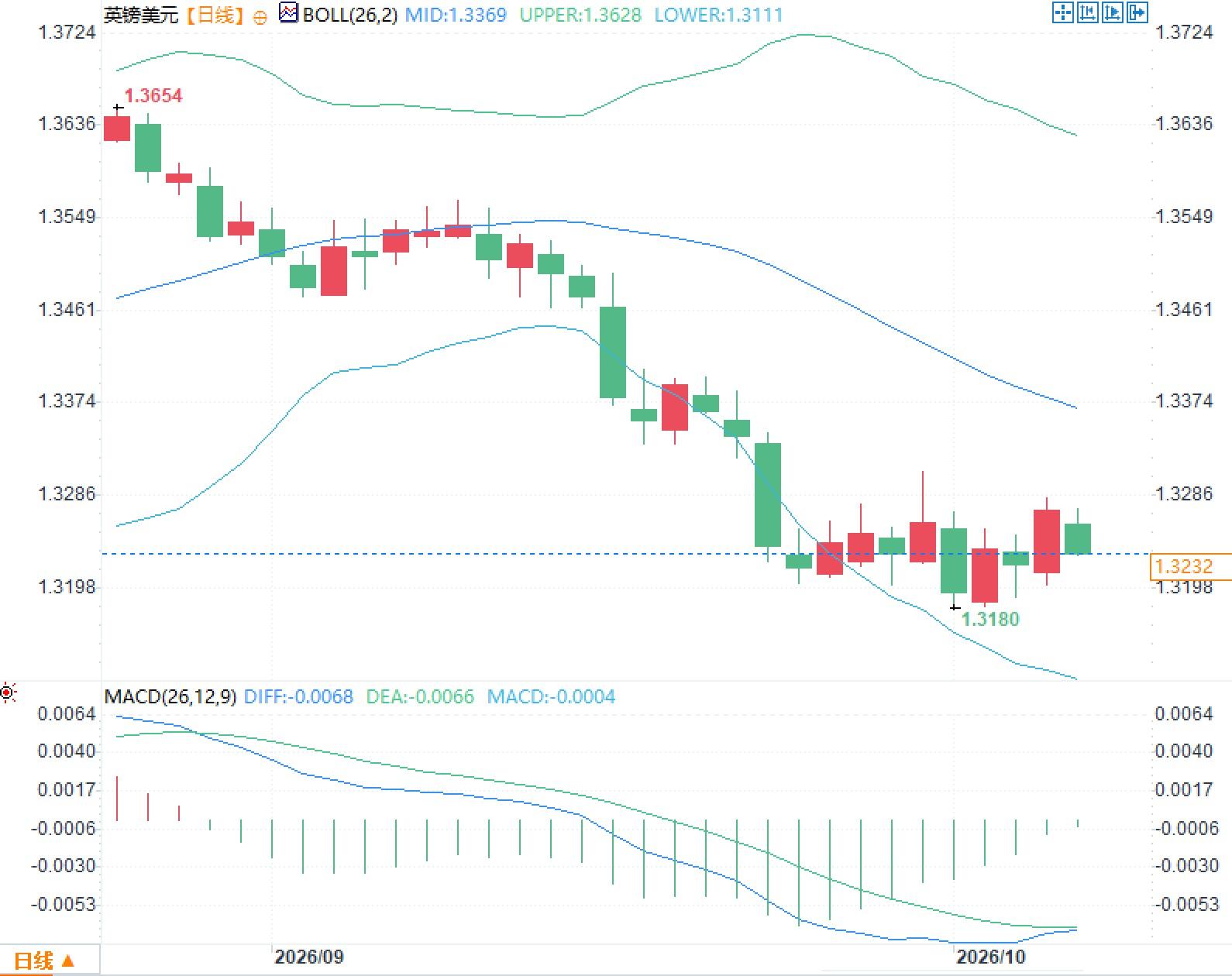 Structurally, the price remains below the Bollinger Band's middle line, which continues to decline, reflecting that the trend pressure formed during the previous downtrend has not yet been fully digested. However, although both MACD lines are below the zero axis, the difference between them has narrowed significantly, and the histogram value is close to zero, indicating that marginal momentum has weakened compared to the previous downtrend. Over the past two weeks, the price has largely remained in the range of approximately 1.318 to 1.331, with the volatility structure shifting from rapid expansion to consolidation.
Fed minutes: Focus on the reaction function, not the recurrence of interest rate hikes
The Federal Reserve raised its target range for the federal funds rate by 25 basis points to 3.75%-4.00% in September, and the minutes of that meeting will be released early Thursday morning. The latest pricing in interest rate futures shows a 78.2% probability of keeping rates unchanged in October and a 21.8% probability of a 25 basis point rate hike; in December pricing, the probability of rates rising to 4.00%-4.25% is about 68.6%. This means the market has already priced in "short-term wait-and-see, with the possibility of further tightening this year" into asset prices. However, the latest US employment data has significantly increased the policy dilemma. Non-farm payrolls increased by only 29,000 in September, the unemployment rate was 4.2%, and average hourly earnings increased by 3.0% year-on-year; meanwhile, the US CPI remained at 3.4% year-on-year in August. The cooling employment situation reduces the urgency of immediate tightening, but inflation remains above the 2% target. Therefore, the truly valuable information in the minutes is the committee members' tolerance for energy shocks, financial conditions, long-term yields, and the persistence of inflation, rather than a reaffirmation of the policy actions already taken in September. The September CPI will be released on October 14. This data may provide more marginal information for subsequent interest rate pricing than a meeting record with a time lag.Bank of England: Interest rate hike disagreements and growth constraints coexist.
The Bank of England kept interest rates at 3.75% in September, with a 6-3 vote and 3 members advocating for an increase to 4.00%. The UK's CPI rose 3.1% year-on-year in August, higher than July's 2.9%; regular wages rose 3.5% year-on-year from May to July, while total wages rose 3.9%. These figures indicate that UK inflation stickiness has not disappeared, but wage growth is no longer accelerating as it had previously. For the pound, policy divergence should not be mechanically interpreted as a one-sided positive. Rising energy prices, on the one hand, increase imported inflation and strengthen the Bank of England's case for maintaining a restrictive policy; on the other hand, they also compress real household income and corporate profits, constraining demand. Therefore, foreign exchange pricing is more dependent on changes in a combination of real interest rate differentials, inflation expectations, and energy import costs. The next UK inflation data will be released on October 21, and the Bank of England's next policy meeting is scheduled for November 5.Oil Prices and Long-Term Yields: Two External Variables to the Resilience of the US Dollar
Brent crude oil traded around $101.80 per barrel on October 7th, with the Middle East conflict and risks to key shipping routes continuing to maintain the energy risk premium. The impact of oil prices on the pound against the dollar is not linear: it can increase the relative attractiveness of dollar assets through safe-haven demand and inflation compensation, but it can also alter the UK's terms of trade and inflation structure through higher energy costs. Meanwhile, the 10-year US Treasury yield remains around 5.3%, indicating that long-term pricing is not solely based on whether the Fed will raise rates next, but also includes factors such as term premiums, inflation uncertainty, and bond supply. For the pound against the dollar, a more compelling explanation lies in the relative changes in real interest rate expectations and risk premiums between the two countries, rather than simply comparing nominal policy rates.Technical Structure: Trend pressure remains, and marginal momentum is converging.
The daily chart shows that the Bollinger Band middle line is about 1.3369, the upper line is about 1.3628, and the lower line is about 1.3111; in the MACD, the DIF is about -0.0068, the DEA is about -0.0066, and the histogram value is about -0.0004. Structurally, the price remains below the Bollinger Band's middle line, which continues to decline, reflecting that the trend pressure formed during the previous downtrend has not yet been fully digested. However, although both MACD lines are below the zero axis, the difference between them has narrowed significantly, and the histogram value is close to zero, indicating that marginal momentum has weakened compared to the previous downtrend. Over the past two weeks, the price has largely remained in the range of approximately 1.318 to 1.331, with the volatility structure shifting from rapid expansion to consolidation.Frequently Asked Questions
Question 1: Why hasn't the US dollar fallen significantly after the employment slowdown? Answer: Exchange rates are not determined by a single data point. The 10-year US Treasury yield is still around 5.3%, energy prices are increasing inflation compensation, and the market still maintains a high probability of another rate hike in December. Weaker employment reduces the necessity for an immediate rate hike in the short term, but it doesn't eliminate inflationary constraints. Question 2: Some Bank of England members advocate for a rate hike; why can't this be directly equated to a positive for the pound? Answer: The energy shock both increases inflation and compresses real income. The UK's August CPI was 3.1%, and wage growth remains high, but growth constraints also exist. The pound's reaction still depends on the real interest rate differential, the persistence of inflation, and energy import costs.- Risk Warning and Disclaimer
- The market involves risk, and trading may not be suitable for all investors. This article is for reference only and does not constitute personal investment advice, nor does it take into account certain users’ specific investment objectives, financial situation, or other needs. Any investment decisions made based on this information are at your own risk.