Copper prices are nearing record highs; why should we be more cautious as prices rise?
2026-10-07 18:32:17
Copper has been one of the best-performing metals this year, with a year-to-date increase of approximately 17%, and prices are approaching historical highs. Against the backdrop of widespread pressure on global commodities, copper's strength stands out, driven by both solid demand and short-term sentiment fueled by policy expectations. Deutsche Bank has predicted a further 50% rise in copper prices to $10 per pound, but this seemingly enticing prospect necessitates that investors maintain greater composure and restraint than usual before entering the market. While copper's long-term story is indeed compelling, it is also a commodity susceptible to sharp fluctuations due to reversals in expectations, requiring a cautious approach.  The core logic behind a long-term bullish outlook for copper: Dual support from demand and supply From a long-term perspective, the reasons for a bullish outlook on copper prices are quite compelling. Firstly, on the demand side, this red metal is at the heart of several high-growth, low-cyclical sectors—electrification, defense, and artificial intelligence data centers. Unlike the traditional construction industry, which is heavily influenced by fluctuations in real estate and infrastructure, growth in these sectors is more structural and sustainable, with rigid and continuously accumulating demand for copper. As long as these sectors continue to expand, the fundamental demand for copper will continue to grow. More decisively, there are constraints on the supply side. Global copper ore grades are continuously declining, meaning that mining the same amount of copper requires processing more ore, constantly pushing up unit costs. At the same time, mining projects generally face high licensing and regulatory hurdles, significantly lengthening the cycle from exploration to actual production—a copper mine discovered today may take nearly twenty years to reach actual production capacity. This structural mismatch of "easy demand growth, difficult supply growth" constitutes a deep support for the long-term upward trend in copper prices. The International Energy Agency (IEA) projects that, based on known copper mining projects and pipelines, primary copper supply, excluding scrap copper, could be 25% lower than demand by 2035. A study earlier this year, led by Adam Simon, professor of Earth and Environmental Sciences at the University of Michigan, further estimates that copper prices must exceed $20,000 per metric ton (approximately $9.07 per pound), about 37% higher than current prices, to stimulate sufficient mining investment to meet long-term demand. In other words, from a long-term supply-demand balance perspective, copper prices still have theoretical upside potential. However , a significant short-term correction risk remains . Despite these attractive price targets, copper also faces considerable downward pressure in the short term. This year's price surge itself has a clear "mismatch" characteristic. Charles Cooper, head of copper research at Wood Mackenzie, points out that since the White House indicated last year that it was considering imposing a 15% tariff on refined copper, buyers have rushed to buy and hoard copper, resulting in large quantities of copper being concentrated in US warehouses. The result is an abundant, even surplus, copper supply in the US market, while the rest of the world faces shortages. According to Cooper's estimates, excluding the US, the rest of the world is expected to face a supply gap of approximately 460,000 tons this year. This distortion, artificially created by policy expectations, is precisely the biggest source of price instability. Currently, industry analysts expect the US to maintain an ambiguous stance on tariffs until at least after the midterm elections, while dealing with inflation. However, the problem is that when prices are already near historical highs, any easing of tariff expectations could become a turning point—whether it's the White House officially announcing no additional tariffs or the market beginning to believe in this possibility, copper prices could fall from their highs. Citigroup metals strategist Tom Mullquin warns that any factor that makes the market doubt tariffs could trigger a knee-jerk reaction in copper prices, pushing them even lower. Furthermore, further interest rate hikes, new turmoil in the oil market, or a sell-off in AI stocks could also spill over into the copper market, becoming triggers for price corrections. It's worth noting that such declines are not necessarily bad—for long-term copper bulls, corrections could actually create more attractive entry opportunities.
 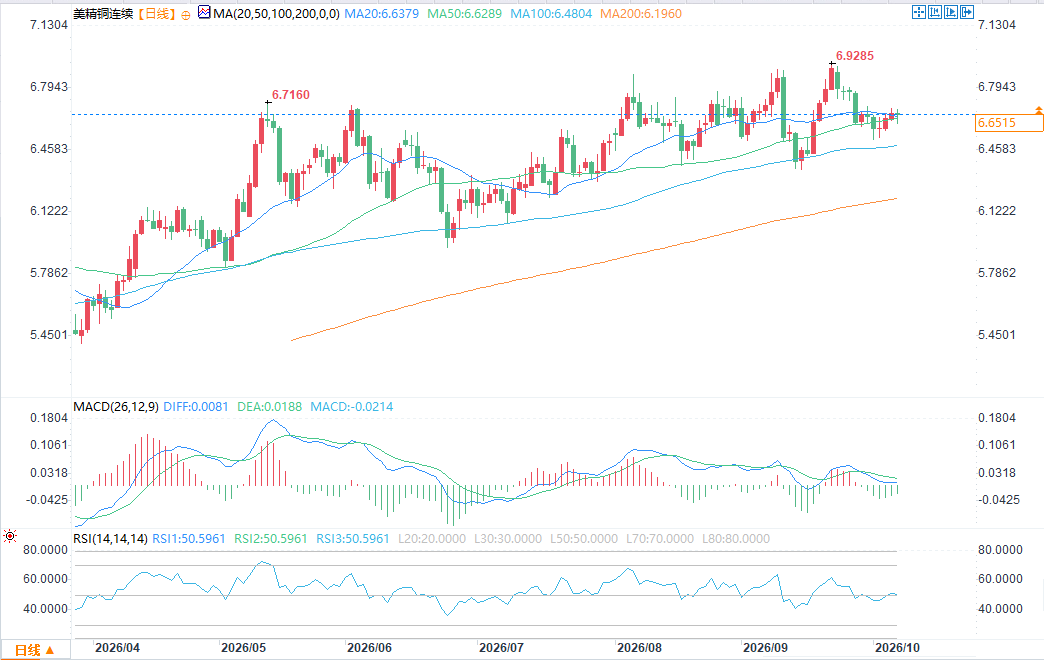 (COMEX Copper Daily Chart Source: EasyForex) Maintaining a Balance Between Trends and Volatility Overall, the copper market presents a complex picture of "long-term supply tightness and short-term overheated sentiment." Long-term structural logic (electrification and supply constraints) provides solid fundamental support for copper prices, while short-term tariff expectations and capital flows amplify volatility. Investors should neither ignore the risk of a pullback due to the long-term narrative nor deny the long-term supply logic due to short-term fluctuations. Continuously monitoring policy variables and market sentiment, and finding a reasonable rhythm amidst volatility, may be a more prudent approach to participating in the copper market. The article does not provide specific entry or exit suggestions, but emphasizes that for such a hot commodity at historically high levels, caution is always a better choice than impulsiveness. At 18:26 Beijing time on Wednesday (October 7), COMEX copper was trading at $6.6515 per pound, up 0.03%.
The core logic behind a long-term bullish outlook for copper: Dual support from demand and supply From a long-term perspective, the reasons for a bullish outlook on copper prices are quite compelling. Firstly, on the demand side, this red metal is at the heart of several high-growth, low-cyclical sectors—electrification, defense, and artificial intelligence data centers. Unlike the traditional construction industry, which is heavily influenced by fluctuations in real estate and infrastructure, growth in these sectors is more structural and sustainable, with rigid and continuously accumulating demand for copper. As long as these sectors continue to expand, the fundamental demand for copper will continue to grow. More decisively, there are constraints on the supply side. Global copper ore grades are continuously declining, meaning that mining the same amount of copper requires processing more ore, constantly pushing up unit costs. At the same time, mining projects generally face high licensing and regulatory hurdles, significantly lengthening the cycle from exploration to actual production—a copper mine discovered today may take nearly twenty years to reach actual production capacity. This structural mismatch of "easy demand growth, difficult supply growth" constitutes a deep support for the long-term upward trend in copper prices. The International Energy Agency (IEA) projects that, based on known copper mining projects and pipelines, primary copper supply, excluding scrap copper, could be 25% lower than demand by 2035. A study earlier this year, led by Adam Simon, professor of Earth and Environmental Sciences at the University of Michigan, further estimates that copper prices must exceed $20,000 per metric ton (approximately $9.07 per pound), about 37% higher than current prices, to stimulate sufficient mining investment to meet long-term demand. In other words, from a long-term supply-demand balance perspective, copper prices still have theoretical upside potential. However , a significant short-term correction risk remains . Despite these attractive price targets, copper also faces considerable downward pressure in the short term. This year's price surge itself has a clear "mismatch" characteristic. Charles Cooper, head of copper research at Wood Mackenzie, points out that since the White House indicated last year that it was considering imposing a 15% tariff on refined copper, buyers have rushed to buy and hoard copper, resulting in large quantities of copper being concentrated in US warehouses. The result is an abundant, even surplus, copper supply in the US market, while the rest of the world faces shortages. According to Cooper's estimates, excluding the US, the rest of the world is expected to face a supply gap of approximately 460,000 tons this year. This distortion, artificially created by policy expectations, is precisely the biggest source of price instability. Currently, industry analysts expect the US to maintain an ambiguous stance on tariffs until at least after the midterm elections, while dealing with inflation. However, the problem is that when prices are already near historical highs, any easing of tariff expectations could become a turning point—whether it's the White House officially announcing no additional tariffs or the market beginning to believe in this possibility, copper prices could fall from their highs. Citigroup metals strategist Tom Mullquin warns that any factor that makes the market doubt tariffs could trigger a knee-jerk reaction in copper prices, pushing them even lower. Furthermore, further interest rate hikes, new turmoil in the oil market, or a sell-off in AI stocks could also spill over into the copper market, becoming triggers for price corrections. It's worth noting that such declines are not necessarily bad—for long-term copper bulls, corrections could actually create more attractive entry opportunities. (COMEX Copper Daily Chart Source: EasyForex) Maintaining a Balance Between Trends and Volatility Overall, the copper market presents a complex picture of "long-term supply tightness and short-term overheated sentiment." Long-term structural logic (electrification and supply constraints) provides solid fundamental support for copper prices, while short-term tariff expectations and capital flows amplify volatility. Investors should neither ignore the risk of a pullback due to the long-term narrative nor deny the long-term supply logic due to short-term fluctuations. Continuously monitoring policy variables and market sentiment, and finding a reasonable rhythm amidst volatility, may be a more prudent approach to participating in the copper market. The article does not provide specific entry or exit suggestions, but emphasizes that for such a hot commodity at historically high levels, caution is always a better choice than impulsiveness. At 18:26 Beijing time on Wednesday (October 7), COMEX copper was trading at $6.6515 per pound, up 0.03%.- Risk Warning and Disclaimer
- The market involves risk, and trading may not be suitable for all investors. This article is for reference only and does not constitute personal investment advice, nor does it take into account certain users’ specific investment objectives, financial situation, or other needs. Any investment decisions made based on this information are at your own risk.