A chart shows that the Baltic Dry Index (BDI) has declined, dragged down by weaker Capesize freight rates.
2026-10-08 01:04:23
The latest data shows that the Baltic Dry Index (BDI) closed at 2994 points on October 7, 2026, a new low since August 25, 2026, down 0.27% month-on-month, marking the third consecutive day of decline (including zero growth). Looking at the short-term charts, the BDI has seen positive growth 3 times, negative growth 8 times, and zero growth in the last 11 BDI data points. Specifically, the Panamax Freight Index (BPI) closed at 2384 points, up 0.76% from the previous value; the Capesize Freight Index (BCI) closed at 4597 points, down 0.88%; and the Supramax Freight Index (BSI) closed at 1800 points, up 0.28%. For detailed charts of the latest 720-day and 10-year trends of the Baltic Dry Index and its three main sub-indices, please refer to the charts specially created by FX678. 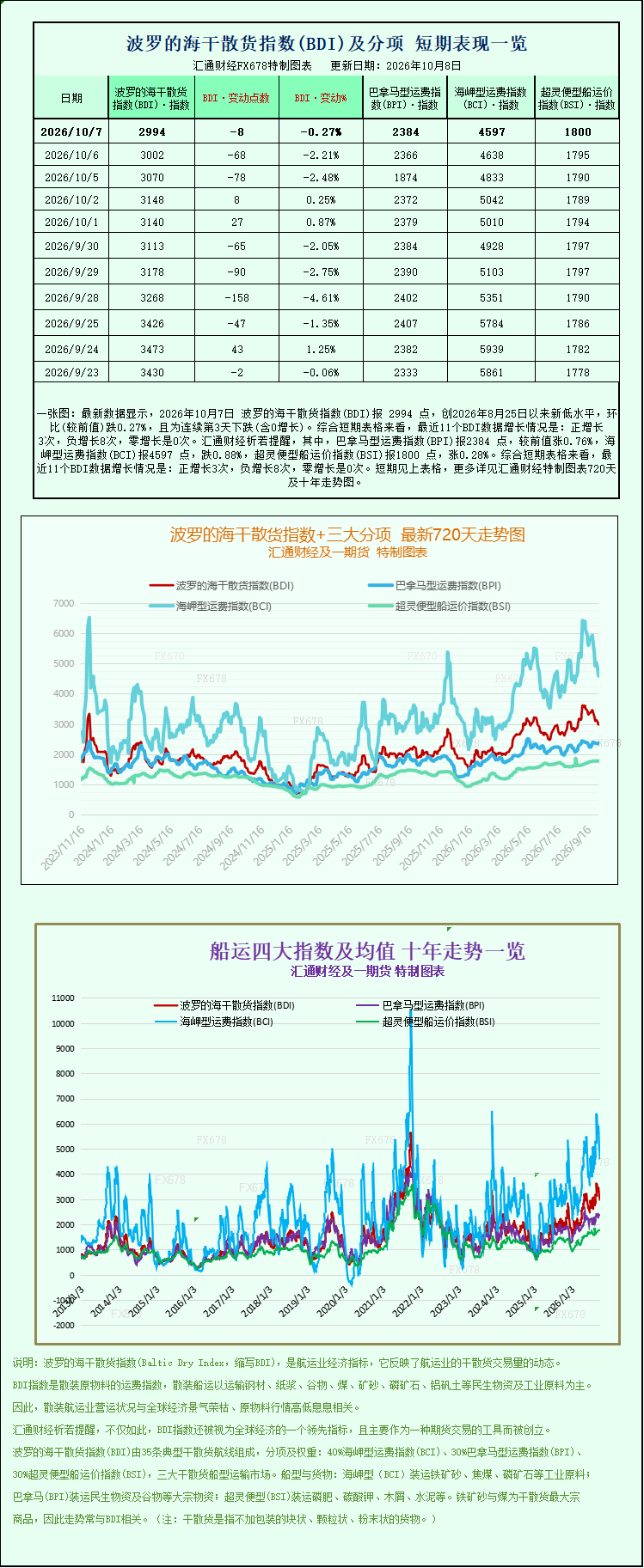 The Baltic Dry Index (BDI) released its latest dry bulk freight data on Wednesday, showing a decline and a clear market divergence: Capesize freight rates, which have the highest weighting, weakened significantly, while Panamax and Supramax rates bucked the trend with slight increases. The correction in large vessel rates ultimately dragged down the overall index. The BDI tracks global shipping rates for Capesize, Panamax, and Supramax vessels, and is a key indicator of the health of international commodity shipping. Data shows that the index fell 8 points, or 0.3%, to close at 2994 points, its lowest level since August 25th. The main reason for this decline was the cooling of the Capesize market; the Capesize Index (BCI) fell 41 points, or 0.9%, to close at 4597 points, also reaching its lowest level since August 21st. Capesize vessels, the largest vessel type in the dry bulk market, have a deadweight tonnage of approximately 150,000 tons per ship. They primarily handle the ocean transport of bulk industrial raw materials such as iron ore and thermal coal, and have the highest weighting in the Baltic Dry Index (BDI). Fluctuations in their charter rates have a decisive impact on the overall index. Specific earnings data shows that the average daily earnings of Capesize vessels declined by $373 to $38,188. Market analysis suggests that the decline in Capesize freight rates is related to two factors: firstly, changes in the raw material procurement pace of the downstream steel industry, with steel mills moderately controlling production, leading to a reduction in iron ore ocean freight volumes; secondly, an increase in the supply of Capesize vessels available for charter on some routes, further suppressing spot charter prices, and the fading of freight rate benefits from the previous peak season. Unlike the downward trend in large Capesize vessels, the medium and small bulk carrier market remained resilient, exhibiting an independent upward trend. The Panamax Freight Index (BPNI) rose 18 points, or 0.8%, to 2384 points. Panamax vessels, typically with a deadweight tonnage of 60,000-70,000 tons, are primarily used for transoceanic transport of goods such as coal and grain. The average daily charter rate for this vessel type increased by $162 to $21,456. With the peak grain export season approaching, global grain trade is becoming more active, supporting demand for Panamax vessels. This, coupled with limited passage through the Panama Canal and changes in vessel turnaround times, has provided some support for freight rates for this vessel type. Smaller Supramax vessels also saw a slight increase, with the Supramax Freight Index (BSIS) rising 5 points, or 0.3%, to close at 1800 points. These vessels are suitable for a wider range of ports and offer more flexible routes. In addition to grain, they also handle orders for transporting steel, fertilizers, and minor mineral products. Increased regional trade activity has driven a steady rise in freight rates for this vessel type. Overall, the current dry bulk shipping market exhibits a pronounced structural divergence, with freight rates for different vessel types showing a disconnect. Large mining vessels are weakening, while medium and small vessels are relatively strong, reflecting the uneven global demand for different types of commodities via sea freight. Demand for iron ore, coal, and other ferrous raw materials via sea freight has cooled temporarily, but trade in grains and other small bulk commodities remains active. Market institutions indicate that in the short term, Capesize freight rates will continue to fluctuate in line with the release of iron ore and coal cargoes, impacting the Baltic Dry Index (BDI). Looking ahead, the traditional peak season for dry bulk shipping in the fourth quarter remains promising. North American grain exports, winter heating coal restocking, and long-distance iron ore transportation demand could all provide support to the market. However, continued attention needs to be paid to uncertainties arising from multiple variables, including downstream manufacturing demand, global shipping capacity deployment, and canal access conditions.
The Baltic Dry Index (BDI) released its latest dry bulk freight data on Wednesday, showing a decline and a clear market divergence: Capesize freight rates, which have the highest weighting, weakened significantly, while Panamax and Supramax rates bucked the trend with slight increases. The correction in large vessel rates ultimately dragged down the overall index. The BDI tracks global shipping rates for Capesize, Panamax, and Supramax vessels, and is a key indicator of the health of international commodity shipping. Data shows that the index fell 8 points, or 0.3%, to close at 2994 points, its lowest level since August 25th. The main reason for this decline was the cooling of the Capesize market; the Capesize Index (BCI) fell 41 points, or 0.9%, to close at 4597 points, also reaching its lowest level since August 21st. Capesize vessels, the largest vessel type in the dry bulk market, have a deadweight tonnage of approximately 150,000 tons per ship. They primarily handle the ocean transport of bulk industrial raw materials such as iron ore and thermal coal, and have the highest weighting in the Baltic Dry Index (BDI). Fluctuations in their charter rates have a decisive impact on the overall index. Specific earnings data shows that the average daily earnings of Capesize vessels declined by $373 to $38,188. Market analysis suggests that the decline in Capesize freight rates is related to two factors: firstly, changes in the raw material procurement pace of the downstream steel industry, with steel mills moderately controlling production, leading to a reduction in iron ore ocean freight volumes; secondly, an increase in the supply of Capesize vessels available for charter on some routes, further suppressing spot charter prices, and the fading of freight rate benefits from the previous peak season. Unlike the downward trend in large Capesize vessels, the medium and small bulk carrier market remained resilient, exhibiting an independent upward trend. The Panamax Freight Index (BPNI) rose 18 points, or 0.8%, to 2384 points. Panamax vessels, typically with a deadweight tonnage of 60,000-70,000 tons, are primarily used for transoceanic transport of goods such as coal and grain. The average daily charter rate for this vessel type increased by $162 to $21,456. With the peak grain export season approaching, global grain trade is becoming more active, supporting demand for Panamax vessels. This, coupled with limited passage through the Panama Canal and changes in vessel turnaround times, has provided some support for freight rates for this vessel type. Smaller Supramax vessels also saw a slight increase, with the Supramax Freight Index (BSIS) rising 5 points, or 0.3%, to close at 1800 points. These vessels are suitable for a wider range of ports and offer more flexible routes. In addition to grain, they also handle orders for transporting steel, fertilizers, and minor mineral products. Increased regional trade activity has driven a steady rise in freight rates for this vessel type. Overall, the current dry bulk shipping market exhibits a pronounced structural divergence, with freight rates for different vessel types showing a disconnect. Large mining vessels are weakening, while medium and small vessels are relatively strong, reflecting the uneven global demand for different types of commodities via sea freight. Demand for iron ore, coal, and other ferrous raw materials via sea freight has cooled temporarily, but trade in grains and other small bulk commodities remains active. Market institutions indicate that in the short term, Capesize freight rates will continue to fluctuate in line with the release of iron ore and coal cargoes, impacting the Baltic Dry Index (BDI). Looking ahead, the traditional peak season for dry bulk shipping in the fourth quarter remains promising. North American grain exports, winter heating coal restocking, and long-distance iron ore transportation demand could all provide support to the market. However, continued attention needs to be paid to uncertainties arising from multiple variables, including downstream manufacturing demand, global shipping capacity deployment, and canal access conditions.
- Risk Warning and Disclaimer
- The market involves risk, and trading may not be suitable for all investors. This article is for reference only and does not constitute personal investment advice, nor does it take into account certain users’ specific investment objectives, financial situation, or other needs. Any investment decisions made based on this information are at your own risk.