The hawkish Federal Reserve meeting minutes boosted the dollar, pushing the dollar index above 102.
2026-10-08 17:58:16
On Thursday (October 8), following the release of the Federal Open Market Committee's hawkish meeting minutes, the latest intraday price action showed the US dollar index climbing above 102. The minutes of the September FOMC meeting released last night indicated that the Fed's stance remained hawkish. However, the money market has already clearly priced in the Fed's hawkish position. Even after a potential 25 basis point rise to 4.25% in December, the market still expects another 50 basis point rate hike next year. Such a move might be too aggressive, but the market is unlikely to attempt to oppose this hawkish interest rate policy.  Why Traders Are Focusing on the US Dollar Index Following the release of the minutes from the September 15-16 FOMC meeting, the Federal Reserve's next policy decision reflected policymakers' concerns about persistently high inflation. Officials unanimously agreed to raise interest rates by 25 basis points, bringing the benchmark range for the federal funds rate to 3.75% to 4.00%. The minutes also noted that further monetary tightening might be necessary if inflation remains high. However, the market does not expect an immediate rate hike. Futures prices indicate a roughly 19% probability of another rate hike at the October meeting, suggesting traders currently favor holding off on further tightening measures before the end of the year. The dollar's movement also depends on the performance of other major currencies, particularly the euro and the yen. Even with relatively optimistic US interest rate expectations, a strong euro or yen could still put pressure on the dollar index. The US Dollar Index is Expected to Rise Gradually Key factors influencing the dollar index include: Federal Reserve Policy: With interest rates expected to continue rising, US Treasury yields are expected to remain high, which is likely to support the dollar's performance. Inflation Data: Persistent price pressures may support tighter monetary policy, while milder inflation data could reduce expectations of interest rate hikes. Treasury Yields: Rising US Treasury yields could increase demand for dollar-denominated assets. Major Currency Movements: A stronger euro or yen could put further downward pressure on the index. The future direction of the US dollar index will depend on whether buyers can stabilize prices above 102 as the market reassesses. Higher-than-expected inflation data, rising Treasury yields, or more hawkish comments from Fed officials could further strengthen market expectations of further policy tightening. However, if US employment data is weak or inflation shows signs of decline, expectations of no further interest rate hikes will decrease, reducing demand for the dollar. A stronger euro or yen would further increase downward pressure on the dollar. ING believes that the dollar remains strongly supported in a complex investment environment. Given the situation in Europe, the dollar is expected to maintain its strong performance in the coming months. Furthermore, last night's auction of 10-year US Treasury bonds went very well, with both the bid rate and indirect bid volume at high levels. This indicates that as long as the yield is high enough, market demand for Treasury bonds will remain. The US dollar index is expected to gradually rise until it reaches the target level of 102.85. Technical Analysis
 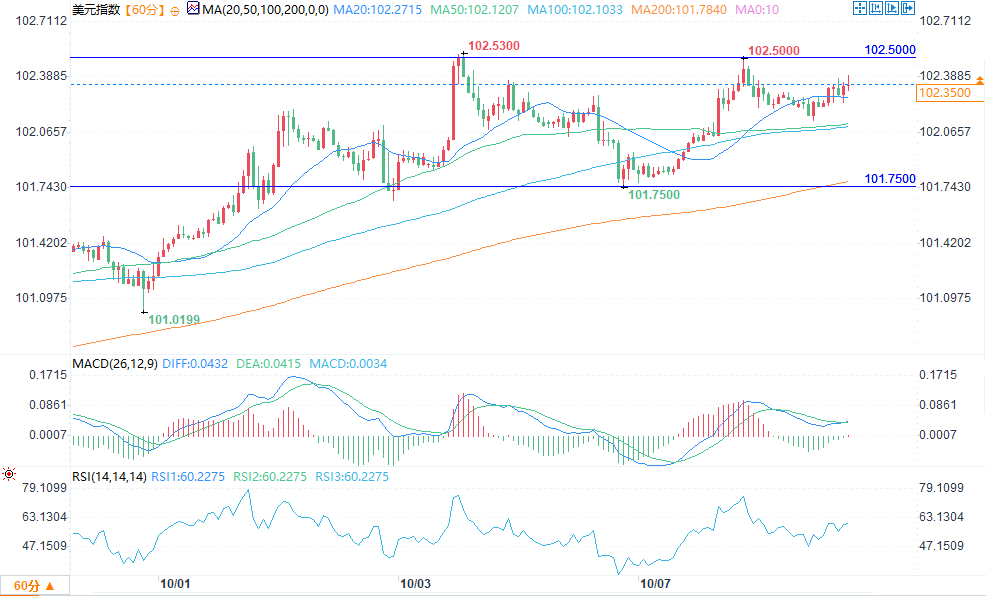 (US Dollar Index Daily Chart Source: EasyTrade) The US Dollar Index is currently oscillating within a short-term upward channel. The overall bullish structure remains intact, but it faces a test of previous highs. The short-term trading range is 101.75-102.50. The battle between bulls and bears is taking place below the resistance level. The bullish trend remains intact, but upward momentum is weakening, so be wary of a pullback after a surge. The DIFF line is above the DEA line, with weak red bars, indicating a significant decline in bullish momentum. The RSI is 60.23, in a neutral-to-strong range, not yet in overbought territory. Short-term bullish momentum hasn't completely exhausted itself, but it's no longer strong. If the RSI breaks above 70, it indicates short-term overheating, increasing the risk of a pullback. Key trading points to watch: Upside: Can the 102.50 resistance level be effectively broken? Downside: Can the 101.75 support level hold? At 17:53 Beijing time, the US Dollar Index was at 102.3830, up 0.10%.
Why Traders Are Focusing on the US Dollar Index Following the release of the minutes from the September 15-16 FOMC meeting, the Federal Reserve's next policy decision reflected policymakers' concerns about persistently high inflation. Officials unanimously agreed to raise interest rates by 25 basis points, bringing the benchmark range for the federal funds rate to 3.75% to 4.00%. The minutes also noted that further monetary tightening might be necessary if inflation remains high. However, the market does not expect an immediate rate hike. Futures prices indicate a roughly 19% probability of another rate hike at the October meeting, suggesting traders currently favor holding off on further tightening measures before the end of the year. The dollar's movement also depends on the performance of other major currencies, particularly the euro and the yen. Even with relatively optimistic US interest rate expectations, a strong euro or yen could still put pressure on the dollar index. The US Dollar Index is Expected to Rise Gradually Key factors influencing the dollar index include: Federal Reserve Policy: With interest rates expected to continue rising, US Treasury yields are expected to remain high, which is likely to support the dollar's performance. Inflation Data: Persistent price pressures may support tighter monetary policy, while milder inflation data could reduce expectations of interest rate hikes. Treasury Yields: Rising US Treasury yields could increase demand for dollar-denominated assets. Major Currency Movements: A stronger euro or yen could put further downward pressure on the index. The future direction of the US dollar index will depend on whether buyers can stabilize prices above 102 as the market reassesses. Higher-than-expected inflation data, rising Treasury yields, or more hawkish comments from Fed officials could further strengthen market expectations of further policy tightening. However, if US employment data is weak or inflation shows signs of decline, expectations of no further interest rate hikes will decrease, reducing demand for the dollar. A stronger euro or yen would further increase downward pressure on the dollar. ING believes that the dollar remains strongly supported in a complex investment environment. Given the situation in Europe, the dollar is expected to maintain its strong performance in the coming months. Furthermore, last night's auction of 10-year US Treasury bonds went very well, with both the bid rate and indirect bid volume at high levels. This indicates that as long as the yield is high enough, market demand for Treasury bonds will remain. The US dollar index is expected to gradually rise until it reaches the target level of 102.85. Technical Analysis (US Dollar Index Daily Chart Source: EasyTrade) The US Dollar Index is currently oscillating within a short-term upward channel. The overall bullish structure remains intact, but it faces a test of previous highs. The short-term trading range is 101.75-102.50. The battle between bulls and bears is taking place below the resistance level. The bullish trend remains intact, but upward momentum is weakening, so be wary of a pullback after a surge. The DIFF line is above the DEA line, with weak red bars, indicating a significant decline in bullish momentum. The RSI is 60.23, in a neutral-to-strong range, not yet in overbought territory. Short-term bullish momentum hasn't completely exhausted itself, but it's no longer strong. If the RSI breaks above 70, it indicates short-term overheating, increasing the risk of a pullback. Key trading points to watch: Upside: Can the 102.50 resistance level be effectively broken? Downside: Can the 101.75 support level hold? At 17:53 Beijing time, the US Dollar Index was at 102.3830, up 0.10%.
- Risk Warning and Disclaimer
- The market involves risk, and trading may not be suitable for all investors. This article is for reference only and does not constitute personal investment advice, nor does it take into account certain users’ specific investment objectives, financial situation, or other needs. Any investment decisions made based on this information are at your own risk.