US CPI and retail sales data will be released next week, and a Bank of Japan board member will speak on the same day. Who will break the stalemate of the yen at 158?
2026-10-09 08:20:16
On Friday (October 9th) during the Asian session, the USD/JPY pair fluctuated slightly higher, currently trading around 158. As the exchange rate returned to 158, the latest developments in the Middle East and the decline in US Treasury yields became the focus of market attention. US President Trump stated on social media that the US would not attack Iran before the midterm elections, and the 10-year US Treasury yield fell back to around 5.22% from its highest level since 2002 reached on Wednesday. Trump said negotiations with Tehran were productive while maintaining the naval blockade, and Brent crude oil fell within minutes of the announcement. Lower oil prices may indicate easing US inflationary pressures, correspondingly reducing the rationale for a Federal Reserve rate hike. The USD/JPY pair tested the 157.50 level twice on Thursday. 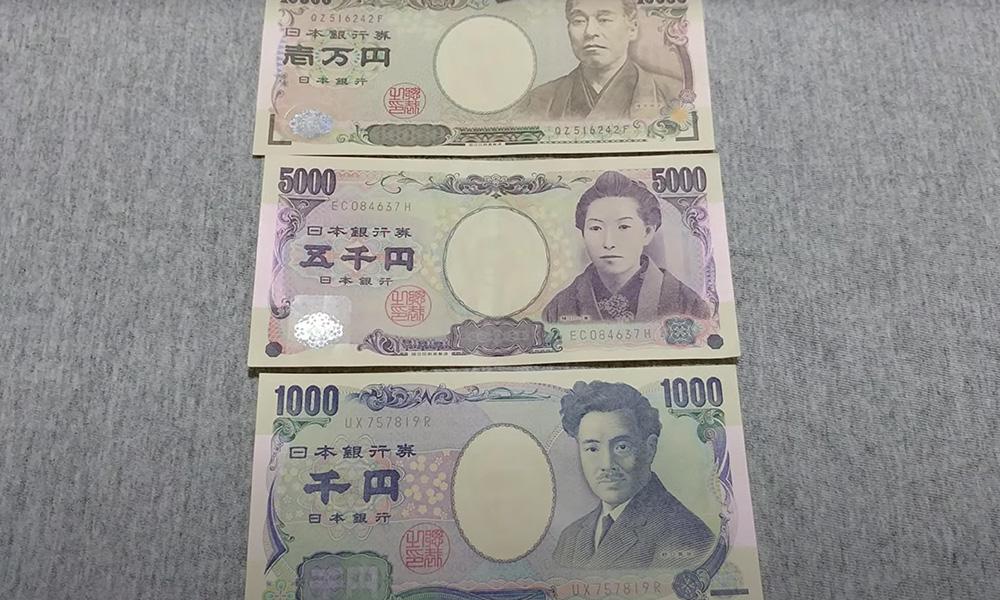
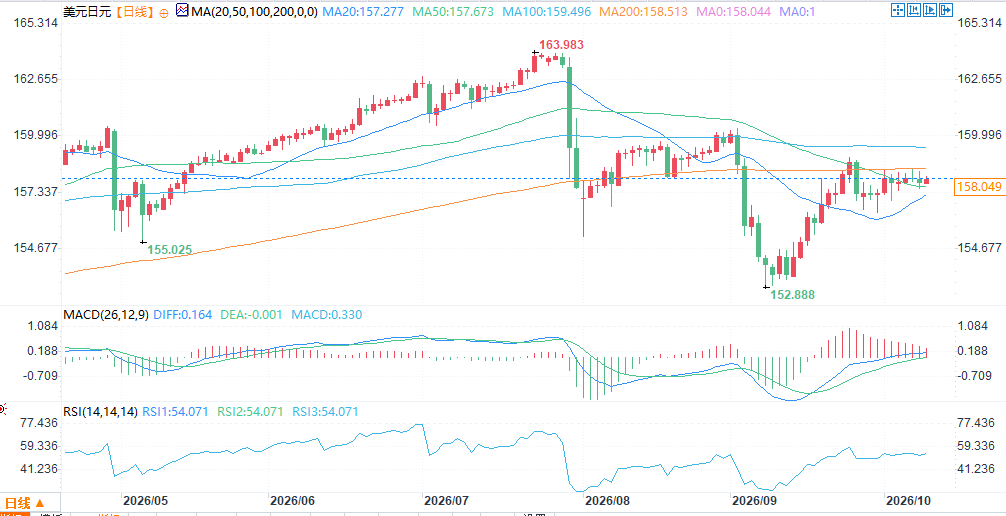 (USD/JPY daily chart, source: EasyForex) At 8:15 Beijing time, USD/JPY was trading at 158.06/07.
Trump stated: No attack on Iran before the midterm elections; negotiations were fruitful.
The 10-year U.S. Treasury yield touched its highest level since 2002 on Wednesday before falling back to close near 5.22% after Trump made a statement on social media. Trump said negotiations with Tehran were productive while maintaining the U.S. naval blockade. Brent crude fell within minutes of the commitment being announced, which expires on November 3. Lower oil prices may indicate easing inflationary pressures in the U.S., reducing the rationale for a Federal Reserve rate hike.USD/JPY: Two dips to 157.50
The USD/JPY exchange rate is essentially driven by the interest rate differential between the US and Japan. This interest rate differential is the additional return earned from borrowing yen, exchanging it for dollars, and holding dollar assets. Currently, the Federal Reserve's policy rate range is 3.75% to 4.00%, while the Bank of Japan's policy rate is 1.25%, a difference of 2.50 to 2.75 percentage points. This gap means that investors can still consistently earn a substantial interest rate differential by borrowing yen at a cost of 1.25% and buying dollar assets with yields close to 4%, which is the fundamental reason for the continued existence of yen carry trades. Any change in the interest rate differential is directly reflected in the USD/JPY exchange rate. When US Treasury yields fall, the return on holding dollar assets decreases, the attractiveness of carry trades weakens, some positions may be closed, the yen gains support, and the USD/JPY exchange rate comes under pressure. Conversely, if US Treasury yields rise or the Bank of Japan maintains an accommodative stance, the interest rate differential widens, and funds are more inclined to borrow yen to buy dollars, causing the USD/JPY exchange rate to rise. Therefore, the 10-year US Treasury yield fell back to around 5.22% from its highest level since 2002 on Wednesday, putting some pressure on the US dollar against the Japanese yen. This was also an important reason why the currency pair tested the 157.50 level twice on Thursday.After Musalaim's speech, the market recovered some of its losses, but closed still at 158.00.
St. Louis Fed President Musaleem subsequently stated in New York that interest rates should rise within the next six to nine months, and the dollar recovered about a third of its losses against the yen. Since October 1st, each closing price has remained within a range of approximately 20 pips around 158.00, indicating that the market tends to maintain equilibrium around this level in the absence of incremental information. This narrow consolidation pattern suggests that traders are awaiting new catalysts to determine direction—whether it's further statements from Fed officials, a breakout in US Treasury yields, or a shift in the Bank of Japan's policy signals. With interest rate differentials still dominating pricing, the area around 158 is likely to continue to serve as a short-term equilibrium zone for both bulls and bears.Market focus for the coming period: Michigan Sentiment Index, CPI, and speeches by Bank of Japan board members.
The University of Michigan Consumer Sentiment Index for Friday is expected to decline slightly to 47.6 from 48.1, but a bigger test for U.S. Treasury yields comes Wednesday, October 14. U.S. consumer price inflation in August was 3.4%, and 2.4% excluding food and energy; these two categories contributed a full percentage point to overall inflation, with oil affecting both. Retail sales and producer price indices will be released next week, and Bank of Japan policy board member Koeda will speak on the same day. Strong core inflation readings could increase bets on a Fed rate hike, pushing the dollar/yen pair back to near its September 24 high of 159.00; weaker readings could keep its closing price hovering around 158.00.Summarize
Trump ruled out striking Iran before the midterm elections, causing the 10-year US Treasury yield to fall from its highest level since 2002. Lower oil prices eased inflationary pressures and the rationale for interest rate hikes. The USD/JPY pair twice tested 157.50, but Moussalem's hawkish comments helped the exchange rate recover some losses, closing near 158.00. Since October 1st, the closing price has remained within a 20-pip range of this level, indicating the market is awaiting further information. The focus now shifts to the October 14th CPI and October 15th retail sales and the Bank of Japan's policymaker speech; the strength of core inflation will determine whether the USD/JPY pair returns to 159.00 or continues to consolidate around 158.00. (USD/JPY daily chart, source: EasyForex) At 8:15 Beijing time, USD/JPY was trading at 158.06/07.
- Risk Warning and Disclaimer
- The market involves risk, and trading may not be suitable for all investors. This article is for reference only and does not constitute personal investment advice, nor does it take into account certain users’ specific investment objectives, financial situation, or other needs. Any investment decisions made based on this information are at your own risk.