Institutions: Soaring US Treasury yields are putting short-term pressure on gold, but the underlying logic for long-term gains remains.
2026-10-09 11:36:20
Kenny Zhu, Director of Research and Investment Strategy at Sprott, analyzed that despite the sharp rise in US Treasury yields, gold has remained within its trading range, and gold ETFs continue to see inflows of new funds. This market signal suggests that gold prices are likely to break upwards in the future. Meanwhile, the long-term trend of central banks around the world continuously reducing their holdings of dollar assets and increasing their allocations to gold continues to support the bullish trend in gold. He explained that concerns about inflation and currency devaluation that are pushing up bond yields will ultimately increase the attractiveness of gold as an investment. Whether it's a soft landing or a deep recession, both could alleviate the pressure on precious metals. Once the Federal Reserve Chairman initiates a policy shift, gold and silver prices may experience a strong surge.
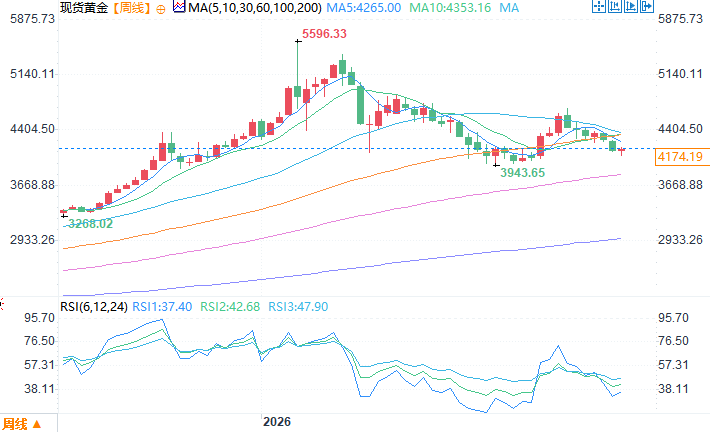 Spot gold weekly chart source: FX678. At 11:35 AM Beijing time on October 9th, spot gold was trading at $4175.73 per ounce.
Gold prices show resilience: ETF funds continue to flow in, and the market is in a tug-of-war between bulls and bears.
Zhu stated that despite persistent inflationary pressures, gold ETFs have maintained net inflows. While the inflows are not as large as during the gold price surge in August, the positive inflows themselves are significant, indicating that market investors still have interest in allocating to gold within the current price range. He said, "Gold has basically held its current trading range, coupled with the continued inflows into gold ETFs, which suggests the market is at a crucial juncture where bulls and bears are undecided. Considering various signals, the market is more inclined to move upwards. Many investors are gradually positioning themselves in gold assets in the current market environment." He also maintained a rational stance, noting that it is too early to conclude that market funds will fully flood into the gold sector. Recent volatility in the bond market has attracted considerable attention from fixed-income investors. The unusually high bond yields have made fixed-income assets a market focus, diverting some market attention.Central Bank Gold Buying Spree: A Long-Term Reshaping of the Global Reserve Asset Structure
The core underlying logic supporting gold prices is the continued gold purchases by global central banks, a trend that continued even during the gold price decline this summer. Zhu believes this trend had already begun before 2022, and the Russia-Ukraine conflict further accelerated this process. He said, "The sanctions imposed by the United States have isolated Russia from the international payment system, which directly demonstrates the powerful influence of the US dollar. Following this, central banks around the world accelerated their gold purchases." The market has long worried that major Asian countries will sell off US Treasury bonds and shift their foreign exchange reserves to other assets, with gold being a major allocation target. Russia has also continued to increase its gold holdings, and many emerging market central banks have followed suit. Even disregarding geopolitical factors, the reduction of dollar assets and increase of gold holdings by central banks around the world is perfectly reasonable. He said, "On the one hand, it's about reducing exposure to US assets; on the other hand, when the dollar strengthens, the local currency will face depreciation pressure. For emerging economies like Turkey, the impact of exchange rate fluctuations is particularly severe, and central banks will choose to sell US Treasury bonds and other dollar assets and buy gold to stabilize their local currencies." Data from 2022 to the present clearly shows that the proportion of dollar assets in global central bank reserves has continued to decline, while the proportion of gold reserves has steadily increased, and the global reserve asset landscape is slowly being restructured.Bonds have inherent weaknesses under inflationary risks.
Zhu acknowledged that historically high bond yields are indeed a significant negative factor suppressing gold prices. However, if yields rise, the root cause being sovereign debt risk and currency devaluation concerns, then even if gold itself doesn't generate interest, its investment value will still be highlighted. He said, "Rising inflation will severely damage bond assets. Bonds are unlikely to hedge against the downside risks of the stock market. The key is to look at the driving factors behind rising yields. The recent rise in yields is essentially a problem of currency dilution, coupled with the slow pace of interest rate hikes by the previous Federal Reserve Chairman in a zero-interest-rate environment, leading to excessive market liquidity and fueling persistent inflationary pressures." He called inflation the biggest weakness of bonds. Once inflation heats up and the Federal Reserve Chairman starts raising interest rates, market interest rates rise, and the market value of bond assets shrinks. Even if investors hold bonds until maturity, persistently high inflation will erode the real purchasing power of fixed coupons.Two economic scenarios are predicted: both a soft landing and a hard landing are favorable for gold.
Zhu proposed two macroeconomic scenarios, both of which would ultimately benefit gold. He said, "The first scenario is a soft landing for the economy. The Federal Reserve Chairman will not need to raise interest rates significantly, macroeconomic data will gradually improve, and a timely policy shift will be achieved. In this environment, the negative factors suppressing gold will gradually subside, and gold prices will return to their long-term upward trend." The second scenario is a black swan event triggering a hard landing for the economy. Once the economy encounters an unexpected shock, the Federal Reserve Chairman will initiate the significant policy shift that the market has been anticipating. He said, "Under this scenario, the pressure on precious metals will not only disappear, but it will even boost gold and silver prices significantly."Conclusion
In summary, the downward pressure from high short-term US Treasury yields remains, but gold has demonstrated strong resilience, with ETF inflows confirming that funds have not withdrawn from the gold market on a large scale. The structural shift in global central bank asset allocation is the core foundation supporting the long-term bull market in gold prices. Kenny Zhu's analysis indicates that the key variable in gold's price movement lies in the timing of the Federal Reserve Chairman's monetary policy adjustments. Regardless of whether the economy experiences a soft or hard landing, gold is expected to see a recovery, and once the policy shift is implemented, gold and silver assets may experience accelerated price increases. Spot gold weekly chart source: FX678. At 11:35 AM Beijing time on October 9th, spot gold was trading at $4175.73 per ounce.
- Risk Warning and Disclaimer
- The market involves risk, and trading may not be suitable for all investors. This article is for reference only and does not constitute personal investment advice, nor does it take into account certain users’ specific investment objectives, financial situation, or other needs. Any investment decisions made based on this information are at your own risk.