Institutions: Silver's long-term upward trend is solid; short-term recommendation: sell call options for profit.
2026-10-09 13:12:17
Persistent high inflation and rising bond yields have been putting continued pressure on the silver market recently. However, Nate Miller, Vice President of Product Development at Amplify ETFs, argues that silver remains a valuable monetary asset and an indispensable diversification tool in asset allocation. Although silver's performance has fallen short of market expectations since its highs at the beginning of the year, current silver prices are still significantly higher than at the same time last year. Miller is not optimistic that the Federal Reserve Chairman can completely control inflation. He believes that silver is forming a new price bottom, and its long-term upward trend remains intact. He also introduced investment strategies suitable for the current volatile market.
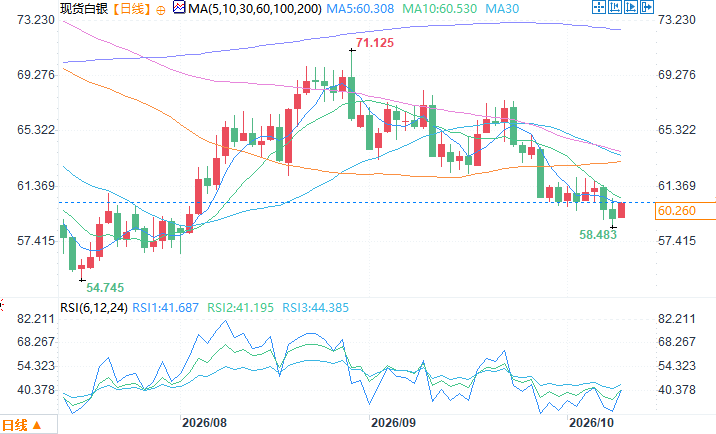 Spot silver daily chart source: FX678. At 13:10 Beijing time on October 9th, spot silver was trading at $60.27 per ounce.
Short-term market conditions are under pressure, but a long-term bottom is forming.
Compared to last year's market, silver only tested the $50 per ounce resistance level in October last year. From an annual perspective, silver still achieved considerable gains. Market expectations of interest rate hikes continue to suppress the precious metals sector, and rising US Treasury yields have increased the opportunity cost of holding non-interest-bearing assets like gold and silver. At the same time, the market generally expects the Federal Reserve Chairman to successfully curb inflation, supporting a stronger dollar, thus putting another layer of downward pressure on commodity prices. Miller stated that if inflation persists beyond market expectations, the current market landscape will change. He said, "Once inflationary pressures gradually ease, especially as energy prices fall, the dollar has room to weaken, and commodity prices such as gold and silver are expected to recover." In his view, short-term negative factors will not completely reverse the long-term trend of silver, which is currently building a new price support base within a trading range.Silver has dual support due to its monetary attributes combined with industrial demand.
Silver possesses both monetary and industrial attributes, a key characteristic that distinguishes it from gold. Miller emphasized the demand from the photovoltaic industry, one of the most important consumer sectors for silver. Strong photovoltaic demand provides additional support for silver, forming a fundamental support for its price. Even with rising bond yields and increased opportunity costs of holding non-interest-bearing assets, silver's diversification value in asset portfolios remains. He believes investors should not only focus on short-term interest rate fluctuations but also pay attention to the long-term risks brought by high inflation. The continued decline in the purchasing power of fiat currencies will continue to highlight the value of precious metals as a store of value.In volatile market conditions, covered call strategies are becoming a new option.
The precious metals investment market has been evolving in recent years, with investment products offering returns changing how investors participate in the silver market. Miller believes that covered call strategies are well-suited to the current wide-range fluctuations in the silver market. A covered call strategy involves selling call options while holding the underlying asset, allowing investors to collect option premiums and generate a stable cash flow to hedge against losses during periods of sideways or declining silver prices. However, this strategy also has limitations; if silver prices experience a significant and rapid rise, the strategy will miss out on some upside potential and cannot completely eliminate downside risk. He says, "In the coming months, covered call versions of silver products will be more attractive." The advantages of this strategy are fully demonstrated during periods of uncertainty surrounding monetary policy and continued wide-range fluctuations in silver prices.Increased volatility in the fourth quarter necessitates weighing the pros and cons of different strategies.
Miller predicts that as the market continues to adjust to the Federal Reserve Chairman's interest rate expectations, silver volatility will remain high in the final months of the year. He said, "The market will likely continue in this state in the fourth quarter, and high volatility will persist." High volatility poses risks to options-based investment products, but increased volatility will also push up option premiums, further enhancing the cash returns of covered call strategies. Investors need to weigh the potential gains against potential losses. This strategy can provide stable cash flow, but carries the risk of missing out on rallies in silver prices. Traditional silver investment can only profit from price increases, but these yield-generating strategies break this limitation. Even if silver prices are unlikely to resume a strong bullish trend in the short term, investors can still maintain their silver positions supported by inflation risks, policy uncertainty, and industrial demand. The inherent weakness of silver as a non-interest-bearing asset has been mitigated for some investors with the support of these new investment tools.Conclusion
In summary, high short-term US Treasury yields and a strong US dollar continue to suppress silver prices. However, silver's dual support from its monetary hedging properties and demand from the photovoltaic industry means its long-term upward trend remains intact. Facing the highly volatile market environment of the fourth quarter, besides long-term holding for capital appreciation, a covered call strategy can leverage option premiums to generate cash flow, adapting to the wide-ranging fluctuations in silver prices. Of course, this strategy has a potential return cap, and investors need to fully understand the risks involved and allocate their investments according to their own risk tolerance. Silver's investment value will not disappear due to short-term market volatility and it remains suitable as a diversification tool in a portfolio. Spot silver daily chart source: FX678. At 13:10 Beijing time on October 9th, spot silver was trading at $60.27 per ounce.
- Risk Warning and Disclaimer
- The market involves risk, and trading may not be suitable for all investors. This article is for reference only and does not constitute personal investment advice, nor does it take into account certain users’ specific investment objectives, financial situation, or other needs. Any investment decisions made based on this information are at your own risk.