Cooling safe-haven demand coupled with low oil prices led to a high-level correction in the USD/CAD exchange rate.
2026-10-09 14:30:18
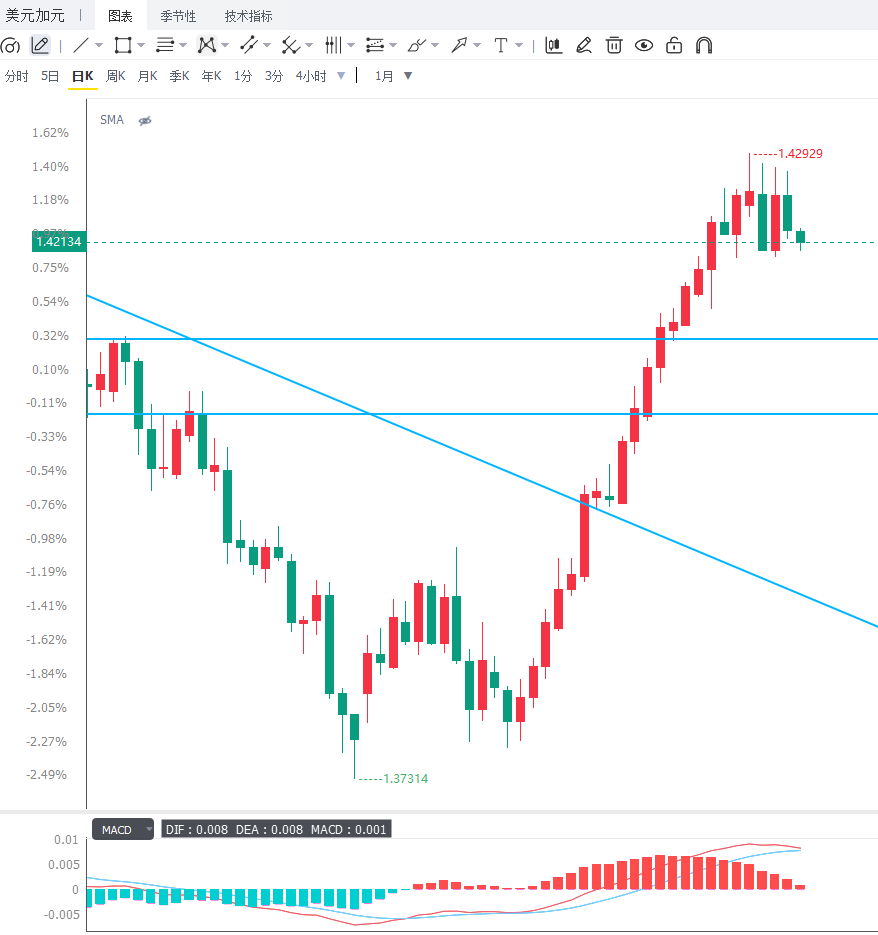
The US dollar continued its decline against the Canadian dollar (USD/CAD) in Asian trading on Friday, trading around 1.4210, marking its second consecutive day of losses. Signs of easing tensions between the US and Iran eased market concerns about a potential escalation of military conflict in the short term, diminishing the safe-haven appeal of the US dollar and putting downward pressure on the exchange rate. However, falling oil prices may limit the Canadian dollar's appreciation potential, while continued emphasis by Federal Reserve officials on the necessity of further tightening monetary policy ensured that the US dollar did not lose its fundamental support.  US President Trump stated that the US is having "productive discussions" with Iran and that there will be no attack on Iran before the US midterm elections. These remarks eased market concerns about further escalation of the geopolitical situation, thus reducing demand for the US dollar as a safe haven. At the same time, Trump stated that despite a record amount of oil passing through the Strait of Hormuz, the US maritime blockade of Iranian ports will remain in full force. This means that while market concerns about a short-term escalation have lessened, uncertainty regarding energy transportation and regional supply remains. Oil price fluctuations are a crucial variable affecting the USD/CAD exchange rate. Canada is a major energy exporter, and oil prices typically influence the Canadian dollar's performance through trade revenue, corporate profits, and market risk appetite. Weaker oil prices may weaken the Canadian dollar's commodity currency support, thus limiting the decline in the USD/CAD exchange rate. Therefore, even if the US dollar comes under pressure due to reduced safe-haven demand, the exchange rate may not necessarily continue its downward trend; oil price movements could still be a key factor influencing the Canadian dollar's performance. Expectations regarding Federal Reserve policy also affect the medium-term trend of the US dollar. According to the CME Group's FedWatch Tool, the market's probability of a Fed rate hike of at least 25 basis points at this month's meeting has fallen from 38% a week ago to about 17.7%, while the probability of a rate hike at the December meeting remains at about 83%. This indicates that market bets on near-term rate hikes have cooled, but expectations for further tightening this year remain high. The divergence between declining short-term safe-haven demand and hawkish medium-term interest rate expectations has created a situation where the dollar's movement faces mutually constraining forces. Speeches by Fed officials have further highlighted the hawkish bias in the policy stance. Musalaim stated that monetary policy may still need to be further tightened in order to bring inflation back to the 2% target level in a timely manner. He pointed out that the US economy is performing relatively strongly, the job market is generally stable, and demand-side pressures remain. In addition, AI-related investments and capital demand may provide structural support for interest rates, and the sustainability of the fiscal path may also affect long-term yields. These statements mean that even if the market lowers the probability of a rate hike this month, it cannot be concluded that the Fed has shifted to easing. Waller's position is more explicit. He believes that further rate hikes are still necessary, but rate hikes do not necessarily need to be continuous. Artificial intelligence investment, energy shocks, and a robust job market could all contribute to persistent inflationary pressures. Such rhetoric reinforces expectations that interest rates will remain high for an extended period, theoretically supporting the US dollar. However, if the market focuses more on easing geopolitical tensions and declining safe-haven demand in the short term, the support from hawkish policy signals for the dollar may be temporarily weakened. Analysts at Scotiabank believe that the recent Canadian dollar movement indicates the market is entering a consolidation and reassessment phase. After a significant weakening of the Canadian dollar, investors may be reassessing the short-term direction of the USD/CAD pair. This view suggests that the current pullback may not necessarily indicate a complete reversal of the medium-term trend, but rather reflects the market's search for a new balance between changing safe-haven demand for the dollar, interest rate expectations, and oil prices. Overall, the USD/CAD pair currently faces a tug-of-war between two main factors: easing geopolitical tensions weakening safe-haven demand for the dollar, while falling oil prices could put pressure on the Canadian dollar; simultaneously, a hawkish stance by the Federal Reserve helps limit the dollar's downside. The future trading direction will depend on whether oil prices stabilize, whether market expectations for a Fed rate hike this year continue to change, and whether safe-haven demand for the dollar can further decline. From a daily chart and short-term indicator perspective, the USD/CAD pair remains in a bearish trend. Technical indicators on October 9th show the exchange rate hovering around 1.4210, with the 14-day Relative Strength Index (RSI) at approximately 35.6, the MACD in negative territory, and most short- and medium-term moving averages issuing sell signals, indicating that downward momentum still dominates. However, some oscillators, such as the Stochastic RSI, have entered oversold territory. If short sellers take profits, a short-term technical rebound is possible. In the short term, 1.4200 forms the initial support area. If the exchange rate breaks below this range, it may test lower psychological levels. If the support holds temporarily, it's necessary to observe whether the exchange rate can regain the pivot level around 1.4260. On the upside, the first resistance level to watch is 1.4260. If buying pressure strengthens further, resistance around 1.4290 should be observed.
  Editor's Summary: The US dollar weakened against the Canadian dollar for the second consecutive day, reflecting a market reassessment of geopolitical risks, safe-haven demand for the US dollar, and the Federal Reserve's interest rate path. Signals of de-escalation between the US and Iran are putting short-term pressure on the dollar; however, falling oil prices may weaken the Canadian dollar's energy support, while the Federal Reserve officials' insistence on further tightening policy limits the dollar's potential for continued weakness.
US President Trump stated that the US is having "productive discussions" with Iran and that there will be no attack on Iran before the US midterm elections. These remarks eased market concerns about further escalation of the geopolitical situation, thus reducing demand for the US dollar as a safe haven. At the same time, Trump stated that despite a record amount of oil passing through the Strait of Hormuz, the US maritime blockade of Iranian ports will remain in full force. This means that while market concerns about a short-term escalation have lessened, uncertainty regarding energy transportation and regional supply remains. Oil price fluctuations are a crucial variable affecting the USD/CAD exchange rate. Canada is a major energy exporter, and oil prices typically influence the Canadian dollar's performance through trade revenue, corporate profits, and market risk appetite. Weaker oil prices may weaken the Canadian dollar's commodity currency support, thus limiting the decline in the USD/CAD exchange rate. Therefore, even if the US dollar comes under pressure due to reduced safe-haven demand, the exchange rate may not necessarily continue its downward trend; oil price movements could still be a key factor influencing the Canadian dollar's performance. Expectations regarding Federal Reserve policy also affect the medium-term trend of the US dollar. According to the CME Group's FedWatch Tool, the market's probability of a Fed rate hike of at least 25 basis points at this month's meeting has fallen from 38% a week ago to about 17.7%, while the probability of a rate hike at the December meeting remains at about 83%. This indicates that market bets on near-term rate hikes have cooled, but expectations for further tightening this year remain high. The divergence between declining short-term safe-haven demand and hawkish medium-term interest rate expectations has created a situation where the dollar's movement faces mutually constraining forces. Speeches by Fed officials have further highlighted the hawkish bias in the policy stance. Musalaim stated that monetary policy may still need to be further tightened in order to bring inflation back to the 2% target level in a timely manner. He pointed out that the US economy is performing relatively strongly, the job market is generally stable, and demand-side pressures remain. In addition, AI-related investments and capital demand may provide structural support for interest rates, and the sustainability of the fiscal path may also affect long-term yields. These statements mean that even if the market lowers the probability of a rate hike this month, it cannot be concluded that the Fed has shifted to easing. Waller's position is more explicit. He believes that further rate hikes are still necessary, but rate hikes do not necessarily need to be continuous. Artificial intelligence investment, energy shocks, and a robust job market could all contribute to persistent inflationary pressures. Such rhetoric reinforces expectations that interest rates will remain high for an extended period, theoretically supporting the US dollar. However, if the market focuses more on easing geopolitical tensions and declining safe-haven demand in the short term, the support from hawkish policy signals for the dollar may be temporarily weakened. Analysts at Scotiabank believe that the recent Canadian dollar movement indicates the market is entering a consolidation and reassessment phase. After a significant weakening of the Canadian dollar, investors may be reassessing the short-term direction of the USD/CAD pair. This view suggests that the current pullback may not necessarily indicate a complete reversal of the medium-term trend, but rather reflects the market's search for a new balance between changing safe-haven demand for the dollar, interest rate expectations, and oil prices. Overall, the USD/CAD pair currently faces a tug-of-war between two main factors: easing geopolitical tensions weakening safe-haven demand for the dollar, while falling oil prices could put pressure on the Canadian dollar; simultaneously, a hawkish stance by the Federal Reserve helps limit the dollar's downside. The future trading direction will depend on whether oil prices stabilize, whether market expectations for a Fed rate hike this year continue to change, and whether safe-haven demand for the dollar can further decline. From a daily chart and short-term indicator perspective, the USD/CAD pair remains in a bearish trend. Technical indicators on October 9th show the exchange rate hovering around 1.4210, with the 14-day Relative Strength Index (RSI) at approximately 35.6, the MACD in negative territory, and most short- and medium-term moving averages issuing sell signals, indicating that downward momentum still dominates. However, some oscillators, such as the Stochastic RSI, have entered oversold territory. If short sellers take profits, a short-term technical rebound is possible. In the short term, 1.4200 forms the initial support area. If the exchange rate breaks below this range, it may test lower psychological levels. If the support holds temporarily, it's necessary to observe whether the exchange rate can regain the pivot level around 1.4260. On the upside, the first resistance level to watch is 1.4260. If buying pressure strengthens further, resistance around 1.4290 should be observed. Editor's Summary: The US dollar weakened against the Canadian dollar for the second consecutive day, reflecting a market reassessment of geopolitical risks, safe-haven demand for the US dollar, and the Federal Reserve's interest rate path. Signals of de-escalation between the US and Iran are putting short-term pressure on the dollar; however, falling oil prices may weaken the Canadian dollar's energy support, while the Federal Reserve officials' insistence on further tightening policy limits the dollar's potential for continued weakness.
- Risk Warning and Disclaimer
- The market involves risk, and trading may not be suitable for all investors. This article is for reference only and does not constitute personal investment advice, nor does it take into account certain users’ specific investment objectives, financial situation, or other needs. Any investment decisions made based on this information are at your own risk.