Despite prolonged blockades, oil prices remain firm; Iran's resilience exceeds market expectations.
2026-10-09 15:44:17
Trump publicly stated that he would not resume military action against Iran before the US midterm elections on November 3, but did not rule out the option of resuming large-scale military operations after the elections. The US stated that productive indirect negotiations are underway between the US and Iran, with both sides exchanging proposals regarding Iran's proposed seven-day reopening of the Strait of Hormuz. The Iranian Foreign Minister stated that he is reviewing the US counter-proposal and will provide a formal response within days. The negotiations are currently only at the stage of exchanging proposals, and no ceasefire or peace agreement has been reached. In the Strait of Hormuz, US forces are escorting oil tankers through the strait at night with their positioning systems disabled. Combined with Gulf oil pipelines bypassing the strait, crude oil exports from Gulf allies are approaching pre-war levels. However, Iran has not given up pressure, recently increasing attacks on oil tankers in the strait. Overall, the volume of shipping, liquefied natural gas, and fuel cargo in the strait remains significantly lower than before the war. For oil tankers willing to risk passage under US protection, shipping insurance and freight rates have skyrocketed, with some tankers earning millions of dollars per day. The conflict continues to spread outwards. The Iranian-backed Houthi rebels continued their counter-offensive against Saudi Arabia, using missiles and drones to attack airports and critical infrastructure in Riyadh and other areas, causing numerous flight cancellations. Nearly half of Riyadh's departing flights were temporarily suspended, and several airlines, including Lufthansa and Air India, suspended routes to and from the Saudi capital. Saudi Arabia and the Yemeni government launched a military operation to expel the Houthi rebels from the Bab el-Mandeb Strait. As a crucial energy trade route in the Red Sea, disruptions to the Bab el-Mandeb Strait force oil tankers to detour around the Cape of Good Hope, further increasing global shipping costs. The simultaneous pressure on multiple shipping routes amplified the risk premium in the global crude oil supply chain. 
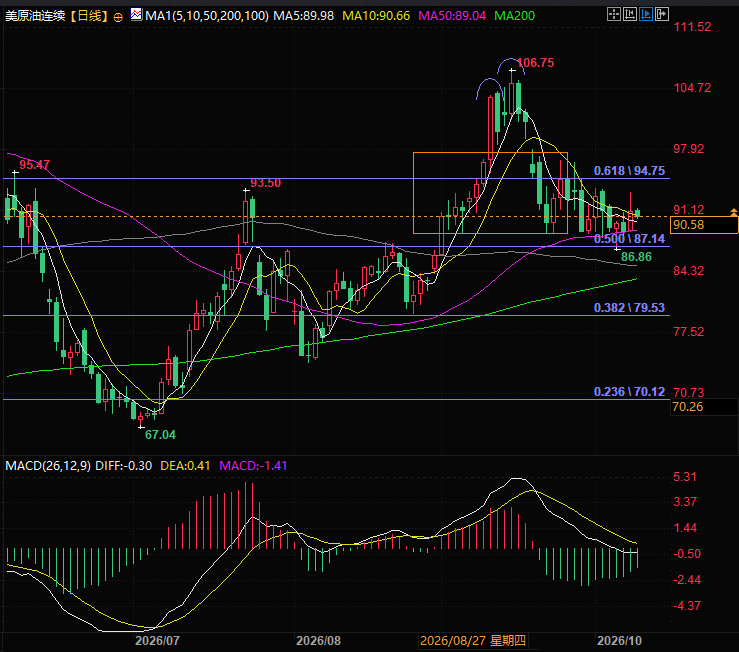 (WTI crude oil futures main contract daily chart, source: EasyTrade) At 15:41 Beijing time, WTI crude oil futures main contract is currently trading at $90.61 per barrel.
Old trading logic: The US and Iran are locked in a tug-of-war, causing oil prices to fluctuate based on geopolitical signals.
The market's previous trading logic was quite clear: neither the US nor Iran was willing to compromise on their core demands, leading to escalating geopolitical tensions and rising oil prices; any positive developments in diplomatic easing would immediately cause oil prices to fall back; and any pressure Iran exerts on shipping through the Strait of Hormuz would trigger another rebound in oil prices. The market initially anticipated that after a period of sustained US sanctions on Iranian oil exports and its financial system, Iran would be forced to make substantial compromises due to financial pressure, and that its oil storage facilities might even reach capacity, forcing a large-scale shutdown of oil extraction.Reality Reversal: After more than 70-80 days of blockade, Iran has shown no significant compromise.
The previous 60-day blockade, followed by Iran's intervention in negotiations, led the market to believe that the blockade threatened oil field storage and extraction, and that 60 days was close to Iran's limit in terms of endurance. However, with the current blockade extending beyond 70 days and approaching 80 days, market expectations are being shattered: Iran has yet to show any significant signs of compromise. This is the most crucial aspect of the game that warrants re-examination. The blockade has indeed severely impacted Iran's foreign exchange earnings, causing the rial to depreciate continuously, domestic inflation to remain high, and increasing pressure on people's livelihoods. However, Iran has relied on its long-established "resistance economy" system to achieve self-sufficiency in basic necessities such as food and crude oil. As long as it doesn't purchase large quantities of dollar-denominated overseas goods, it can maintain its domestic supply of basic necessities through domestic production and barter trade. Crude oil extraction will not be directly halted due to the blockade of overseas exports; oil field output prioritizes domestic consumption, and production will only be forced to decrease once storage facilities are completely full, a point that has not yet been reached. For Iran, retaining its uranium enrichment capacity and refusing to hand over enriched uranium has become a highly cost-effective strategic choice. Abandoning uranium enrichment is tantamount to directly discarding Iran's most important negotiating bargaining chip; however, as long as Iran maintains its nuclear threshold status, it retains leverage for sustained deterrence. On the surface, the blockade hasn't caused Iran's rapid collapse, which is why many observers intuitively feel that "sanctions seem ineffective." The blockade is a form of slow, sap-draining; it won't directly cripple the regime in the short term, but it continuously depletes Iran's foreign exchange reserves and its ability to upgrade its oil facilities.The other side of the game: the costs of prolonged lockdowns are being transmitted globally.
Conversely, the longer the situation drags on, the more the cost pressures on the global energy market will be transmitted outwards. Global crude oil reserves are being rapidly depleted, the US Treasury continues to bear the enormous costs of its military deployments in the Middle East, and energy procurement and logistics costs for countries worldwide are constantly rising. If oil prices rise again, Iran will regain its bargaining power. The US is attempting to use economic sanctions to continuously weaken Iran, forcing it to make concessions on the nuclear issue and the Strait of Hormuz; Iran, relying on its self-sufficiency system, is enduring internal economic pain, using Strait of Hormuz shipping and its nuclear capabilities as long-term bargaining chips, waiting for oil prices to rise and for the US to soften its negotiating stance.Market Outlook: With the war of attrition continuing, Iran's resilience may exceed market expectations.
In the short term, Iran's ability to hold out is likely to exceed previous market expectations. The focus of oil price pricing will gradually shift from "short-term military conflict risks" to long-term supply contraction, inventory depletion, and a war of attrition between the two sides. Several key variables need to be continuously monitored: the tanker attacks in the Strait of Hormuz, the intensity of Houthi attacks on Saudi Arabia, substantial progress in US-Iran negotiations, changes in global crude oil inventories, and the extent of increases in freight and insurance costs. Technically, even with a bearish technical trend and a downtrend in moving averages, international oil prices are clearly oscillating within a range. This means that even in a downtrend, there are frequent sharp rises, and the oscillation range is clearly defined: firstly, oscillating between the Fibonacci retracement levels of 87 and 95, and secondly, oscillating within a trading range. This trend aligns with our previous analysis. (WTI crude oil futures main contract daily chart, source: EasyTrade) At 15:41 Beijing time, WTI crude oil futures main contract is currently trading at $90.61 per barrel.- Risk Warning and Disclaimer
- The market involves risk, and trading may not be suitable for all investors. This article is for reference only and does not constitute personal investment advice, nor does it take into account certain users’ specific investment objectives, financial situation, or other needs. Any investment decisions made based on this information are at your own risk.