With inflation at 3.8% and French debt pressures compounded, why is the euro facing a dual pricing contradiction?
2026-10-09 15:54:16
On Friday, October 9th, the French sovereign bond market remained under pressure, with the boundaries of European Central Bank (ECB) policy intervention becoming a key issue in euro exchange rate pricing. ECB President Christine Lagarde stated on the 8th that the central bank possesses the necessary tools to address "irrational market dynamics," but did not announce any intervention. The euro was currently trading at approximately 1.122 against the dollar, having previously touched a 17-month low, with a cumulative decline of over 3% in the past five weeks. The core of the market debate has shifted from rising French bond yields to the boundary between fiscal risk repricing and monetary policy transmission failure. 
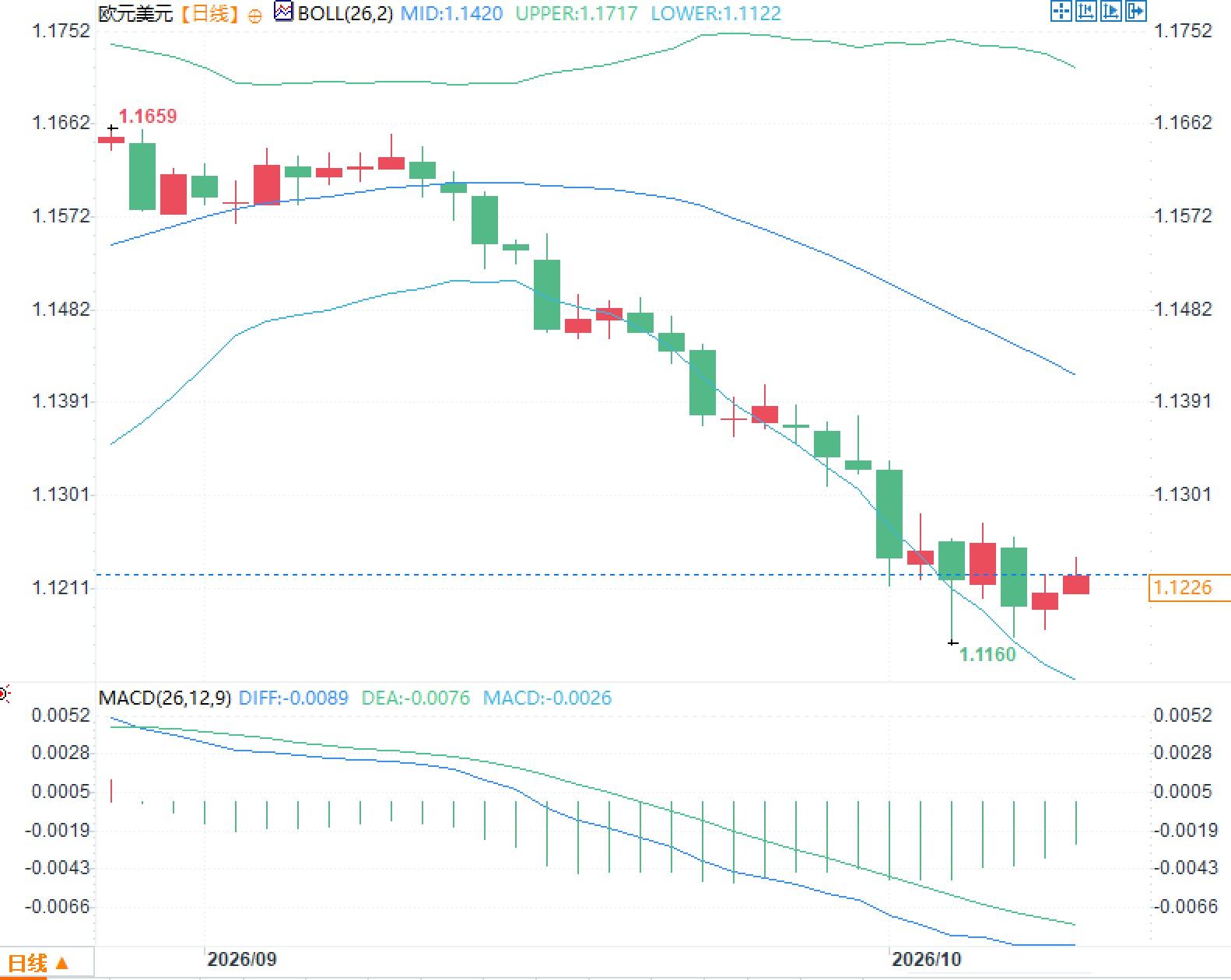 In the MACD indicator, the DIFF line is approximately -0.0089 and the DEA line is approximately -0.0076. Both lines are below the zero line, and the DIFF line is lower than the DEA line. The recent narrowing of the negative histogram bars reflects a marginal change in short-term momentum, but momentum convergence does not necessarily correlate with a change in trend structure.
I. French Fiscal Risks: The bond market is reassessing sovereign credit.
France's fiscal pressure is evolving from budget disputes into a systemic reassessment of sovereign credit risk premiums. On October 6th, the French Ministry of Finance raised its 2026 public fiscal deficit target from 5.0% of GDP to 5.4%, with a planned reduction to 5.0% in 2027, still significantly higher than the EU's 3% fiscal benchmark. The latest official data shows that as of the end of the second quarter of 2026, France's public debt reached €3.5955 trillion, accounting for 119.0% of GDP, higher than 117.5% in the first quarter. Simultaneously, fiscal adjustments face difficulties in political negotiation, and both existing debt and new financing needs are attracting market attention. On October 8th, the yield on French 10-year government bonds was around 4.9%, and the yield spread between French and German bonds widened significantly. It is important to distinguish that rising government bond yields do not necessarily indicate a failure of financial market functions. Nominal yields simultaneously include the risk-free rate, inflation compensation, term premium, credit risk, and liquidity compensation. When the fiscal deficit continues to expand and debt rollover pressure increases, investors' demands for higher risk compensation are economically reasonable. The widening spread between French and German bond yields, in particular, reflects credit differentiation among member states rather than being simply attributed to a rise in risk-free interest rates across the Eurozone. Therefore, high yields and a failure of the market pricing mechanism are two different concepts.II. ECB Policy Boundaries: Market Protection Cannot Replace Fiscal Discipline
Lagarde's remarks on August 8 regarding the response to "irrational market dynamics" have reignited the question of the applicability of the ECB's transmission protection tool. Established in 2022, the ECB's transmission protection tool primarily targets market volatility that lacks fundamental justification, is disorderly, and seriously threatens the transmission of a unified monetary policy. This tool can be used for public sector bonds with remaining maturities of 1 to 10 years, but this does not imply a commitment by the ECB to set yield caps on specific member states' government bonds. More importantly, the tool's use is subject to policy constraints. The ECB needs to comprehensively consider compliance with fiscal rules, the effectiveness of fiscal corrections, debt sustainability, macroeconomic imbalances, and related policy commitments. France is currently still in the process of addressing excessive deficits. In June 2026, after assessing that France had taken effective corrective actions, the relevant institutions suspended the process. However, this does not mean the process has officially ended, nor does it mean the transmission protection tool can be used unconditionally. The real institutional challenge lies in how to distinguish between reasonable credit risk reassessment and disorderly selling detached from fundamentals. Excessive policy intervention that compresses the fiscal risk premium could weaken incentives for fiscal consolidation and create moral hazard; conversely, a lack of response to severe market dysfunction could lead to excessive divergence in member states' financing conditions. The European Central Bank must maintain a clear boundary between price stability, the effectiveness of policy transmission, and fiscal discipline.III. The interplay of inflation and interest rate differentials: The pricing mechanism of the euro against the US dollar becomes more complex.
French debt risk is not the sole explanatory variable for the current euro exchange rate. Following the European Central Bank's (ECB) policy rate hike in September, the deposit facility rate reached 2.50%. Simultaneously, the Eurozone's preliminary September inflation figure rose to 3.8%, higher than August's 3.2%; energy prices increased by 18.8% year-on-year, with core inflation at 2.5%. Rising energy costs may simultaneously increase long-term inflation compensation, compress real purchasing power, and complicate fiscal adjustments. This means that rising long-term bond yields do not necessarily correspond to improved economic growth or a corresponding increase in monetary policy interest rate expectations. For the euro against the dollar, it is crucial to distinguish between the ECB's short-term interest rate expectations and France's unique sovereign risk premium. The former affects currency holding returns and cross-currency interest rate differentials, while the latter affects asset risk compensation, cross-border capital allocation, and the liquidity preference of the financial system. Therefore, rising French bond yields cannot be mechanically interpreted as increased attractiveness of the euro's interest rate differential. Fiscal credibility, interest rate expectations in both regions, and international capital demand collectively constitute the current macroeconomic pricing framework for the euro against the dollar.IV. Technical Structure of EUR/USD: Differences Between Momentum Changes and Trend Confirmation
Observing the daily chart, the euro/dollar pair has experienced a sustained pullback and is currently exhibiting low-level fluctuations. The Bollinger Band's middle line remains downward sloping, with the price below it and the lower edge of the channel continuing to extend. This indicates that the average price within the historical observation window has shifted downward, and there is still a significant asymmetry in the volatility distribution. In the MACD indicator, the DIFF line is approximately -0.0089 and the DEA line is approximately -0.0076. Both lines are below the zero line, and the DIFF line is lower than the DEA line. The recent narrowing of the negative histogram bars reflects a marginal change in short-term momentum, but momentum convergence does not necessarily correlate with a change in trend structure.
- Risk Warning and Disclaimer
- The market involves risk, and trading may not be suitable for all investors. This article is for reference only and does not constitute personal investment advice, nor does it take into account certain users’ specific investment objectives, financial situation, or other needs. Any investment decisions made based on this information are at your own risk.