Trump ruled out striking Iran before the midterm elections, and gold rose about 1.5%, erasing its weekly losses. How far can this rebound go?
2026-10-09 15:44:18
On Friday (October 9th) during the European session, spot gold rose by about 1.5%, essentially erasing all of its losses for the week, and is currently trading around $4195 per ounce. This followed a social media post by Trump stating that the US is having productive discussions with Tehran and making it clear that there will be no military action against Iran before the midterm elections. Following Trump's post, oil prices, real yields, and the dollar all fell, allowing gold to rebound. 
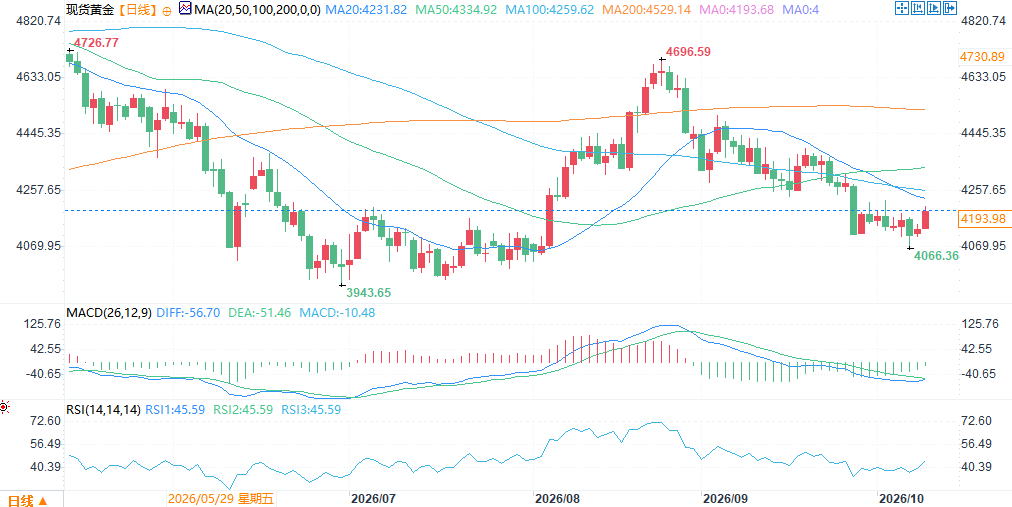 (Spot gold daily chart, source: EasyTrade) At 15:37 Beijing time, spot gold was trading at $4194.12 per ounce.
Trump rules out attacking Iran before the midterm election; oil prices, real yields, and the dollar all fall.
Gold erased its weekly losses after President Trump stated on social media that the U.S. was having productive discussions with Tehran and would not attack Iran before the midterm elections. The market reacted immediately, removing the escalation premium that had accumulated following reports of Trump weighing the possibility of a military strike against Iran before the midterm elections. Following Trump's post, oil prices, real yields, and the dollar all fell, triggering a gold rally. This reaction demonstrates gold's high sensitivity to changes in geopolitical risk premiums, especially when these premiums move in tandem with key drivers such as oil prices, real yields, and the dollar.Iran's foreign minister said he would respond to the US proposal within days, and a positive outcome could turn into a bullish one.
Looking ahead, Iranian Foreign Minister Araqchi stated yesterday that Tehran is reviewing Washington's response to the Iranian proposal and expects a reply in the coming days. A positive outcome could turn the outlook for gold from neutral to bullish, as easing geopolitical tensions could further depress oil prices, inflation expectations, and concerns about interest rate hikes. However, a negative response wouldn't change much, but could limit gold's upside potential. This statement indicates that Iran's response is a key variable for gold's short-term direction; a positive outcome could provide additional support, while a negative outcome could limit gains.Next week's US CPI report is key; the strength or weakness of inflation will influence the Federal Reserve's expectations.
Next week, the focus will shift to the US CPI report. A stronger-than-expected reading could trigger a hawkish repricing of Federal Reserve interest rate expectations, putting new pressure on gold. Conversely, a weaker reading could alleviate concerns about interest rate hikes, providing another boost to precious metals. This logic shows that CPI data will affect gold through the Federal Reserve's interest rate expectations channel, and the strength of inflation is one of the core variables determining the short-term direction of gold.Institutional Views
Goldman Sachs predicts that spot gold prices will rise to $4,900 per ounce by the end of 2026, driven by strong demand from central banks seeking to diversify their foreign exchange reserves. The bank emphasizes that central bank gold purchases have become a multi-year structural trend, with average monthly purchases significantly higher than before 2022, providing solid support for gold prices. While short-term Fed policy and rising real yields may slow the upward trend, Goldman Sachs believes that interest rate hikes will only delay, not end, the current gold bull market. The gradual recovery of private investment demand and hedging needs related to geopolitical and fiscal risks will further push up gold prices. UBS's latest view points out that high real yields and a strong dollar still pose headwinds for gold in the short term, but the medium- to long-term fundamentals remain unchanged. It expects gold prices to regain momentum by the end of the year and continue into 2027. Specifically, it forecasts $4,600 per ounce in December 2026, $5,000 in March 2027, $5,200 in June 2027, and $5,400 in September 2027. UBS emphasizes that central bank gold purchases (estimated at 750-1000 tons for the year) and reserve diversification trends provide stable support, while concerns about fiscal sustainability will also strengthen gold's role as a strategic hedging asset. The bank views a price pullback to around $4000 as an opportunity to increase long-term allocations, rather than a signal of a change in its bullish outlook.Summarize
Gold erased its losses for the week as Trump ruled out attacking Iran before the midterm elections, removing the escalation premium from the market. Oil prices, real yields, and the dollar all fell, triggering a gold rebound. Iran's foreign minister stated that a response to the US proposal would be given within days; a positive outcome could turn the outlook for gold from neutral to bullish, while a negative outcome could limit upside. Next week's US CPI report is key; a stronger-than-expected report could trigger a hawkish repricing, suppressing gold; a weaker-than-expected report could ease concerns about interest rate hikes, supporting gold. Going forward, attention should be paid to Iran's response, US CPI data, oil price movements, real yields, the dollar, and expectations for Fed policy. If geopolitical tensions further ease and the CPI is relatively soft, gold may continue to rise; if the CPI is strong or geopolitical tensions escalate again, gold may face pressure. (Spot gold daily chart, source: EasyTrade) At 15:37 Beijing time, spot gold was trading at $4194.12 per ounce.
- Risk Warning and Disclaimer
- The market involves risk, and trading may not be suitable for all investors. This article is for reference only and does not constitute personal investment advice, nor does it take into account certain users’ specific investment objectives, financial situation, or other needs. Any investment decisions made based on this information are at your own risk.