Falling oil prices ease inflationary pressures; could silver rebound?
2026-10-09 14:38:16
On Friday during Asian trading hours, spot silver (XAG/USD) rebounded to around $60.10 per ounce, ending a three-day losing streak. Silver prices have recently found some support, mainly due to the decline in international oil prices, easing market concerns about renewed inflation, and a decrease in expectations for a near-term interest rate hike by the Federal Reserve. However, silver is currently still in a relatively weak technical structure, and marginal improvements in the macroeconomic environment are insufficient to confirm a trend reversal.  The decline in oil prices was a significant factor driving the short-term recovery in precious metals. US President Trump stated that the US is having "productive discussions" with Iran and that there will be no attack on Iran before the US midterm elections. These statements eased market concerns about further escalation of the Middle East situation, putting downward pressure on oil prices. If geopolitical risk premiums continue to decline, the impact of energy prices on overall inflation may weaken, and market concerns about further monetary policy tightening are expected to subside. Silver does not generate interest income, therefore its price is relatively sensitive to changes in interest rate expectations and real yields. When the market believes that the necessity for further Fed rate hikes has decreased, the opportunity cost of holding silver may decrease, thus supporting silver prices. According to the CME FedWatch Tool, the market's expectation of a rate hike of at least 25 basis points at this month's policy meeting has fallen to about 17.7%, down from 38% a week ago; meanwhile, the market's expectation of a rate hike at the Fed's December meeting remains at about 83%. This indicates that while traders have lowered their near-term rate hike expectations, they have not abandoned their judgment of further policy tightening this year. Recent statements from Fed officials have also complicated the policy outlook. Musalaem emphasized that monetary policy may still need to be further tightened to bring inflation back down to 2%. He pointed out that the US economy and job market are performing well, demand-side pressures remain, and AI-related investments and capital needs may also push real interest rates to remain at relatively high levels. These remarks reflect that the Fed has not clearly shifted to easing despite the easing of short-term inflationary pressures. Waller's comments were more directly hawkish. He believes that further rate hikes are still necessary, but not necessarily in consecutive meetings. He also pointed out that AI investments, the energy shock, and continued strong economic and employment performance may perpetuate inflationary pressures. Since inflation has been above target for an extended period, the Fed needs to guard against the risk of inflation expectations losing their anchor. This means that even if the probability of a near-term rate hike decreases, the possibility of interest rates remaining high for a longer period still exists. For silver prices, the market is currently caught in a tug-of-war between two forces. On the one hand, falling oil prices have eased inflation concerns and reduced short-term rate hike expectations, providing conditions for a silver rebound; on the other hand, Fed officials continue to emphasize the necessity of further tightening policy, and if the dollar and US Treasury yields strengthen again, the upside potential for silver may still be limited. Furthermore, silver possesses attributes of both precious and industrial metals. Besides being influenced by interest rates and safe-haven demand, it is also affected by global economic growth prospects and changes in industrial demand. Therefore, a decline in oil prices does not necessarily mean a continued rise in silver prices; the market still needs to pay attention to subsequent changes in the US dollar, real yields, and overall risk appetite. From a daily chart perspective, spot silver is currently trading around $60.10, with an overall bearish bias. Silver prices are below the 9-period and 50-period exponential moving averages, indicating that the short-term rebound has not changed the medium-term downward pressure pattern. The 14-day Relative Strength Index (RSI) is approximately 40.7, below the neutral level of 50, but not yet in the typical oversold zone, indicating that downward momentum still exists, and the market cannot be judged to have bottomed out solely based on a rebound after a continuous decline. On the upside, the 9-period exponential moving average around $60.74 constitutes the first resistance level. If silver prices can effectively break through and hold this level, the short-term rebound is expected to continue, with the next target being the 50-period exponential moving average around $63.39. This level is a crucial technical juncture for determining whether the bearish trend can ease; if prices encounter resistance here, silver prices may face renewed pressure. From a 4-hour short-term trading perspective, it's more appropriate to observe whether the rebound can form sustained higher highs rather than chasing the price upwards directly. If silver prices break through $60.74 and maintain above that level, the short-term recovery signal will strengthen; if the rebound falters and falls back below $60, we should be wary of selling pressure regaining dominance. Since current data does not provide clear 4-hour moving average values or reliable structural support levels, it's not advisable to artificially set lower, more precise support targets. The focus should be on the struggle around the $60 level and the price's performance near key moving averages.
 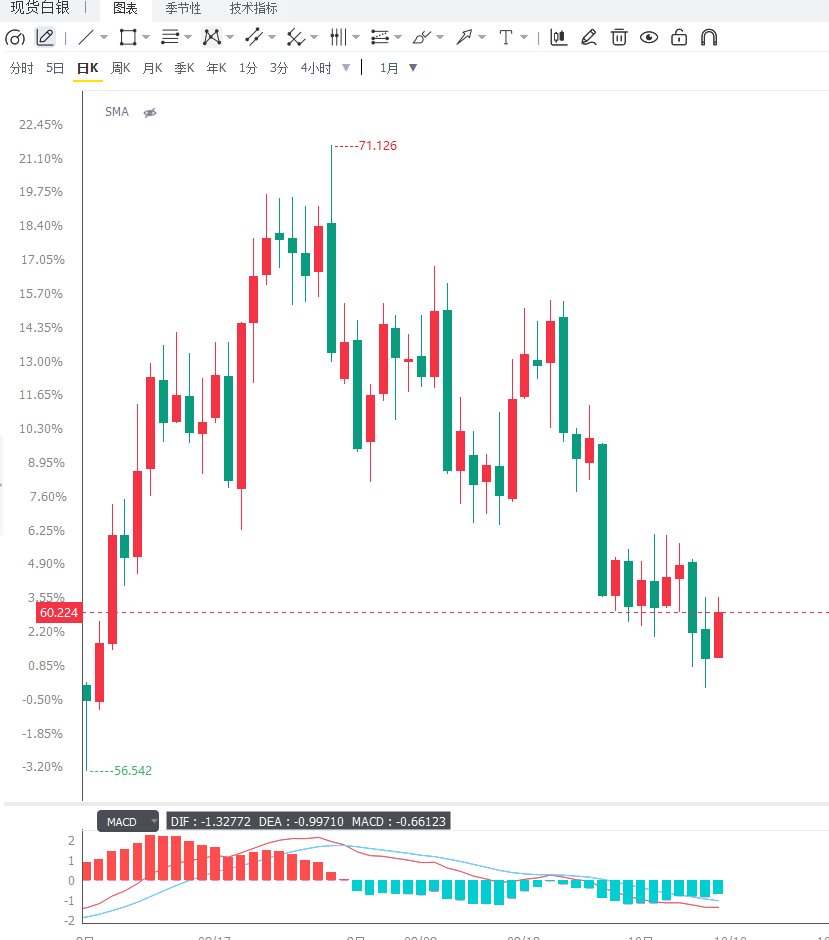 Editor's Summary: The recent rebound in silver prices was primarily driven by falling oil prices and a cooling of short-term interest rate hike expectations. However, Federal Reserve officials still favor further tightening of monetary policy, meaning that the downward pressure on silver prices from the interest rate and yield environment has not yet disappeared. In the short term, $60.74 is the primary level to observe the strength of the rebound; a break above this level is needed to potentially test the resistance near $63.39. If $60 cannot be held, the market should remain wary of a continuation of the decline. Investors should simultaneously monitor crude oil price movements, Federal Reserve policy signals, and changes in the US dollar and US Treasury yields to avoid mistaking short-term rebounds for a trend reversal.
The decline in oil prices was a significant factor driving the short-term recovery in precious metals. US President Trump stated that the US is having "productive discussions" with Iran and that there will be no attack on Iran before the US midterm elections. These statements eased market concerns about further escalation of the Middle East situation, putting downward pressure on oil prices. If geopolitical risk premiums continue to decline, the impact of energy prices on overall inflation may weaken, and market concerns about further monetary policy tightening are expected to subside. Silver does not generate interest income, therefore its price is relatively sensitive to changes in interest rate expectations and real yields. When the market believes that the necessity for further Fed rate hikes has decreased, the opportunity cost of holding silver may decrease, thus supporting silver prices. According to the CME FedWatch Tool, the market's expectation of a rate hike of at least 25 basis points at this month's policy meeting has fallen to about 17.7%, down from 38% a week ago; meanwhile, the market's expectation of a rate hike at the Fed's December meeting remains at about 83%. This indicates that while traders have lowered their near-term rate hike expectations, they have not abandoned their judgment of further policy tightening this year. Recent statements from Fed officials have also complicated the policy outlook. Musalaem emphasized that monetary policy may still need to be further tightened to bring inflation back down to 2%. He pointed out that the US economy and job market are performing well, demand-side pressures remain, and AI-related investments and capital needs may also push real interest rates to remain at relatively high levels. These remarks reflect that the Fed has not clearly shifted to easing despite the easing of short-term inflationary pressures. Waller's comments were more directly hawkish. He believes that further rate hikes are still necessary, but not necessarily in consecutive meetings. He also pointed out that AI investments, the energy shock, and continued strong economic and employment performance may perpetuate inflationary pressures. Since inflation has been above target for an extended period, the Fed needs to guard against the risk of inflation expectations losing their anchor. This means that even if the probability of a near-term rate hike decreases, the possibility of interest rates remaining high for a longer period still exists. For silver prices, the market is currently caught in a tug-of-war between two forces. On the one hand, falling oil prices have eased inflation concerns and reduced short-term rate hike expectations, providing conditions for a silver rebound; on the other hand, Fed officials continue to emphasize the necessity of further tightening policy, and if the dollar and US Treasury yields strengthen again, the upside potential for silver may still be limited. Furthermore, silver possesses attributes of both precious and industrial metals. Besides being influenced by interest rates and safe-haven demand, it is also affected by global economic growth prospects and changes in industrial demand. Therefore, a decline in oil prices does not necessarily mean a continued rise in silver prices; the market still needs to pay attention to subsequent changes in the US dollar, real yields, and overall risk appetite. From a daily chart perspective, spot silver is currently trading around $60.10, with an overall bearish bias. Silver prices are below the 9-period and 50-period exponential moving averages, indicating that the short-term rebound has not changed the medium-term downward pressure pattern. The 14-day Relative Strength Index (RSI) is approximately 40.7, below the neutral level of 50, but not yet in the typical oversold zone, indicating that downward momentum still exists, and the market cannot be judged to have bottomed out solely based on a rebound after a continuous decline. On the upside, the 9-period exponential moving average around $60.74 constitutes the first resistance level. If silver prices can effectively break through and hold this level, the short-term rebound is expected to continue, with the next target being the 50-period exponential moving average around $63.39. This level is a crucial technical juncture for determining whether the bearish trend can ease; if prices encounter resistance here, silver prices may face renewed pressure. From a 4-hour short-term trading perspective, it's more appropriate to observe whether the rebound can form sustained higher highs rather than chasing the price upwards directly. If silver prices break through $60.74 and maintain above that level, the short-term recovery signal will strengthen; if the rebound falters and falls back below $60, we should be wary of selling pressure regaining dominance. Since current data does not provide clear 4-hour moving average values or reliable structural support levels, it's not advisable to artificially set lower, more precise support targets. The focus should be on the struggle around the $60 level and the price's performance near key moving averages. Editor's Summary: The recent rebound in silver prices was primarily driven by falling oil prices and a cooling of short-term interest rate hike expectations. However, Federal Reserve officials still favor further tightening of monetary policy, meaning that the downward pressure on silver prices from the interest rate and yield environment has not yet disappeared. In the short term, $60.74 is the primary level to observe the strength of the rebound; a break above this level is needed to potentially test the resistance near $63.39. If $60 cannot be held, the market should remain wary of a continuation of the decline. Investors should simultaneously monitor crude oil price movements, Federal Reserve policy signals, and changes in the US dollar and US Treasury yields to avoid mistaking short-term rebounds for a trend reversal.
- Risk Warning and Disclaimer
- The market involves risk, and trading may not be suitable for all investors. This article is for reference only and does not constitute personal investment advice, nor does it take into account certain users’ specific investment objectives, financial situation, or other needs. Any investment decisions made based on this information are at your own risk.