Gold Trading Alert: Bulls Launch a Comeback Amidst the Shadow of Fed Rate Hikes! This Week's US CPI and Fed Chair's Speech Will Be Key
2026-10-12 07:40:17
Gold prices fell to a two-month low of $4,066.30 per ounce earlier last week, before bargain hunting pushed spot gold back up to a one-week high. Spot gold rose 1.5% to $4,194.99 per ounce on Friday, for a weekly gain of approximately 1.3%; U.S. December gold futures rose 1.4% to settle at $4,216.3 per ounce. However, gold prices traded in a narrow range in early trading on Monday (October 12), currently hovering around $4,195 per ounce, with market sentiment remaining cautious. Overall, gold is currently in a consolidation phase above the psychological level of $4,000, with bulls and bears fiercely tug-of-war over the Fed's interest rate path, the strength of the dollar, U.S. Treasury yields, and geopolitical risks. 
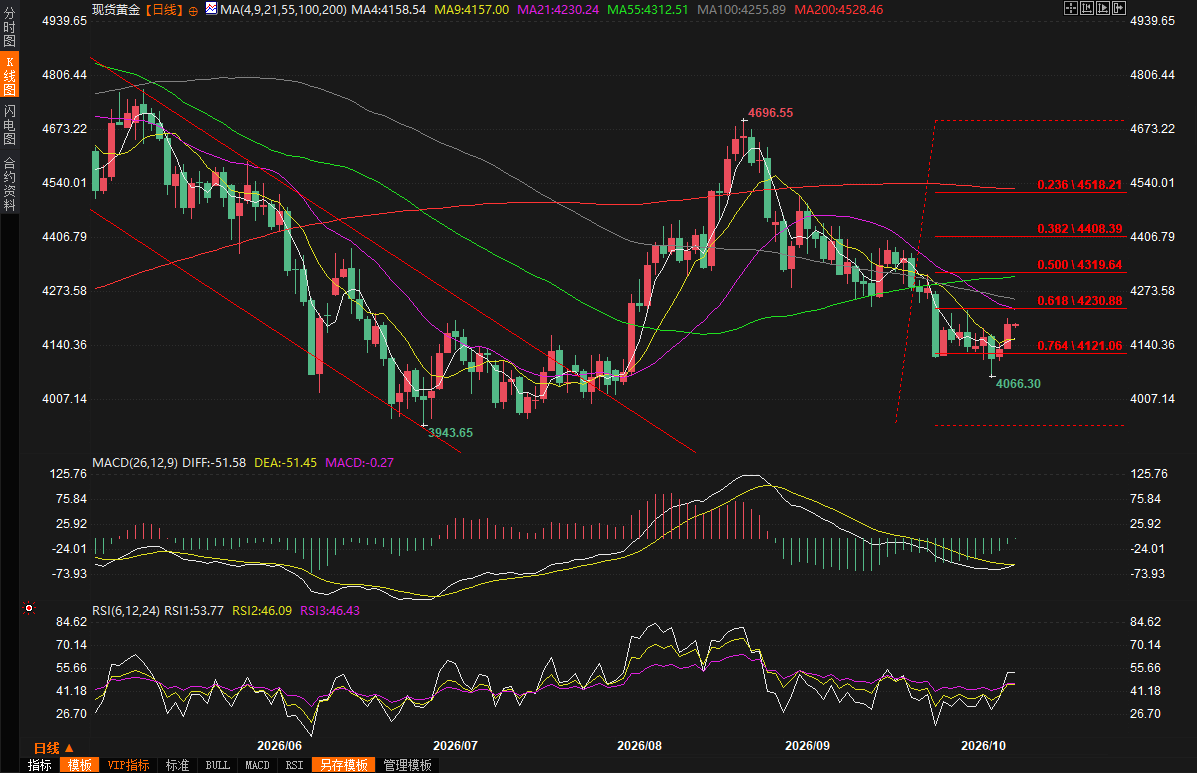 (Spot gold daily chart, source: FX678) At 07:31 Beijing time, spot gold is currently trading at $4196.35 per ounce.
Gold prices initially declined before rebounding, with a perceived bottom appearing around $4,000.
Last week's gold price movement can be described as a rollercoaster ride before stabilizing. At the beginning of the week, a stronger dollar and rising US Treasury yields pressured non-yielding assets, with spot gold briefly falling to $4066.30 per ounce on Wednesday, a two-month low. Just as the market worried that gold prices might slide further towards $4000 or even lower, bargain hunters began to enter the market. Rhona O'Connell, head of market analysis at Stone X, stated that the rise in gold prices was due to "buying on dips, with a bottom gradually forming around $4000." She believes the market has already priced in expectations of further Fed rate hikes and continued net buying by official institutions. Without any "black swan" events, it will be difficult for gold prices to convincingly break upwards. This statement highlights the core contradiction currently facing gold: support from physical buying and central bank buying, while resistance from interest rate expectations and a strong dollar. Friday's rebound was more a result of short covering and bargain hunting than a signal of a trend breakout.The Federal Reserve and US Treasury yields: the "interest rate ceiling" for gold.
The biggest obstacle to gold's current rebound remains the Federal Reserve and the bond market. St. Louis Fed President Musalaim stated last Thursday that the Fed needs to raise interest rates again to bring inflation back to its 2% target. The CME FedWatch tool shows traders currently expect an 18% probability of a Fed rate hike in October and an 84% probability of at least a 25 basis point hike by the end of December. In a high-interest-rate environment, gold is often less attractive than yield-paying assets, a key reason for previous pressure on gold prices. Bybit's chief market analyst, Han Tan, stated that this week's Consumer Price Index (CPI) could be a catalyst for the next significant fluctuation in gold prices. If inflation remains stubborn, forcing the Fed into a steeper rate hike cycle, spot gold could retest the psychological support level of $4,000. However, the bond market is not entirely on the bears' side. The yield on the 10-year US Treasury bond retreated from its more than 20-year high reached last Wednesday, and Treasury prices fell on Friday as investors took profits ahead of last week's inflation data release. The 10-year Treasury yield rose 2.8 basis points to 5.261%, but fell 3.5 basis points last week, marking its biggest weekly drop in two months. The 30-year Treasury yield edged up to 5.608%, down 2.9 basis points last week. The two-year Treasury yield rose 4.4 basis points to 4.799%, down 3.4 basis points last week. Chip Hughey, Managing Director of Fixed Income at Truist Wealth, said that strong auctions of 10-year and 30-year Treasury bonds this week drove a sharp rise in bond prices, and Friday saw some of those gains given back. A slight respite in the market after a significant drop in yields across all maturities is normal. Interest rate futures markets indicate an 80% probability that the Federal Reserve will keep interest rates unchanged at its policy meeting this month. Ruchir Sharma, an economist at Nomura Securities, also believes that core CPI inflation may decline in September as the impact of temporary increases in wireless communication service prices fades. Given that the Fed has no urgent need for consecutive rate hikes and the midterm elections are approaching, inflation forecasts are unlikely to increase the likelihood of a Fed rate hike in October. University of Michigan data shows that consumer inflation expectations for the next year rose to 4.7% in October from 4.6% in September, far exceeding the 3.4% level before the outbreak of the Iran-Iraq War in February; the consumer confidence index further declined to 46.3 in early October, compared to 48.1 in September. Hughey points out that when the 10-year Treasury yield approaches 5.30%-5.35%, it typically attracts buying interest, causing unease in the stock market and a sell-off of risk assets, thus limiting further yield increases. This means that the pressure of US Treasury yields on gold is not linear; once yields approach short-term highs, gold may actually get a breather.A strong dollar exerts downward pressure, but the safe-haven premium persists.
Investors are concerned about France's record public debt and the tough political resistance to budget cuts; in contrast, the US economy and the dollar are performing strongly, with the dollar index rising 0.12% on Friday to close at 102.23, up about 0.3% this week, marking its fourth consecutive week of gains and its longest winning streak since May 2025. A strong dollar typically puts pressure on dollar-denominated gold, but the market doesn't move in one direction. Risk premiums on French and Italian government bonds, which surged at the end of September, are poised to decline this week as investors await new developments before demanding higher returns to compensate for fiscal and political risks. Spain's announcement of snap elections earlier this week also added pressure on the euro. Eugene Epstein, head of trading and structured products at Moneycorp, said that multiple factors are currently intertwined, including rising oil prices and the French situation, making it difficult to say which factor has a greater impact on the market; the market is relatively in a wait-and-see mode, with everyone waiting for speeches from Federal Reserve officials, as the dollar is currently highly sensitive to their statements. For gold, a strong dollar is a short-term suppressor, but European fiscal and political risks, uncertainty surrounding the US midterm elections, and the situation in the Middle East are still maintaining a safe-haven premium for gold.The Strait of Hormuz remains shrouded in shadow.
Geopolitically, the situation in the Strait of Hormuz has once again gripped market sentiment. Iran's Revolutionary Guard reported on Sunday (October 11) that a mine exploded, affecting a supertanker transiting the Strait of Hormuz and causing a fire in the engine room. The Revolutionary Guard stated that the tanker, carrying crude oil, was heading towards the Persian Gulf exit but had its navigation system disabled and was sailing on an unauthorized route. Iran stated that this was the third attack on oil tankers in the past two days, attributing the incidents to tankers sailing in the restricted area. The Revolutionary Guard warned that any vessel disabling its navigation and identification systems would be considered a hostile act and would face severe and decisive consequences. Iran has announced the closure of the Strait of Hormuz and warned that safe passage is only possible through routes authorized by its armed forces. This maritime passage is strategically important for international oil transport, connecting the Persian Gulf to sea routes to global markets. The United States insists it has not blocked the strait and claims to maintain military control over the area, although its military presence is reportedly limited to the outer sections of the strait. Meanwhile, Rezaei, secretary of Iran's Supreme National Security Council, stated on the 11th that the United States had accepted some of Iran's conditions for reopening the Strait of Hormuz, but it remained unclear whether the remaining conditions could be met. Rezaei said that over the past two months, the US had requested a proposal from Iran through three channels: Pakistan, Qatar, and Iraq. Iran presented seven conditions to the US and made it clear that it would not open the Strait of Hormuz or engage in negotiations unless these conditions were met. He stated that the US had responded, but Iran felt the response was insufficient and that the US needed to clarify some ambiguities. Iran would observe whether the US could dispel its doubts before deciding on further actions. Rezaei also warned that if the US launched another invasion of Iran, US assets in the Middle East, including critical data systems and artificial intelligence facilities, would be targeted. He further stated that Iran was prepared to demonstrate new military capabilities should war break out again and refuted US claims regarding the reopening of the Strait of Hormuz, stating that some ships were using smuggling networks and that current shipping volumes were still far below pre-war levels; Iran would continue to maintain control of the strait. Tensions in the Middle East have kept oil prices high, supporting expectations of further interest rate hikes by the Federal Reserve and safe-haven demand for the US dollar, which is putting downward pressure on gold prices. Investors need to continue to pay attention to news related to the Middle East situation.Institutional opinions and surveys show that half of Wall Street investors are bullish, but retail investors still do not constitute a majority.
From an institutional perspective, market opinions are clearly divided. Adrian Day, president of Adrian Day Asset Management, holds a neutral view, expecting more back-and-forth volatility before the war ends, which will lower CPI expectations and ease pressure on central banks to raise interest rates. The end of the war will also eliminate the safe-haven premium of the dollar. He does not expect a sharp drop in gold prices, but neither will he expect a breakout. James Stanley, senior market strategist at Forex, is bullish, believing that last week may have seen a capitulation sell-off, with sellers quickly withdrawing from the lows after clean selling pressure emerged. The weekly close in the red is noteworthy; while predicting the bottom is difficult, increasing evidence suggests sustained buying interest in gold around $4,000. Rich Checkan, president and COO of Asset Strategies International, is bullish. The prevailing view is that the Fed will not raise interest rates at the October FOMC meeting, which will ease short-term pressure on gold. Treasury yields and a strong dollar will limit gains, but gold should still rise this week. Kevin Grady, president of Phoenix Futures and Options, is watching this week's CPI report to observe gold's short-term reaction and clues about the Fed's medium-term direction, but he warns that a single figure cannot truly reflect the complexity of the situation. He says the key is how the Fed digests this data. The market rallied after disappointing jobs data of 29,000 jobs, as investors believed the Federal Reserve would not raise interest rates further and were now trying to figure out what the Fed would do next. A Kitco News gold survey released last weekend, involving 14 analysts, showed that after gold's positive weekly performance, half of Wall Street analysts were again bullish: 7 experts (50%) expected gold prices to rise this week, only 2 (14%) expected them to fall, and the remaining 5 (36%) were unsure or expected sideways movement. The Kitco online survey received 206 votes. Despite gold's resilience, Main Street investors have not regained a bullish majority: 93 retail traders (45%) expected gold prices to rise this week, 77 (37%) expected them to fall, and the remaining 36 (18%) expected sideways movement. This indicates that professional institutions are slightly optimistic about gold's short-term trend, but retail investor sentiment has not yet formed an overwhelming bullish stance, and the market remains in a phase of hesitation and waiting for a catalyst.Key events this week: CPI, PPI, and the Federal Reserve Chairman's speech.
This week's inflation data will be the main focus, with the release of the September Consumer Price Index (CPI) and Producer Price Index (PPI). The market will also pay attention to key regional manufacturing surveys and a speech by Federal Reserve Chairman Kevin Warsh. September existing home sales data will be released on Tuesday. Wednesday will focus on the CPI report. Thursday will see PPI, September retail sales, weekly initial jobless claims, and manufacturing surveys from the Philadelphia Fed and the New York Fed. On Thursday evening local time (Friday morning Beijing time), traders will focus on Chairman Warsh's speech at an IMF event in Bangkok. For gold, CPI is the most important short-term variable. If inflation remains stubborn, the market may strengthen expectations of a steeper Fed rate hike, potentially leading to a renewed strengthening of the dollar and Treasury yields, and spot gold may retest the psychological support level of $4,000. If core CPI falls as Nomura expects, the urgency for continued Fed rate hikes will decrease, and gold may hold above $4,000 and challenge recent highs. Furthermore, the situation in the Middle East, oil prices, the dollar index, and changes in the Treasury yield curve will all jointly determine whether gold prices can transform last week's rebound into a more sustained upward trend. In summary, gold is currently in a phase of highly intertwined bullish and bearish factors. On the bullish side, there is continued buying interest around $4,000, expectations of net buying by official institutions remain, the Strait of Hormuz risk in the Middle East remains unresolved, European fiscal and political uncertainty, the approaching US midterm elections, and high consumer inflation expectations all provide potential support for gold. On the bearish side, the possibility of further interest rate hikes by the Federal Reserve has not been completely ruled out, the high-interest-rate environment weakens the attractiveness of non-yielding assets, the US dollar index has risen for four consecutive weeks, US Treasury yields, although retreating from their highs, remain at high levels, Indian gold demand is weak, and trading in China is thin due to holidays, with no strong support from physical consumption. From a technical and psychological perspective, $4,000 is transforming from a simple psychological barrier into a bottoming area repeatedly tested by the market. However, without a "black swan" event or inflation and employment data significantly altering the Fed's path, it will be difficult for gold prices to convincingly break through to the upside. Going forward, CPI and PPI will provide clues about Fed policy, while the Strait of Hormuz could ignite safe-haven demand at any time. The battle to defend gold at $4,000 is not over yet; the real big volatility may be waiting at the intersection of this week's data and geopolitical news. (Spot gold daily chart, source: FX678) At 07:31 Beijing time, spot gold is currently trading at $4196.35 per ounce.
- Risk Warning and Disclaimer
- The market involves risk, and trading may not be suitable for all investors. This article is for reference only and does not constitute personal investment advice, nor does it take into account certain users’ specific investment objectives, financial situation, or other needs. Any investment decisions made based on this information are at your own risk.