With the Reserve Bank of Australia's minutes and employment data released in quick succession, who will decide the next move for the Australian dollar?
2026-10-12 08:18:19
The Australian dollar remained range-bound against the US dollar during Asian trading hours on Monday (October 12), currently trading around 0.6985, almost unchanged for the day. Two key data releases scheduled for this week could provide guidance for the Australian dollar's next move. Australia's focus this week is on two data releases that will shape expectations for the Reserve Bank of Australia's (RBA) next policy move: the minutes of the September policy meeting released on Tuesday, and the September labor force survey released on Thursday. 
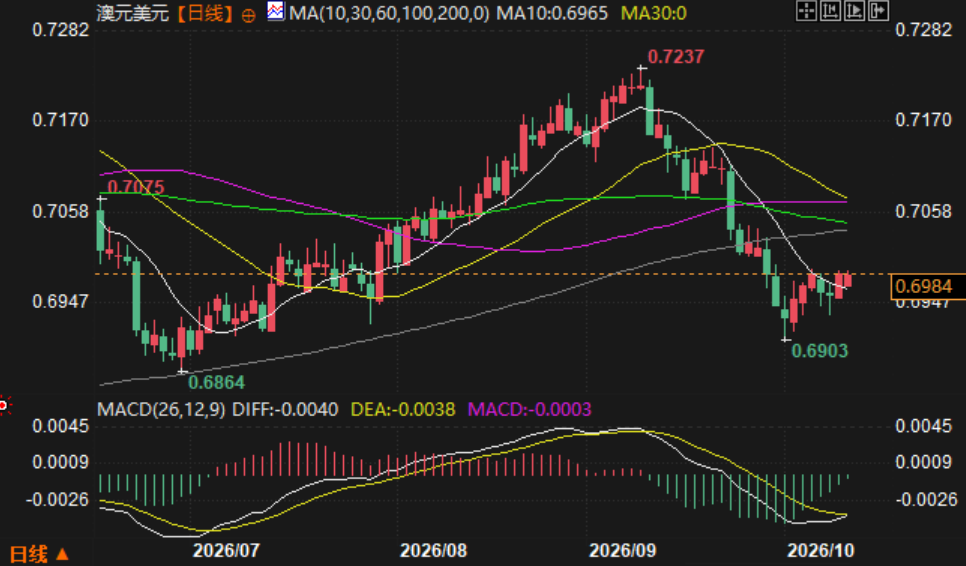 (Australian dollar against US dollar daily chart, source: EasyForex) At 8:08 Beijing time, the Australian dollar was trading at 0.6984/85 against the US dollar.
RBA Minutes: Examining Whether Bullock's Dovish Post-Meeting Tone Aligns with the Meeting Record
The Reserve Bank of Australia's (RBA) September meeting minutes will be released on Tuesday. Commonwealth Bank stated that the minutes will reveal the arguments for maintaining the current interest rate and will focus on whether they align with the more dovish tone of Bill Bullock at the press conference—when she noted that four rate hikes would take time to transmit. Commonwealth Bank believes the threshold for further rate hikes is now higher. Westpac, on the other hand, takes a more assertive stance, predicting another rate hike to 4.85% before December and stating that the market will look to the minutes for forward guidance. At the heart of this divergence is the fact that while the formal decision was to raise rates, the governor's wording was cautious. The minutes will reveal how seriously the committee took maintaining the current rate when deciding to raise it. If the minutes show the committee is cautious about further action, it will support market pricing in a pause; if the minutes emphasize that inflation risks remain skewed to the upside, it could reinforce expectations of further tightening.Employment data: The unemployment rate is expected to remain at 4.6%, the highest since the end of 2021.
Thursday's jobs data will follow the unexpected increase of about 40,000 in August, but the unemployment rate will still rise to 4.6%, the highest since the end of 2021, as the participation rate rose to 67.1%, slightly below record. Westpac forecasts 20,000 new jobs in September, in line with the consensus, with the participation rate falling to 67.0% and the unemployment rate remaining at 4.6%. The bank said that cost-of-living pressures and higher interest rates are attracting more people into the labor market, causing labor supply to outpace demand. The Federal Reserve expects weaker growth of 10,000, noting that its internal data shows job growth closer to 20,000 per month, and also expects the unemployment rate to be 4.6%. The bank warned that this data could be noisier than usual: a survey group with extremely low unemployment is rotating out, posing an upside risk; and the August rise may have been exaggerated and could be partially reversed. The Federal Reserve cautioned against interpreting any decline in the unemployment rate as a trend change, expecting it to gradually rise as the economy slows.Consumer and Business Confidence: Interest Rate Hikes Have Impacted Households, Business Conditions Have Turned Negative
Interest rate hikes have already impacted households. Westpac's consumer confidence index fell 4.7% to 80.4 in October, near its weakest level in survey history, with respondents' confidence significantly lower after the decision than before. On the business side, Tuesday's NAB business survey will follow August's report, marking the first negative reading in six years. These declines in both confidence indicators provide important context for the Reserve Bank of Australia's (RBA) policy path. If consumer and business confidence continues to weaken, the scope for further interest rate hikes will be constrained. However, if inflationary pressures persist, the RBA may have to continue tightening amid weak confidence.Oil Prices: The Swing Factors Behind Two Outcomes
Oil prices are a key factor driving the two possible outcomes of the Reserve Bank of Australia's (RBA) minutes. The committee explicitly mentioned the pressure on fuel prices from the Middle East conflict in its September decision. Therefore, any strength in crude oil prices due to attacks in the Gulf would reinforce the inflation argument, supporting further rate hikes; conversely, if oil prices fall, inflationary pressures would ease, strengthening the case for pausing or slowing rate hikes. This channel means that developments in the Middle East will be transmitted to the RBA's policy expectations through oil prices, thus affecting the Australian dollar.Policy Path: The Divergence Between the Commonwealth Bank and Westpac
The divergence between the Commonwealth Bank and Westpac on policy path reflects the duality of current Australian economic data. On the one hand, inflation remains too high, and the committee has clearly reserved the option of further tightening; on the other hand, consumer confidence is near historic lows, business conditions have turned negative, and economic growth is slowing. This dilemma means that the Reserve Bank of Australia's next move will heavily depend on upcoming data—the minutes will reveal details of the committee's discussions, employment data will show the actual state of the labor market, and oil prices will determine the evolution of inflationary pressures. These three factors are key variables determining the short-term direction of the Australian dollar.Summarize
Australia's focus this week is on the Reserve Bank of Australia's (RBA) September meeting minutes released on Tuesday and the September employment data released on Thursday. The minutes carry more weight than usual, as Bullock's post-meeting tone was more dovish than the decisions themselves. The Commonwealth Bank believes the threshold for further rate hikes is higher, while Westpac still predicts a rate hike to 4.85% by the end of the year. The employment data is expected to show the unemployment rate remaining at 4.6%, the highest since the end of 2021. Westpac predicts an increase of 20,000, while the Commonwealth Bank predicts 10,000. Consumer confidence is near historic lows, and business sentiment has turned negative. Oil prices are a pivotal factor behind both outcomes, with the Middle East situation transmitting to inflation expectations and RBA policy through oil prices. For the Australian dollar, a dovish tone in the minutes will support a pause in pricing and suppress the Australian dollar, while a hawkish tone will strengthen expectations of further tightening. If the unemployment rate unexpectedly rises in the employment data, it will exacerbate market concerns about downside risks to growth. The combination of the minutes and the employment data will determine the short-term direction of the Australian dollar. (Australian dollar against US dollar daily chart, source: EasyForex) At 8:08 Beijing time, the Australian dollar was trading at 0.6984/85 against the US dollar.
- Risk Warning and Disclaimer
- The market involves risk, and trading may not be suitable for all investors. This article is for reference only and does not constitute personal investment advice, nor does it take into account certain users’ specific investment objectives, financial situation, or other needs. Any investment decisions made based on this information are at your own risk.