US September CPI Preview: The Triple Logic of Energy Impact on Core Inflation and Fed Pricing
2026-10-12 11:06:20
The U.S. September CPI will be released on Wednesday (October 14). The market expects overall inflation to rise to about 3.7% from 3.4%, mainly driven by a jump in energy prices, primarily fueled by gasoline, while core inflation is expected to remain stable around 2.4%. This report is the last inflation data before the Federal Reserve's meeting on October 27-28 and will directly influence the market's pricing of the Fed's policy path. 
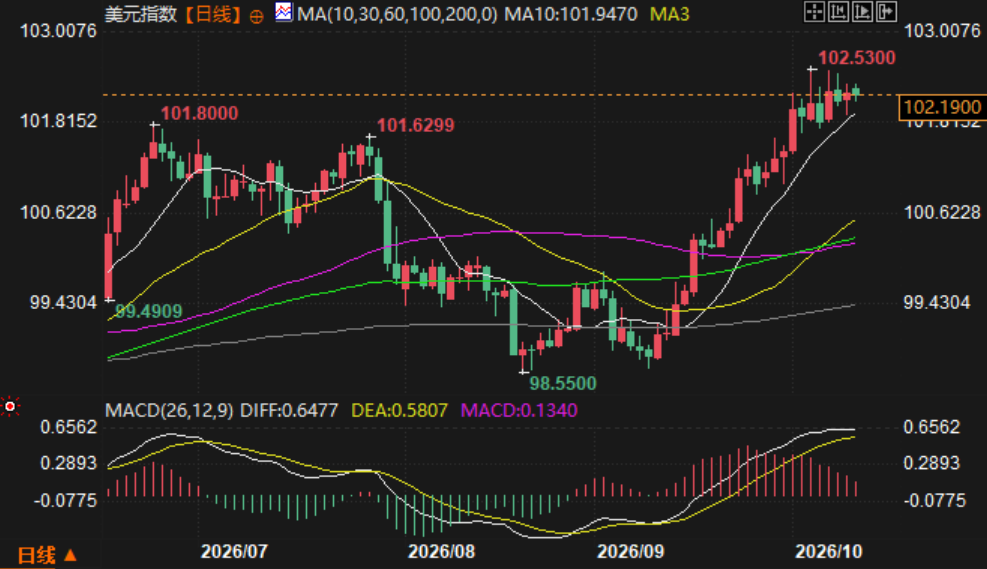 (US Dollar Index Daily Chart, Source: FX678)
Market expectations: Overall CPI will rise 0.6% month-on-month and 3.7% year-on-year.
The US September CPI will be released at 8:30 PM Beijing time on Wednesday, the last inflation report before the Federal Reserve's meeting on October 27-28. The market expects the overall CPI to rise 0.6% month-on-month, higher than August's 0.4%, pushing the annual inflation rate from 3.4% to approximately 3.7%, a four-month high. The Cleveland Fed's real-time inflation forecast points in the same direction, at approximately 0.5% month-on-month and 3.6% year-on-year. Energy is the main driver. Analysts expect energy prices to rise by about 5.5% month-on-month in September, led by gasoline, which will be the largest energy contribution since March. Gasoline prices rose more than 27% year-on-year in August. This data indicates that the energy impact of the US-Iran conflict is substantially translating into US consumer prices.Core inflation is expected to remain stable at 2.4%, diverging from overall data.
Core inflation, excluding food and energy, is expected to tell a calmer story. Forecasts point to a month-over-month increase of about 0.2%, down from 0.3% in August, keeping the annual core inflation rate at 2.4%. August's core data was boosted by a one-off jump in telephone services following a methodological change; analysts expect corrections in volatile items such as hotel prices and used car sales. Airline fares are an exception, rising as higher fuel costs are passed on to ticket prices. This divergence puts the Federal Reserve in an awkward position. Overall inflation is rising due to energy, while core inflation remains stable. The Fed needs to determine which better reflects underlying inflation trends.Fed pricing: Probability of October rate hike drops to about one in four, December still priced in.
The Federal Reserve raised its target range to 3.75%-4.00% on September 16, but after only 29,000 new non-farm payroll jobs were reported in September, the probability of a rate hike at its October 27-28 meeting dropped to about a quarter. The market is still largely pricing in a December rate hike. Goldman Sachs previously expected another rate hike in October, but this view assumed oil prices would fall back to around $85, while Brent crude remained above $100. This context implies the following for CPI data: strong core data, coupled with energy-driven overall inflation, could reignite bets on an October rate hike; weak core data would strengthen expectations of a December rate hike. The two scenarios have opposite effects on the dollar, Treasury yields, and gold.Market Response Framework: Core Data is More Important Than Overall Data
The US Treasury market may focus more on core data than overall data. A weaker core figure would benefit front-end interest rates and suppress the dollar, while a stronger core figure could reignite pricing in an October rate hike. Gold could benefit from a weaker core figure and declining yields. The core logic of this framework is that overall inflation is driven by energy, and energy prices are highly volatile; the Fed is more concerned with the potential price pressures reflected in core inflation. Therefore, the deviation of actual core data from expectations will drive market pricing more effectively than overall data.US Dollar Index and CPI
The US dollar index is currently near its highest level since April 2025, supported by high US Treasury yields and geopolitical safe-haven demand. If Wednesday's core CPI remains stable at 2.4% as expected, or even falls below expectations, it will confirm the market's dovish pricing in an October rate hike, and the dollar may face short-term downward pressure as the marginal weakening of the interest rate advantage prompts some long positions to take profits. Conversely, if the core CPI is unexpectedly strong, coupled with energy-driven overall inflation rising to 3.7%, it could reignite bets on an October rate hike, pushing US Treasury yields further upward, and the dollar index could break through previous highs. Overall, overall inflation is driven by energy, and the Federal Reserve focuses more on core data; therefore, the directional reaction of the dollar will mainly depend on the deviation of the core CPI from expectations, rather than the absolute level of the overall data. (US Dollar Index Daily Chart, Source: FX678)Follow-up focus: PPI, retail sales, and Walsh's speech
Thursday's producer prices and retail sales will add more information to the inflation picture. Federal Reserve Chairman Warsh will speak at the International Monetary Fund conference in Bangkok early Friday, his last scheduled appearance before the meeting. If Warsh's remarks express concerns about inflation, it could strengthen expectations of a rate hike; if he downplays the impact of the energy shock, it could support pricing in a rate standstill.Summarize
US September CPI is projected to show overall inflation rising to 3.7%, driven by a roughly 5.5% month-on-month increase in energy prices, while core inflation is expected to remain stable at 2.4%. This divergence presents the Federal Reserve with a dilemma: overall inflation is rising due to the energy shock, while core inflation remains stable. The market is currently pricing in about a one-in-four chance of an October rate hike, with a December rate hike still largely priced in. For the market, core data is more important than overall data—a weaker core figure would benefit front-end interest rates and suppress the dollar, which would be good for gold; a stronger core figure could reignite the pricing of an October rate hike. With Brent crude oil still above $100 and Saudi infrastructure attacks ongoing, the risks of energy-driven inflation extend far beyond this report. Warsh's speech on Friday and Thursday's PPI and retail sales data will provide further clues to policy expectations ahead of the Fed meeting. At 11:05 Beijing time, the US dollar index was at 102.17.- Risk Warning and Disclaimer
- The market involves risk, and trading may not be suitable for all investors. This article is for reference only and does not constitute personal investment advice, nor does it take into account certain users’ specific investment objectives, financial situation, or other needs. Any investment decisions made based on this information are at your own risk.