A surge in traffic to the Hormuz River coupled with tightening shipping capacity has created a new bottleneck for oil prices due to tanker shortages.
2026-10-12 12:02:18
Brent crude futures fell slightly in Asian trading on Monday (October 12), down about 1%, and are currently trading around $103 per barrel. Structural bottlenecks on the supply side are becoming a new variable in market pricing. A research report from JPMorgan Chase on October 9 pointed out that the pressure on oil prices in October came from a shortage of tankers, rather than crude oil itself. Exports from the Middle East through the Strait of Hormuz rose from about 7.5 million barrels per day in July and August to about 12 million barrels per day in September, pushing delivered crude oil prices back to spring highs. European refining margins have turned negative again, increasing the risk of refineries cutting operating rates. 
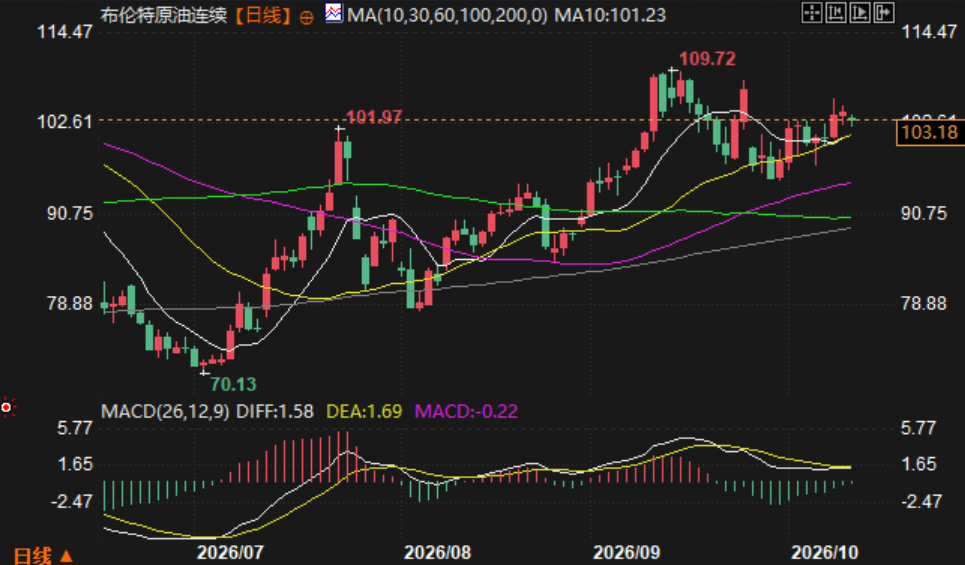 (Brent crude oil futures daily chart, source: EasyTrade) At 12:01 Beijing time, Brent crude oil futures were trading at $103.11 per barrel.
Key takeaway: The bottleneck is the ship, not the oil.
JPMorgan believes that October's oil price pressure stemmed from transportation costs and difficulties, rather than a shortage of crude oil. Delivery prices for crude oil have rebounded to spring highs, and European refining margins have fallen below zero again, increasing the risk of refineries cutting operating rates. The core of this assessment is that in the current oil market, marginal prices are set by delivery costs, not the crude oil itself. This means the gap between benchmark futures and the actual prices refineries pay may widen, with freight exposure benefiting more directly than crude oil exposure alone. Negative European refining margins increase the likelihood of operating rate cuts, which would reduce crude oil demand and potentially limit benchmark prices while delivery costs remain high.Hormuz flow surges: from 7.5 million barrels to 12 million barrels
The root of this tension can be traced back to September, when Middle Eastern producers increased their shipments through the Strait of Hormuz. Traffic rose from approximately 7.5 million barrels per day in July and August to around 12 million barrels per day in September, drawing more and more tankers to the region. By September, more than four-fifths of the world's Very Large Crude Carriers (VLCCs)—the largest class of tankers, each capable of carrying approximately 2 million barrels—were actively serving, with virtually no spare capacity. This data suggests that fleet utilization is nearing its limit, and any further increase in shipping demand will face capacity constraints.Decreased transport efficiency: ship-to-ship transfers and detour routes
JPMorgan Chase points out that the problem isn't just about the number of ships, but also their efficiency. More ships are being used for ship-to-ship transfers—moving cargo from one tanker to another at sea—a process that can take up to 10 days for a single vessel. Other ships are choosing longer routes to avoid high-risk waters. Both extend voyages and reduce the amount of cargo each tanker can handle, thus requiring more ships to transport the same amount of oil. This decline in efficiency is a structural cause of capacity constraints, not simply a shortage of ships.Sanctions tighten: 125 Iranian supertankers excluded
The sanctions have further tightened the situation. Approximately 125 Iranian Very Large Crude Carriers (VLCCs), representing about 13% of the global fleet, have been effectively excluded from mainstream markets due to US measures. Many of these vessels are anchored or adrift in the Persian Gulf or near Sri Lanka and Malaysia. This exclusion of capacity means that the effective supply of the global fleet has decreased by about 13%, exacerbating capacity shortages.Global tanker fleet tightens broadly: from regional shortages to global tensions
JPMorgan Chase estimates that transporting Middle Eastern crude oil (excluding Iranian crude) now requires an average of 35 more Very Large Crude Carriers (VLCCs), 13 more medium-sized Suezmax tankers, and 10 more smaller Aframax tankers than in 2025. As the region absorbs more of its fleet, VLCC usage in other regions has decreased by 16 vessels. Producers in the Atlantic Basin are adapting by switching to smaller vessels, with one VLCC carrying roughly the equivalent cargo of two Suezmax or three Aframax tankers. Outside the Middle East, Aframax usage is increasing by an average of approximately 140 vessels, or 23%, compared to 2025, while Suezmax usage is increasing by approximately 50 vessels, or 11%. JPMorgan Chase concludes that what was originally a regional VLCC shortage has evolved into a widespread tightening of the global tanker fleet. The unique aspect of this situation is that simply increasing crude oil production cannot alleviate the tension: without additional vessels, additional exports may exacerbate the situation. The speed of traffic in the Hormuz, rates for smaller tanker classes, and any changes in U.S. pressure on Iranian shipping could determine whether this second "April" will last as long as the first.Summarize
JPMorgan Chase points out that the oil price pressure in October stemmed from a shortage of tankers rather than a shortage of crude oil. The Hormuz flow rose from 7.5 million barrels per day in July and August to 12 million barrels per day in September, with over four-fifths of the world's Very Large Crude Carriers (VLCCs) in operation. Ship-to-ship transshipment and detours reduced transport efficiency, and approximately 125 Iranian VLCCs, equivalent to 13% of the global fleet, were excluded due to sanctions. JPMorgan estimates that transporting Middle Eastern crude oil will require an average of 35 more VLCCs, 13 more Suezmaxes, and 10 more Aframaxes than in 2025, transforming what was initially a regional shortage into a widespread tightening of the global tanker fleet. The unique aspect of this situation is that simply increasing crude oil supply cannot alleviate the tension, as the bottleneck lies in the vessels, not the crude oil itself. Crude oil delivery prices rebounded to spring highs, and European refining margins turned negative, increasing the risk of refinery cuts to operating rates, potentially limiting benchmark prices while delivery costs remain high. The duration of this tension will be determined by the speed of the Hormuz flow, smaller tanker rates, and US pressure on Iranian shipping. (Brent crude oil futures daily chart, source: EasyTrade) At 12:01 Beijing time, Brent crude oil futures were trading at $103.11 per barrel.
- Risk Warning and Disclaimer
- The market involves risk, and trading may not be suitable for all investors. This article is for reference only and does not constitute personal investment advice, nor does it take into account certain users’ specific investment objectives, financial situation, or other needs. Any investment decisions made based on this information are at your own risk.