Iran has proposed a seven-point negotiation framework, but oil transportation costs remain a key concern.
2026-10-12 15:38:19
International crude oil prices are currently fluctuating at high levels, with bullish and bearish forces balancing each other. The main contradiction in the market is no longer the crude oil production gap, but rather the continuously soaring oil shipping rates and the resulting increase in global economic operating costs, which are the most worrying risks at the macro level. The deadlock in the seven-point negotiations between the US and Iran, the Houthi attacks on Saudi Arabia posing risks to Middle Eastern shipping routes, and the anticipated ceasefire between Russia and Ukraine are all offsetting each other. Institutions such as Goldman Sachs, ING, and Capital Economics generally believe that the hidden cost impact of shipping disruptions is reshaping the logic of crude oil trade and global inflation. 
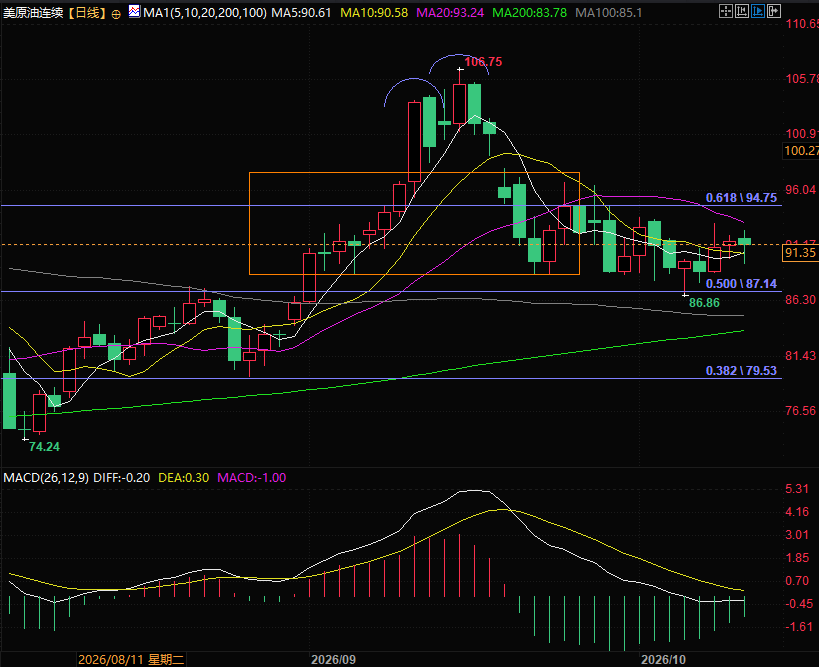 (WTI crude oil futures main contract daily chart, source: EasyTrade) At 15:34 Beijing time, the WTI crude oil futures main contract was trading at $91.18 per barrel.
Negotiations on the Strait of Hormuz stalled, geopolitical premiums continued to be priced in.
Iran, through Qatar's mediation, presented the US with a seven-point negotiation framework, promising to restore normal navigation in the Strait of Hormuz within seven days if all US demands were met. Currently, Iran states that the US response has been insufficient, negotiations have essentially stalled, and shipping across the Strait cannot return to its pre-war stable state. As a vital route for nearly 30% of global crude oil exports, the stalemate in the Strait creates a risk of resonance between the two straits, supporting the geopolitical premium in oil prices. JPMorgan Chase points out that as long as shipping in the Persian Gulf cannot return to stable and normalized operations, the market will continue to price in a risk premium; Goldman Sachs estimates that the current Brent crude oil price incorporates a geopolitical risk premium of approximately $22 per barrel, and this high premium is unlikely to fall quickly in the short term.Houthi attacks increase tail risks in the Middle East
The Houthi rebels have recently launched a series of attacks on targets within Saudi Arabia, extending their reach from Red Sea merchant ships to Saudi civilian aviation facilities, and have continued to signal a potential blockade of the Bab el-Mandeb Strait. While they have not yet directly attacked Saudi Arabia's core oil production capacity, the market is beginning to price in the tail risk of attacks on energy facilities. Goldman Sachs' commodities team warns that if attacks on Middle Eastern shipping lanes increase, WTI crude oil prices could rise to $110 per barrel; if the conflict eases, oil prices could fall back to around $70. HSBC warns that shipping lane disturbances may evolve from one-off incidents into a new market norm priced in over time.The anticipated ceasefire in the Russia-Ukraine energy conflict is acting as a hedging force for oil prices.
Market speculation is focused on a potential ceasefire in the Russia-Ukraine energy conflict. If an agreement is reached, the tail risk of damage to Russia's energy infrastructure will decrease, potentially offsetting some of the upward pressure on oil prices from Middle East geopolitical tensions. However, the agreement has not yet been formally confirmed by either Russia or Ukraine and remains merely an expectation, with a high risk of reversal. The International Energy Agency believes that a ceasefire can only eliminate tail risks on the supply side and is unlikely to bring about a large-scale increase in crude oil supply.VLCC freight rates hit a 60-year high, as transportation costs reshape pricing logic.
The maritime standoff in the Persian Gulf, coupled with a global shortage of oil tankers, has driven VLCC (Very Large Crude Carrier) freight rates to a 60-year high after adjusting for inflation. ING estimates that in September, freight rates on the Saudi-Netherlands route, converted to the equivalent of $35 per barrel of crude oil, reached a third of the Brent crude price, compared to just $2 in the same period last year. October freight rates remained extremely high. ING emphasizes that these high shipping costs are being passed down the refined product chain, continuously squeezing global refining profits. Previously, the market focused on crude oil well production, but now the cost of crude oil at the port of call is determined by both oil prices and freight rates. Even if crude oil production continues uninterrupted, the high transportation costs have become a heavy burden on the crude oil trading system.Summary and Technical Analysis:
Currently, the forces supporting oil prices are Middle East geopolitical disturbances, the tail risks of shipping lane blockades, and rising oil transportation costs. Conversely, the forces constraining oil price increases are the expectation of a ceasefire in the Russia-Ukraine energy conflict, the recovery of offshore oil production in the Gulf of Mexico, and the combined effect of high oil prices and high freight rates suppressing global oil demand, creating a negative demand feedback loop. Key areas to monitor going forward include the progress of US-Iran negotiations, the navigation status of the Bab el-Mandeb Strait and the Strait of Hormuz, the implementation of the Russia-Ukraine energy ceasefire, changes in VLCC freight rates and refining margins, and expectations regarding US inflation and Federal Reserve policy. The core focus of current oil price research is not simply judging whether oil prices will rise or fall, but rather assessing the impact on global inflation. Oil prices are likely to remain range-bound, but persistently high oil transportation costs continue to increase global economic operating costs. Even if the rise in spot crude oil prices slows, end-user oil costs are unlikely to fall, significantly increasing downward pressure on inflation. If Middle East geopolitical conflicts recur, freight rates and insurance premiums will continue to rise, continuously injecting cost pressures into production and consumption, which is the most critical hidden risk in the current macroeconomic market. Technical Analysis: WTI crude oil futures are still oscillating within the 87-95 range, awaiting a directional move. (WTI crude oil futures main contract daily chart, source: EasyTrade) At 15:34 Beijing time, the WTI crude oil futures main contract was trading at $91.18 per barrel.
- Risk Warning and Disclaimer
- The market involves risk, and trading may not be suitable for all investors. This article is for reference only and does not constitute personal investment advice, nor does it take into account certain users’ specific investment objectives, financial situation, or other needs. Any investment decisions made based on this information are at your own risk.