The divergence between the US dollar index and the correlation with short-term US Treasury yields continues to show resilience.
2026-10-12 14:48:19
The US dollar faces a week packed with economic data releases, with key indicators such as CPI, PPI, and retail sales figures to be released on Wednesday and Thursday. While these figures are the core focus of market attention, a more noteworthy phenomenon is the sudden breakdown in the correlation between the US dollar and US short-term Treasury yields. For most of this year, the two maintained a positive correlation, but since October, the correlation has deteriorated sharply. Even with some pullback after the sharp rise in US Treasury yields in September and a cooling of market expectations for further tightening of monetary policy by the Federal Reserve, the US dollar has maintained its strength. If it weren't for renewed concerns about French public finances dragging down the euro, the current price level of the US dollar would likely be significantly lower. With multiple variables intertwined, this week's macroeconomic data and developments in the European debt market will jointly determine the future direction of the US dollar index.
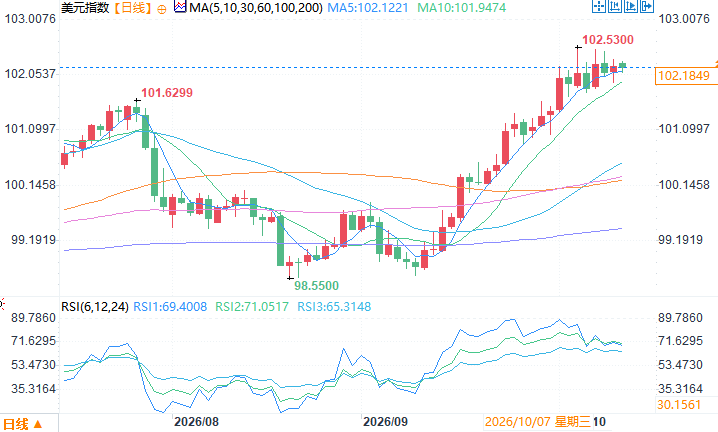 US Dollar Index Daily Chart Source: EasyForex
 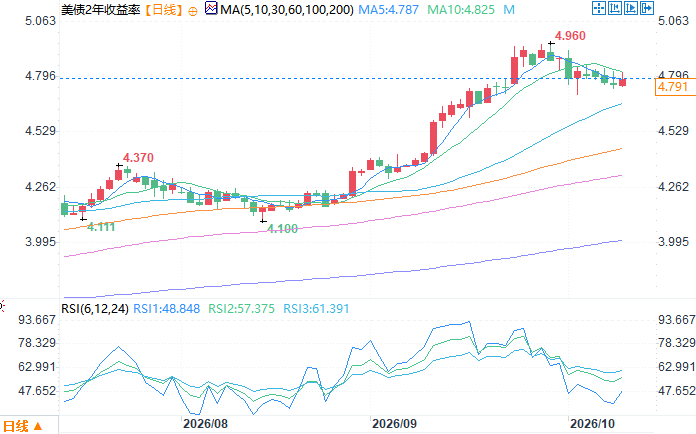 The daily chart of the 2-year US Treasury yield. Source: EasyTrade. At 14:46 Beijing time on October 12, the US dollar index was at 102.18.
The correlation between the US dollar index and US Treasury yields has weakened significantly.
The weakening correlation between the US dollar index and US short-term Treasury yields is clearly reflected in relevant statistics. At the end of September, the 10-period rolling correlation coefficient between the US dollar index and the US two-year Treasury yield was +0.66, and the 20-period rolling correlation coefficient was +0.55. By the end of last week, both figures had fallen back to -0.39 and +0.19, respectively. Similar changes were observed in the middle segments of the five-year Treasury yield curve, indicating that this divergence is not limited to short-term bonds. Since the end of September, the US dollar index has risen by approximately 0.75%, while the two-year Treasury yield has fallen by 9.6 basis points and the five-year Treasury yield has fallen by 6.8 basis points. The dollar's strength against the backdrop of declining yields has broken previous trading patterns.The cooling of expectations for a Fed rate hike and the weakening of the euro have supported the resilience of the dollar.
Earlier this month, weaker-than-expected US non-farm payroll data, coupled with signals from several Federal Reserve officials, offset market expectations of another rate hike in October, leading to a downward adjustment in market pricing for further monetary tightening. Data shows that the cumulative rate hike expectation by the end of next year has fallen from slightly above 100 basis points in mid-September to approximately 80 basis points. If the dollar continues its positive correlation with short-term US Treasury yields from earlier this year, it should weaken in the current environment. However, exchange rate movements are not solely determined by domestic US factors. Renewed market concerns about French public finances and the potential spillover of risks to other European sovereign bond markets, coupled with rising energy prices, have continued to weigh on the euro. With the euro accounting for 57.6% of the dollar index, its continued weakness is the core reason why the dollar has remained resilient amidst falling US Treasury yields and cooling rate hike expectations.CPI data causes volatility, but it's difficult to pinpoint the exact direction of the US dollar.
This week sees a large release of US economic data, but historical data analysis makes it difficult to predict the dollar's trend. A review of market performance following 188 CPI releases since 2011 reveals that dollar volatility typically increases on the day inflation data is released, but there's no stable pattern, making it impossible to determine whether the trend will continue or reverse. This means that traders must not only closely monitor upcoming US economic data, but also pay close attention to the dynamics of the European bond market, whose influence on the dollar's subsequent performance is comparable to that of US domestic inflation data.Conclusion
Overall, the US dollar faces multiple tests this data week. The divergence between US Treasury yields and the dollar's movement reveals that the core driver of the current dollar strength comes from the weakness of the euro, rather than expectations of US interest rate hikes. The upcoming CPI data will amplify short-term volatility, but it's unlikely to immediately trigger a one-sided trend. Investors need to observe two fronts: closely monitoring US inflation and retail sales data, and continuously tracking risks in the European sovereign debt market. Changes in these two sectors will jointly determine whether the dollar index can achieve an upward breakout. US Dollar Index Daily Chart Source: EasyForex The daily chart of the 2-year US Treasury yield. Source: EasyTrade. At 14:46 Beijing time on October 12, the US dollar index was at 102.18.- Risk Warning and Disclaimer
- The market involves risk, and trading may not be suitable for all investors. This article is for reference only and does not constitute personal investment advice, nor does it take into account certain users’ specific investment objectives, financial situation, or other needs. Any investment decisions made based on this information are at your own risk.