The triangular game between the US Treasury bond strike zone, the cooling of AI narratives, and the strong dollar.
2026-10-12 17:48:21
On Monday (October 12), international gold prices rebounded but then fluctuated downwards, currently trading around 4172. Price action is primarily driven by three main factors: bargain hunting in the long-term US Treasury market, a market reassessment of AI's impact on US GDP growth falling short of expectations, and the interplay of changes in the US dollar index. These multiple macroeconomic factors are converging, limiting the short-term upside potential for gold prices, but medium- to long-term support factors are gradually accumulating. 
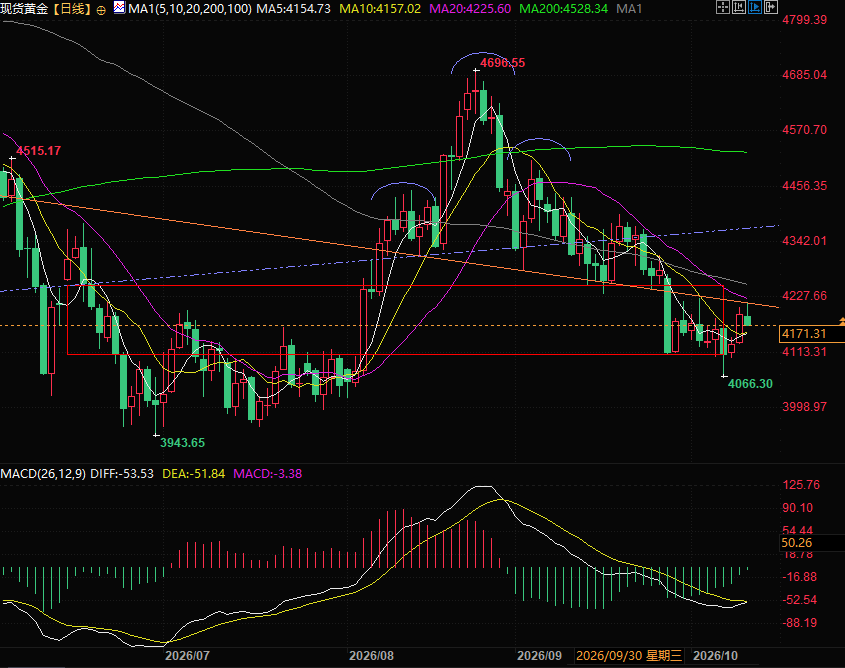 (Spot gold daily chart, source: EasyTrade) At 17:46 Beijing time, spot gold is currently trading at $4170 per ounce.
Long-term bonds saw bargain hunting, but high yields remain the biggest constraint on gold prices.
Following a round of panic selling in the global bond market, the risk-free yield on US Treasuries has risen above 5%, prompting some funds to buy long-term Treasury bonds at lower prices. Recent auction data for 10-year and 30-year US Treasury bonds confirms this trend: bid-to-cover ratios for both tranches reached new highs, while the allocation ratio for primary dealers fell to a historical low. This indicates that end-user funds (investment funds, overseas institutions, etc.) are actively entering the market to buy bonds, and primary dealers no longer need to underwrite them, suggesting a temporary end to the panic selling of long-term bonds. However, this does not mean the pressure on gold has been completely relieved. Gold is a non-interest-bearing asset, and the continued high yields on long-term US Treasuries will continue to increase the opportunity cost of holding gold. As long as long-term bond yields remain high for an extended period, it will be difficult for gold prices to experience a sustained and significant rebound; the high-interest-rate environment remains the core constraint suppressing gold price increases.AI growth expectations revised, divergence in risk assets conceals a liquidity trap.
Previously, the market was highly optimistic, betting that AI capital expenditure would continue to boost US GDP and significantly improve total factor productivity. However, as data has been continuously validated, the market has gradually realized that the current economic stimulus from AI comes only from the massive capital investment in computing power and data centers. The expected productivity dividend has failed to materialize, and the AI growth narrative has begun to cool. This shift in expectations has provided some support for gold prices. Currently, risk assets are showing a clear divergence: the Nasdaq has rebounded in stages thanks to AI leaders, but equity markets in many global economies continue to weaken. It is crucial to be wary here: AI underperformance does not necessarily mean an immediate unilateral rise in gold prices. Once the market collectively lowers its earnings expectations for technology companies, a panic correction will occur in the equity market, and short-term liquidity will contract rapidly. During a liquidity crisis, gold will be sold off along with stocks, exhibiting a "liquidity first, safe-haven later" characteristic. Only after the liquidity shock subsides will recession expectations become the main theme, benefiting gold.Multiple risks are weighing on the euro, indirectly pushing up the dollar and limiting the safe-haven appeal of gold.
The ongoing conflict between Russia and Ukraine, the situation in Iran, and the Houthi rebels in the Red Sea should theoretically give gold a safe-haven premium. However, the core pricing instrument for this round of geopolitical events is not gold, but crude oil. Geopolitical tensions are pushing up oil prices, increasing global production costs, further strengthening inflation stickiness, forcing the Federal Reserve to maintain high interest rates, which in turn supports a strong US dollar index. Besides the geopolitical situation in the Middle East and Eastern Europe, internal risks within the Eurozone also warrant attention: the legacy of the European debt crisis has not been fully eliminated, coupled with the ongoing governance crisis in France, raising market concerns about the fiscal and political stability of the Eurozone and dragging down the euro exchange rate. The euro is the currency with the highest weighting in the US dollar index; a weaker euro will directly contribute to a stronger dollar. Gold is priced in US dollars, and a strong dollar will directly weaken the rebound momentum of gold prices. Even if geopolitical risks continue to escalate, with the dollar remaining strong, gold will struggle to fully realize its safe-haven appeal, and its upside potential will be continuously constrained.The medium- to long-term logic is gradually taking shape, awaiting recession expectations to dominate the market.
Looking at the longer term, multiple factors are gradually accumulating long-term investment value for gold. On the one hand, high oil prices due to geopolitical conflicts continue to increase business operating costs; on the other hand, the expansion of AI computing power is driving up the prices of resources such as electricity, coupled with high interest rates continuing to erode corporate profits, gradually revealing the pressure on corporate profitability. As the market focus shifts from "high inflation and high growth" to expectations of economic recession, and the period of tightening liquidity gradually passes, gold's safe-haven and value-preserving value will be fully realized.Summary and Technical Analysis:
Gold prices remain in a consolidation phase in the short term, with high US Treasury yields, a strong dollar, and potential liquidity risks limiting the potential for a rebound. Declining AI expectations, geopolitically driven energy inflation, and uncertainties within the Eurozone provide medium- to long-term support for gold. The key focus going forward is the US CPI data; its strength will directly determine how long the market expects high US Treasury yields to be sustained. If inflation rebounds again, long-term yields are likely to rise further, putting pressure on gold prices. If inflation steadily declines, the market will price in lower interest rates in advance, opening up room for a gold price rebound. A significant trend-driven opportunity for gold requires waiting for the damage of high interest rates to the real economy to fully materialize and for recession expectations to become the dominant market theme. Technically, spot gold rebounded from the bottom of its trading range, then touched the neckline of a head and shoulders pattern before pulling back. Currently, it is consolidating around the trading range, with bulls and bears battling it out. (Spot gold daily chart, source: EasyTrade) At 17:46 Beijing time, spot gold is currently trading at $4170 per ounce.
- Risk Warning and Disclaimer
- The market involves risk, and trading may not be suitable for all investors. This article is for reference only and does not constitute personal investment advice, nor does it take into account certain users’ specific investment objectives, financial situation, or other needs. Any investment decisions made based on this information are at your own risk.