Crude oil trading alert: Geopolitical premiums and supply repatriation are at play, with short-term price action expected to fluctuate around $93.
2026-10-13 09:42:18
WTI crude oil prices edged lower in Asian trading on Tuesday, trading around $92.90 per barrel, continuing its recent pattern of high-level consolidation. Brent crude oil prices rose in tandem, trading above $100. After experiencing significant volatility in the previous period, oil prices are currently in a state of equilibrium amid intense competition between bullish and bearish factors.  Geopolitical tensions remain a core factor supporting oil prices. The Houthi rebels in Yemen recently attacked Riyadh Airport, the Saudi capital, and warned that all airports and airspace in Saudi Arabia, except for Mecca and Medina, are unsafe. Meanwhile, attacks on oil tankers in the Gulf of Oman have been frequent, escalating the navigational risks in the Strait of Hormuz. Kpler data shows that only seven oil tankers passed through the Strait of Hormuz on October 6, the lowest level since July 23. IMF Managing Director Kristalina Georgieva warned that even if the Gulf conflict ends quickly, high oil prices could persist for some time due to high transportation costs and insufficient global refining capacity. However, potential supply repatriation is putting downward pressure on oil prices. US President Trump announced that the US and Russia have reached an agreement on diesel supply, with Russia immediately supplying more than 300,000 tons of diesel to the global market, increasing to 500,000 tons in November, and further increasing by 1 million to 3 million tons. Russian Deputy Prime Minister Novak confirmed that Russia has issued an order to partially lift the ban on diesel exports, expecting to export 3 million to 3.5 million tons of diesel per month by the end of 2026, returning to pre-crisis levels. Furthermore, the US and Iran are discussing a phased agreement to reopen the Strait of Hormuz; substantial progress in negotiations would significantly alleviate market concerns about supply disruptions. Regarding inventory data, the market is awaiting guidance from the API crude oil inventory report. Preliminary surveys indicate that US crude oil inventories are expected to increase by approximately 1.9 million barrels in the week ending October 9, while refined product inventories may decline. Previously, EIA data showed that commercial crude oil inventories unexpectedly decreased by 3.2 million barrels to 424.1 million barrels in the week ending October 2, with refinery utilization rising to 92.7%, indicating resilient demand. It is worth noting that the US Strategic Petroleum Reserve has fallen to its lowest level since 1982, significantly shrinking the domestic energy buffer, which structurally provides a floor for oil prices. Goldman Sachs recently raised its December Brent crude oil price forecast by $5 to $90 per barrel, noting that the current risk premium in oil prices has reached $22 per barrel, second only to the historical peak in April of this year. The bank emphasized that the West has little remaining inventory to consume, and if shipping through the Strait of Hormuz is disrupted, there is an extreme upside risk to oil prices. From a technical perspective, the WTI crude oil daily chart presents a neutral-to-strong pattern. Prices are trading above the Bollinger Band middle line ($91.60) and have held above the 100-day simple moving average, indicating that the medium-term uptrend structure remains intact. The 14-day RSI reading is around 54, in neutral territory, significantly cooling from the overbought state at the end of September, indicating that short-term momentum is approaching equilibrium. The upper Bollinger Band is around $96.70, forming the main resistance level; the lower band, around $86.50, is a potential buying area during a deep pullback. As long as prices remain above $91.60, the pullback is expected to be limited; a decisive break above $96.70 could lead to a retest of previous highs. From the 4-hour chart, oil prices are fluctuating widely within the $90-$95 range, with short-term moving averages intertwined, making the direction unclear. The MACD indicator is hovering around the zero line, with alternating red and green bars, reflecting a temporary balance between bullish and bearish forces. If the price can break through $93.5 with significant volume, the short-term rebound is likely to continue; conversely, if it falls below the $90 level, it may test support at $88.5 or even $87.
 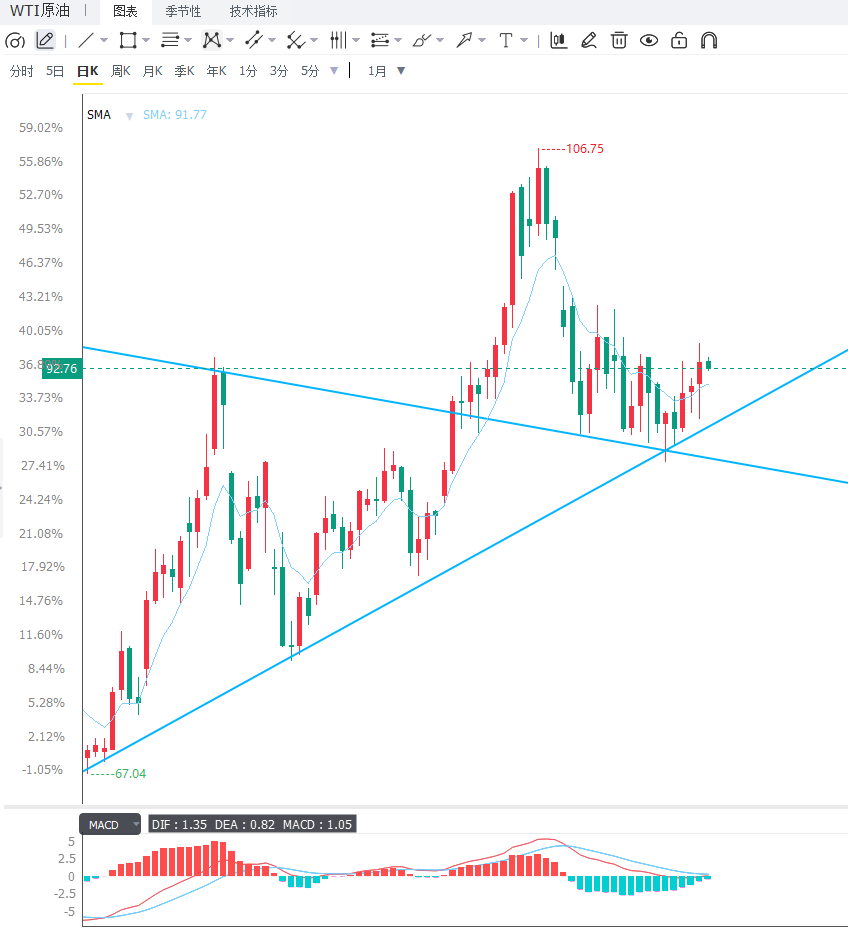 The editor summarizes that WTI crude oil is currently caught in a tug-of-war between "geopolitical risk premium" and "supply repatriation expectations." The Houthi attacks on Saudi facilities, the risk of disruption to navigation in the Strait of Hormuz, and historically low US strategic reserves provide solid support for oil prices; however, the US-Russia diesel supply agreement, the conciliatory signals from US-Iran negotiations, and expectations of a potential increase in API inventories limit the upside potential. Technically, prices have stabilized above key moving average support, and the RSI is neutral to slightly bullish, suggesting a short-term bias towards high-level consolidation. Watch whether the $91.60 support level holds; if it holds, a move towards the $96.70 resistance level is possible; a break below this level could lead to a pullback towards $86.50. Close attention should be paid to API inventory data, the progress of US-Iran negotiations, and the situation regarding navigation in the Strait of Hormuz, as these factors will directly influence the short-term direction of oil prices.
Geopolitical tensions remain a core factor supporting oil prices. The Houthi rebels in Yemen recently attacked Riyadh Airport, the Saudi capital, and warned that all airports and airspace in Saudi Arabia, except for Mecca and Medina, are unsafe. Meanwhile, attacks on oil tankers in the Gulf of Oman have been frequent, escalating the navigational risks in the Strait of Hormuz. Kpler data shows that only seven oil tankers passed through the Strait of Hormuz on October 6, the lowest level since July 23. IMF Managing Director Kristalina Georgieva warned that even if the Gulf conflict ends quickly, high oil prices could persist for some time due to high transportation costs and insufficient global refining capacity. However, potential supply repatriation is putting downward pressure on oil prices. US President Trump announced that the US and Russia have reached an agreement on diesel supply, with Russia immediately supplying more than 300,000 tons of diesel to the global market, increasing to 500,000 tons in November, and further increasing by 1 million to 3 million tons. Russian Deputy Prime Minister Novak confirmed that Russia has issued an order to partially lift the ban on diesel exports, expecting to export 3 million to 3.5 million tons of diesel per month by the end of 2026, returning to pre-crisis levels. Furthermore, the US and Iran are discussing a phased agreement to reopen the Strait of Hormuz; substantial progress in negotiations would significantly alleviate market concerns about supply disruptions. Regarding inventory data, the market is awaiting guidance from the API crude oil inventory report. Preliminary surveys indicate that US crude oil inventories are expected to increase by approximately 1.9 million barrels in the week ending October 9, while refined product inventories may decline. Previously, EIA data showed that commercial crude oil inventories unexpectedly decreased by 3.2 million barrels to 424.1 million barrels in the week ending October 2, with refinery utilization rising to 92.7%, indicating resilient demand. It is worth noting that the US Strategic Petroleum Reserve has fallen to its lowest level since 1982, significantly shrinking the domestic energy buffer, which structurally provides a floor for oil prices. Goldman Sachs recently raised its December Brent crude oil price forecast by $5 to $90 per barrel, noting that the current risk premium in oil prices has reached $22 per barrel, second only to the historical peak in April of this year. The bank emphasized that the West has little remaining inventory to consume, and if shipping through the Strait of Hormuz is disrupted, there is an extreme upside risk to oil prices. From a technical perspective, the WTI crude oil daily chart presents a neutral-to-strong pattern. Prices are trading above the Bollinger Band middle line ($91.60) and have held above the 100-day simple moving average, indicating that the medium-term uptrend structure remains intact. The 14-day RSI reading is around 54, in neutral territory, significantly cooling from the overbought state at the end of September, indicating that short-term momentum is approaching equilibrium. The upper Bollinger Band is around $96.70, forming the main resistance level; the lower band, around $86.50, is a potential buying area during a deep pullback. As long as prices remain above $91.60, the pullback is expected to be limited; a decisive break above $96.70 could lead to a retest of previous highs. From the 4-hour chart, oil prices are fluctuating widely within the $90-$95 range, with short-term moving averages intertwined, making the direction unclear. The MACD indicator is hovering around the zero line, with alternating red and green bars, reflecting a temporary balance between bullish and bearish forces. If the price can break through $93.5 with significant volume, the short-term rebound is likely to continue; conversely, if it falls below the $90 level, it may test support at $88.5 or even $87. The editor summarizes that WTI crude oil is currently caught in a tug-of-war between "geopolitical risk premium" and "supply repatriation expectations." The Houthi attacks on Saudi facilities, the risk of disruption to navigation in the Strait of Hormuz, and historically low US strategic reserves provide solid support for oil prices; however, the US-Russia diesel supply agreement, the conciliatory signals from US-Iran negotiations, and expectations of a potential increase in API inventories limit the upside potential. Technically, prices have stabilized above key moving average support, and the RSI is neutral to slightly bullish, suggesting a short-term bias towards high-level consolidation. Watch whether the $91.60 support level holds; if it holds, a move towards the $96.70 resistance level is possible; a break below this level could lead to a pullback towards $86.50. Close attention should be paid to API inventory data, the progress of US-Iran negotiations, and the situation regarding navigation in the Strait of Hormuz, as these factors will directly influence the short-term direction of oil prices.
- Risk Warning and Disclaimer
- The market involves risk, and trading may not be suitable for all investors. This article is for reference only and does not constitute personal investment advice, nor does it take into account certain users’ specific investment objectives, financial situation, or other needs. Any investment decisions made based on this information are at your own risk.