Japan's September PPI fell, but expectations of an interest rate hike remained, causing the USD/JPY exchange rate to decline slightly.
2026-10-13 15:12:18
The USD/JPY exchange rate fell sharply during Asian trading hours on Tuesday, trading around 158.25. The direct trigger for the yen's strength was the Bank of Japan's September corporate price index, released on Tuesday—up 6.8% year-on-year and down 0.3% month-on-month, both below market expectations. Although the year-on-year increase slowed from August's 7.6%, the yen-denominated import price index surged 24.5% year-on-year, with chemical products rising 13.3%, plastic products 12.8%, and non-ferrous metal products soaring 40.2%, reflecting that the yen's depreciation and Middle East geopolitical risks have jointly pushed up raw material costs. Sompo Research Institute senior economist Rihito Koike stated that the Middle East conflict has brought high uncertainty, international oil prices remain high, and wholesale inflation may accelerate again. 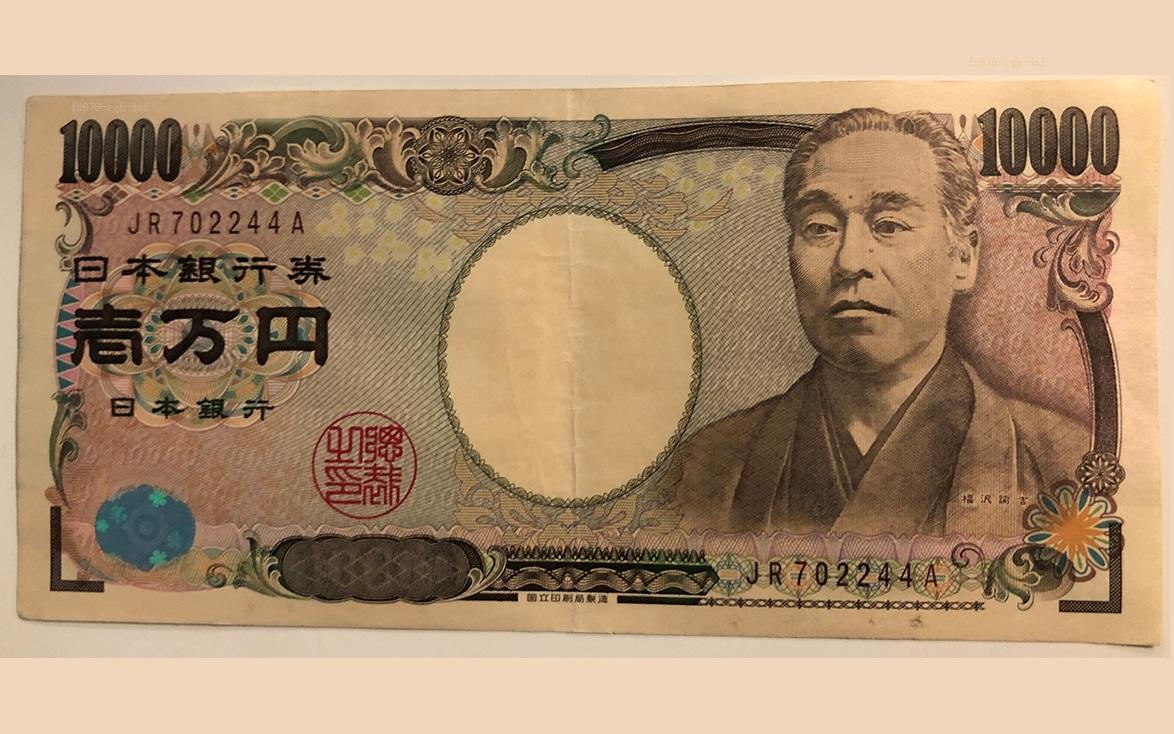 The market's pricing in the Bank of Japan's (BOJ) interest rate hike path has not reversed despite the decline in PPI. The BOJ has already raised interest rates twice this year, in June and September. Governor Kazuo Ueda previously stated that financial conditions remain accommodative and underlying inflation is gradually approaching the 2% target. The BOJ may signal at its policy meeting on October 29-30 that underlying inflation has essentially reached the 2% target, paving the way for another rate hike in the coming months. Most analysts expect the next rate hike window to fall in December, with the market betting on a probability exceeding 80%. The latest IMF report also points out that the BOJ may still gradually raise interest rates, bringing them closer to a neutral level. The support logic for the US dollar remains intact. Cleveland Fed President Hamack delivered a hawkish speech on Monday, stating that US interest rates need further increases, favoring a "smaller, more frequent" approach, and warning that companies planning price increases exceeding input cost increases is an early sign of a solidified "inflationary mindset." The FXS Fed Sentiment Index rose to 138.92, clearly within the hawkish range. CME FedWatch shows that the probability of the Federal Reserve keeping interest rates unchanged in October is close to 80%, but the probability of a 25 basis point rate hike in December has risen to 70.3%. Furthermore, the escalating situation in the Middle East—with the Houthi rebels launching multiple attacks on Saudi Arabia and increased shipping risks in the Strait of Hormuz—continues to drive safe-haven funds towards dollar assets. However, the exchange rate faces significant resistance in the 159.50 to 160.00 range. Back in April, after the exchange rate broke through 160.72, Japanese authorities intervened with approximately $34.5 billion, and Finance Minister Katsunobu Kato recently reiterated that Japan is prepared to deal with excessive foreign exchange volatility. This asymmetric risk of "triggering intervention alerts when approaching 160" makes it difficult for bulls to push the exchange rate higher above this range. The market also remains cautious ahead of Wednesday's release of the US September CPI data, with analysts expecting overall CPI year-on-year to rise from 3.4% in August to 3.6% to 3.7%, and core CPI year-on-year to rise from 2.4% to 2.5%. From a technical perspective, the USD/JPY pair remains in a consolidation phase at high levels after a continuous rise on the daily chart. The pair closed at 158.68 in the previous trading session, holding steadily above the 20-day moving average (approximately 158.11) and the 50-day moving average (approximately 158.75), maintaining a healthy bullish structure. However, the 100-day moving average, located in the area of approximately 157.55 to 159.50 (the exact range may vary depending on the data source), constitutes a key resistance level. A decisive break above this level is needed to confirm the continuation of the bullish trend. The RSI is in the neutral-to-strong zone around 54, not yet reaching extreme overbought territory, while the MACD histogram is narrowing, indicating a weakening of upward momentum. On the 4-hour chart, the pair quickly retreated from the high of 158.68 to 158.11, and the short-term moving average system shows signs of a death cross, leaving the direction unclear. The first resistance levels to watch are 158.75 (50-day moving average) and 159.10 (upper Bollinger Band), with stronger resistance in the 159.50 to 160.00 warning zone. On the downside, the first support level to watch is the psychological level of 158.00. A break below this level would test 157.65 (middle Bollinger Band) and 157.55 (100-day moving average), with stronger support at 156.25 (lower Bollinger Band).
 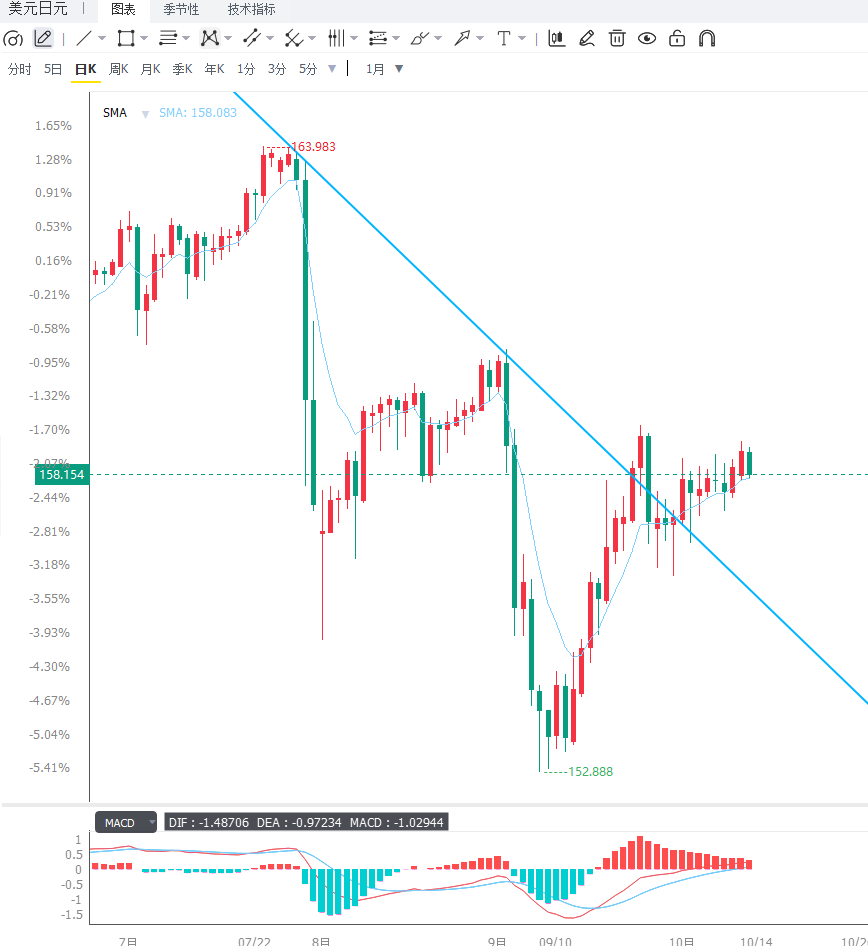 Editor's Summary: The USD/JPY pair is currently caught in a tug-of-war between "USD-JPY interest rate differential supporting the dollar" and "BOJ rate hike expectations + intervention concerns suppressing the exchange rate." While Japan's September PPI unexpectedly declined, soaring import costs and widespread price increases in core commodities still support rate hike expectations, with a greater than 80% probability of another rate hike in December. The dollar remains strong due to the Fed's hawkish stance and safe-haven demand from the Middle East, but Wednesday's US CPI data will be a key variable—if core inflation is stronger than expected, it could reignite bets on an October rate hike, potentially pushing the exchange rate up to test the 159.10-159.50 resistance zone; if the data is weak, the dollar may face profit-taking, and the exchange rate could retrace to the 158.00-157.65 support zone. Furthermore, the risk of Japanese intervention in the 159.50-160.00 area remains the biggest uncertainty for the bulls, requiring vigilance against sudden intervention that could trigger sharp fluctuations. Until the 158.00 support is effectively broken, the overall structure will likely remain one of high-level consolidation, awaiting a breakout in the CPI data.
The market's pricing in the Bank of Japan's (BOJ) interest rate hike path has not reversed despite the decline in PPI. The BOJ has already raised interest rates twice this year, in June and September. Governor Kazuo Ueda previously stated that financial conditions remain accommodative and underlying inflation is gradually approaching the 2% target. The BOJ may signal at its policy meeting on October 29-30 that underlying inflation has essentially reached the 2% target, paving the way for another rate hike in the coming months. Most analysts expect the next rate hike window to fall in December, with the market betting on a probability exceeding 80%. The latest IMF report also points out that the BOJ may still gradually raise interest rates, bringing them closer to a neutral level. The support logic for the US dollar remains intact. Cleveland Fed President Hamack delivered a hawkish speech on Monday, stating that US interest rates need further increases, favoring a "smaller, more frequent" approach, and warning that companies planning price increases exceeding input cost increases is an early sign of a solidified "inflationary mindset." The FXS Fed Sentiment Index rose to 138.92, clearly within the hawkish range. CME FedWatch shows that the probability of the Federal Reserve keeping interest rates unchanged in October is close to 80%, but the probability of a 25 basis point rate hike in December has risen to 70.3%. Furthermore, the escalating situation in the Middle East—with the Houthi rebels launching multiple attacks on Saudi Arabia and increased shipping risks in the Strait of Hormuz—continues to drive safe-haven funds towards dollar assets. However, the exchange rate faces significant resistance in the 159.50 to 160.00 range. Back in April, after the exchange rate broke through 160.72, Japanese authorities intervened with approximately $34.5 billion, and Finance Minister Katsunobu Kato recently reiterated that Japan is prepared to deal with excessive foreign exchange volatility. This asymmetric risk of "triggering intervention alerts when approaching 160" makes it difficult for bulls to push the exchange rate higher above this range. The market also remains cautious ahead of Wednesday's release of the US September CPI data, with analysts expecting overall CPI year-on-year to rise from 3.4% in August to 3.6% to 3.7%, and core CPI year-on-year to rise from 2.4% to 2.5%. From a technical perspective, the USD/JPY pair remains in a consolidation phase at high levels after a continuous rise on the daily chart. The pair closed at 158.68 in the previous trading session, holding steadily above the 20-day moving average (approximately 158.11) and the 50-day moving average (approximately 158.75), maintaining a healthy bullish structure. However, the 100-day moving average, located in the area of approximately 157.55 to 159.50 (the exact range may vary depending on the data source), constitutes a key resistance level. A decisive break above this level is needed to confirm the continuation of the bullish trend. The RSI is in the neutral-to-strong zone around 54, not yet reaching extreme overbought territory, while the MACD histogram is narrowing, indicating a weakening of upward momentum. On the 4-hour chart, the pair quickly retreated from the high of 158.68 to 158.11, and the short-term moving average system shows signs of a death cross, leaving the direction unclear. The first resistance levels to watch are 158.75 (50-day moving average) and 159.10 (upper Bollinger Band), with stronger resistance in the 159.50 to 160.00 warning zone. On the downside, the first support level to watch is the psychological level of 158.00. A break below this level would test 157.65 (middle Bollinger Band) and 157.55 (100-day moving average), with stronger support at 156.25 (lower Bollinger Band). Editor's Summary: The USD/JPY pair is currently caught in a tug-of-war between "USD-JPY interest rate differential supporting the dollar" and "BOJ rate hike expectations + intervention concerns suppressing the exchange rate." While Japan's September PPI unexpectedly declined, soaring import costs and widespread price increases in core commodities still support rate hike expectations, with a greater than 80% probability of another rate hike in December. The dollar remains strong due to the Fed's hawkish stance and safe-haven demand from the Middle East, but Wednesday's US CPI data will be a key variable—if core inflation is stronger than expected, it could reignite bets on an October rate hike, potentially pushing the exchange rate up to test the 159.10-159.50 resistance zone; if the data is weak, the dollar may face profit-taking, and the exchange rate could retrace to the 158.00-157.65 support zone. Furthermore, the risk of Japanese intervention in the 159.50-160.00 area remains the biggest uncertainty for the bulls, requiring vigilance against sudden intervention that could trigger sharp fluctuations. Until the 158.00 support is effectively broken, the overall structure will likely remain one of high-level consolidation, awaiting a breakout in the CPI data.
- Risk Warning and Disclaimer
- The market involves risk, and trading may not be suitable for all investors. This article is for reference only and does not constitute personal investment advice, nor does it take into account certain users’ specific investment objectives, financial situation, or other needs. Any investment decisions made based on this information are at your own risk.