Russian diesel prices are expected to provide some respite, with multiple institutions offering their views on oil prices.
2026-10-13 16:50:19
Oil prices retreated slightly from their highs on Tuesday (October 13). WTI crude futures, which had broken through $94 in the previous trading session, were currently trading at $92.14. Traders are weighing the marginal easing from increased Russian diesel supply while continuing to assess potential risks to West Asian energy infrastructure and maritime shipping. Despite the ongoing Houthi attacks and the Hormuz attack on a ship, the market has lowered the extreme probability of a complete supply disruption across the Straits. Coupled with expectations of improved refined product supply following the US-Russia diesel agreement, the previously accumulated geopolitical risk premium has been retraced, prompting this round of price correction. However, the underlying fundamentals have not reversed; low global inventories and a structurally tight diesel balance continue to provide support for oil prices. 
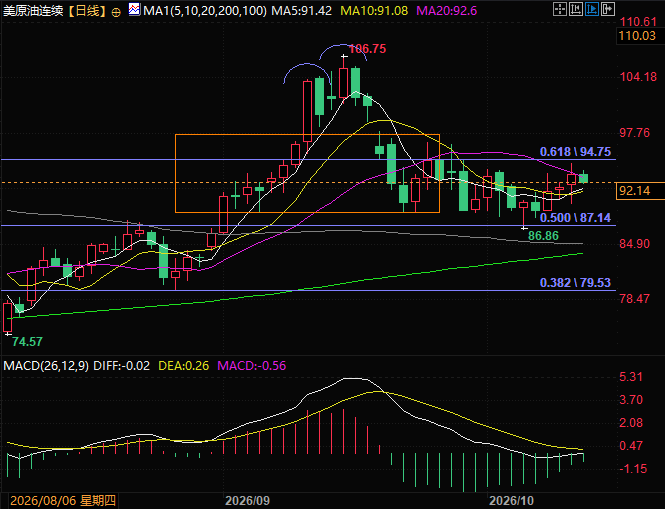 (WTI crude oil futures contract daily chart, source: EasyTrade) At 16:45 Beijing time, WTI crude oil futures contract daily chart is currently trading at $92.17 per barrel.
Soaring shipping costs are reshaping the pricing logic of physical goods through insurance and freight rates.
The Strait of Hormuz, a global energy chokepoint, has recently seen multiple attacks on merchant ships, prompting the UKMTO to issue continuous high-risk navigation warnings. Impacted by these risks, a large number of empty VLCCs are choosing to bypass the Persian Gulf, reducing the efficiency of the Fujairah port's crude oil transshipment system and putting continued pressure on Gulf crude oil export capacity. War risk premiums and tanker freight rates on Gulf routes have surged. At its Riyadh meeting, OPEC+ pointed out that current shipping and insurance costs have reached historical highs, with some voyages incurring costs exceeding one-third of the crude oil's value. These high logistics costs are passed down through the supply chain, simultaneously increasing the burden on oil-producing countries and refineries, and pushing up global inflation. Qatar's latest crude oil OSP (off-the-board premium) is significantly discounted (the price of oil at the point of local loading is drastically reduced), reflecting oil-producing countries' efforts to hedge against Strait risks and compete for long-term Asian contracts; the actual cost to refineries at the port of call has not decreased significantly.Global crude oil buffer inventories are at low levels, significantly reducing the resilience of the safety cushion.
Global commercial crude oil inventories are low, leaving a weak safety cushion. If shipping lanes or facilities are damaged, the upward potential for oil prices will be significantly amplified. Saudi Arabia is accelerating pipeline diversification, planning to increase pipeline export capacity to 10 million barrels per day in the medium to long term to reduce reliance on the Strait of Hormuz. However, this capacity is a medium- to long-term plan and cannot address short-term geopolitical shocks.The tight balance of refined oil products has become the core source of pressure, and the diesel crack spread remains firm.
Compared to crude oil, the structural shortage in the diesel market is key to supporting oil prices. Goldman Sachs analyst Eamonn Sheridan believes that diesel is under the greatest pressure in this round of energy shocks. Increased Russian diesel supply can only provide temporary relief and is unlikely to completely reverse the tight global middle distillate balance. The bank estimates that if Europe releases 50 million barrels of strategic reserves, wholesale diesel prices in the US Gulf Coast and Europe could drop by $11 per barrel, but this scenario is only a hypothetical simulation and has not yet materialized. Goldman Sachs judges that the tight supply of refined oil products is likely to continue until 2027, and high crack spreads will support refinery operations and crude oil procurement demand. ING strategists Warren Patterson and Ewa Manthey added that the market is currently trading on two main themes: Middle East shipping risks are bullish for oil prices, but the US-Russia diesel agreement and the expectation of a ceasefire in the Russia-Ukraine energy conflict are suppressing refined oil crack margins. Even if the Middle East conflict continues, if Persian Gulf crude oil flows normally, the upside potential for oil prices is limited; after Brent crude reached $100 per barrel, the risk-reward ratio for long positions worsened, and the volatility caused by US policy intervention needs to be watched closely.Multi-institutional scenario simulation: a two-way path between baseline expectations and conflict escalation
On October 11, the IEF Ministerial Meeting was held in Riyadh, coinciding with the OPEC+JMMC side event the following day. As a dialogue platform between oil-producing and consuming countries, the IEF warned of the risks of a shipping safety crisis and rising shipping costs. OPEC+ lowered its 2026 oil demand growth forecast from 1.4 million barrels per day at the beginning of the year to 400,000 barrels per day, reflecting the suppression of demand by high oil prices. The IMF: In the baseline scenario, the Strait of Hormuz will reopen to navigation in 2027; in the scenario of escalating conflict, oil prices will surge to $130 per barrel in the first quarter of 2027, dragging down the global economy and raising inflation. Goldman Sachs: In the downside scenario assuming a recovery in Persian Gulf production, Brent crude may fall back to $60 per barrel in 2027; if the conflict escalates, oil prices will rebound. The EIA: It judges that Iran will not proactively and completely block the Strait of Hormuz, as oil exports are its core revenue source, and the shortage of some refined oil products may continue into 2028.Market Summary: Risk premium pricing faces tail-end crisis; institutional consensus and divergence coexist.
Overall, low inventory, high shipping costs, and a tight diesel balance collectively support oil prices, while the futures-spot price spread continues to price the tail risk of the Hormuz waterway disruption. This article maintains its previous assessment of oil prices. Although several institutions have recently issued warnings about oil prices, the oscillating pattern of US intervention for excessive price increases and Iranian intervention for excessive price decreases remains unchanged. The current correction is essentially due to marginal easing brought about by expectations of Russian diesel supply, with the market giving back some of the extreme geopolitical premium. If the frequency of attacks decreases in the future, the futures-spot price spread will continue to narrow; if the conflict escalates again, the risk premium on the spot side will rebound rapidly. The consensus among institutions is that near-month trading focuses on immediate waterway risk, while far-month trading focuses on the expectation of waterway repair in 2027. The divergence lies in the weighting of the tail-end upside risk assessment. The IMF and Goldman Sachs place more emphasis on the significant oil price elasticity brought about by the waterway disruption, while institutions such as ING are more concerned about the suppression of crack spreads by new refined product supply. OPEC+ production policies can adjust supply and demand, but cannot eliminate geopolitical waterway risks. Key signals to monitor for market analysis include: tanker traffic through the Strait of Hormuz, VLCC freight rates and war risk insurance premiums, and transshipment activity in Fujairah; crude oil futures-spot price spreads and diesel crack spreads; global commercial crude oil inventories; and geopolitical events such as Houthi attacks, attacks on ships in the Strait, and US-Iran diplomatic developments. Technically, oil prices remain range-bound, but the 5-day and 10-day moving averages are showing bullish signs, suggesting a potential breakout. (WTI crude oil futures contract daily chart, source: EasyTrade) At 16:45 Beijing time, WTI crude oil futures contract daily chart is currently trading at $92.17 per barrel.- Risk Warning and Disclaimer
- The market involves risk, and trading may not be suitable for all investors. This article is for reference only and does not constitute personal investment advice, nor does it take into account certain users’ specific investment objectives, financial situation, or other needs. Any investment decisions made based on this information are at your own risk.