French fiscal risks and high oil prices are weighing on the euro, while the pound's resilience is supporting the EUR/GBP exchange rate to remain weak.
2026-10-13 16:06:19
On Tuesday, the euro rebounded slightly in Asian trading, rising above 0.8450, but remained constrained by both structural risks within Europe and the relative strength of the pound. French fiscal risk is currently the biggest fundamental drag on the euro. Since October, French government bonds have been subject to continuous selling, with the 10-year yield once approaching 5%, a new high since 2002; the Franco-German interest rate spread has widened to approximately 159 basis points, returning to levels seen during the 2011 European debt crisis. France's fiscal deficit is projected to reach 5.4% of GDP by 2026, with public debt approaching 120% of GDP, and plans to issue approximately €340 billion in government bonds in 2027. The government's proposed €54 billion fiscal consolidation plan faces significant political resistance in the divided National Assembly, and IMF Managing Director Kristalina Georgieva made a rare statement last week urging France to reduce its deficit to below 5%. More worryingly, bond market volatility has begun to spread to peripheral countries such as Italy and Greece, widening the structural cracks in the Eurozone's sovereign credit system.  Brent crude oil prices remained above $105, putting additional pressure on the Eurozone. Escalating geopolitical tensions in the Middle East—with Houthi attacks on Saudi Arabia and increased shipping risks in the Strait of Hormuz—have put the oil market in a tug-of-war between "geopolitical conflict supporting prices" and "high interest rates suppressing demand," but short-term dominant factors clearly lean towards the supply side. OPEC+ has confirmed that its voluntary production cut of 2.2 million barrels per day will continue until the end of 2026, and global commercial crude oil inventories have declined for five consecutive weeks and are significantly below the five-year average. For the Eurozone, a net importer of crude oil, high oil prices directly push up imported inflation, compress real purchasing power, and increase the difficulty of fiscal adjustments. The pound, however, has shown relative resilience. Bank of England Monetary Policy Committee member Megan Green delivered a hawkish speech on Monday during the IMF meeting in Bangkok, stating that the UK economy is growing faster than expected, the labor market remains resilient, and the current interest rate level of 3.75% is insufficient to curb inflation, clearly supporting further rate hikes. The UK's current inflation rate is 3.1%, and it is expected to rise to about 4% in the fourth quarter of this year, double the 2% target. The market has priced in an 83% probability of a Bank of England rate hike in November, with institutions such as Goldman Sachs, Barclays, and JPMorgan Chase all expecting a 25 basis point increase. Despite the UK's own fiscal uncertainty (the budget will be announced on October 28), the strengthened expectation of a rate hike has provided interest rate support for the pound. Germany's final harmonized CPI reading for September confirmed that inflation accelerated year-on-year to 3.3% (previous 2.9%) and rose 0.6% month-on-month (previous 0.2%), but the euro did not receive a significant boost after the data release, reflecting that the market has already fully priced in the ECB's dilemma between fiscal risks and inflationary pressures in France. From a technical perspective, the EUR/GBP daily chart maintains a downtrend, with the exchange rate trading below the 100-day moving average. After recently hitting new lows, a technical rebound has occurred. The RSI is in oversold territory (around 30), indicating that downward pressure is dominant but selling pressure has eased somewhat, suggesting a short-term rebound is possible; the MACD histogram remains green, indicating that the bearish momentum has not yet clearly weakened. The first resistance level is in the 0.8470-0.8480 area, corresponding to the upper edge of the recent trading range and the dynamic pressure of the 20-day EMA. A break above this level could extend the short-term rebound to the 0.8500 psychological level, with stronger resistance in the 0.8520-0.8540 area. On the downside, the first support level to watch is 0.8440-0.8444, corresponding to the 16-month low and the lower Bollinger Band. A break below this level would likely lead to a test of the 0.8420-0.8400 area, with stronger support around 0.8380. On the 4-hour chart, the price has formed a small consolidation pattern after rebounding from the lows, with short-term moving averages intertwined, making the direction unclear.
 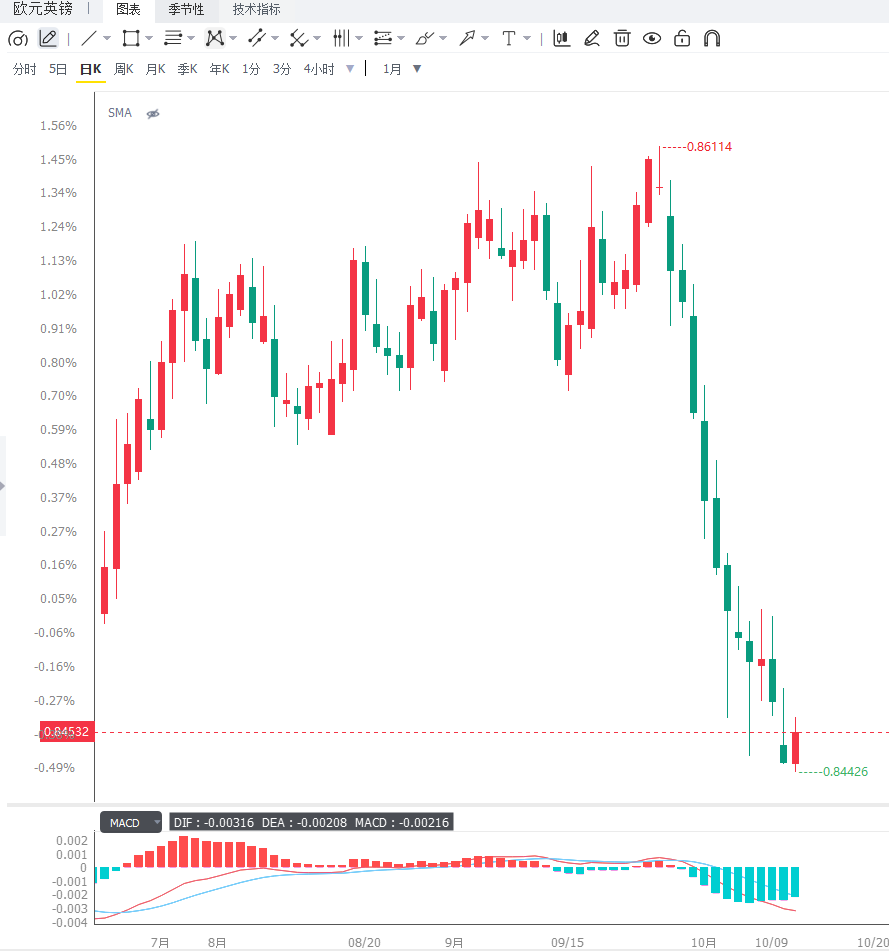 The editor summarizes that the EUR/GBP is currently in a structurally divergent pattern: "French fiscal risks and high oil prices are suppressing the euro," while "expectations of a Bank of England rate hike are supporting the pound." Volatility in the French bond market and rising energy costs in the Eurozone constitute medium-term headwinds for the euro, while the high probability of a Bank of England rate hike in November provides interest rate support for the pound. This week's US CPI data on Wednesday, PPI data on Thursday, and UK economic data will be important short-term variables—if the dollar strengthens due to inflation data, the EUR/GBP may weaken further due to pressure on the euro against the dollar; if the dollar retraces, a short-term respite for the euro may lead to a slight rebound in the EUR/GBP, but the resistance zone between 0.8470 and 0.8500 is dense, limiting the upside potential.
Brent crude oil prices remained above $105, putting additional pressure on the Eurozone. Escalating geopolitical tensions in the Middle East—with Houthi attacks on Saudi Arabia and increased shipping risks in the Strait of Hormuz—have put the oil market in a tug-of-war between "geopolitical conflict supporting prices" and "high interest rates suppressing demand," but short-term dominant factors clearly lean towards the supply side. OPEC+ has confirmed that its voluntary production cut of 2.2 million barrels per day will continue until the end of 2026, and global commercial crude oil inventories have declined for five consecutive weeks and are significantly below the five-year average. For the Eurozone, a net importer of crude oil, high oil prices directly push up imported inflation, compress real purchasing power, and increase the difficulty of fiscal adjustments. The pound, however, has shown relative resilience. Bank of England Monetary Policy Committee member Megan Green delivered a hawkish speech on Monday during the IMF meeting in Bangkok, stating that the UK economy is growing faster than expected, the labor market remains resilient, and the current interest rate level of 3.75% is insufficient to curb inflation, clearly supporting further rate hikes. The UK's current inflation rate is 3.1%, and it is expected to rise to about 4% in the fourth quarter of this year, double the 2% target. The market has priced in an 83% probability of a Bank of England rate hike in November, with institutions such as Goldman Sachs, Barclays, and JPMorgan Chase all expecting a 25 basis point increase. Despite the UK's own fiscal uncertainty (the budget will be announced on October 28), the strengthened expectation of a rate hike has provided interest rate support for the pound. Germany's final harmonized CPI reading for September confirmed that inflation accelerated year-on-year to 3.3% (previous 2.9%) and rose 0.6% month-on-month (previous 0.2%), but the euro did not receive a significant boost after the data release, reflecting that the market has already fully priced in the ECB's dilemma between fiscal risks and inflationary pressures in France. From a technical perspective, the EUR/GBP daily chart maintains a downtrend, with the exchange rate trading below the 100-day moving average. After recently hitting new lows, a technical rebound has occurred. The RSI is in oversold territory (around 30), indicating that downward pressure is dominant but selling pressure has eased somewhat, suggesting a short-term rebound is possible; the MACD histogram remains green, indicating that the bearish momentum has not yet clearly weakened. The first resistance level is in the 0.8470-0.8480 area, corresponding to the upper edge of the recent trading range and the dynamic pressure of the 20-day EMA. A break above this level could extend the short-term rebound to the 0.8500 psychological level, with stronger resistance in the 0.8520-0.8540 area. On the downside, the first support level to watch is 0.8440-0.8444, corresponding to the 16-month low and the lower Bollinger Band. A break below this level would likely lead to a test of the 0.8420-0.8400 area, with stronger support around 0.8380. On the 4-hour chart, the price has formed a small consolidation pattern after rebounding from the lows, with short-term moving averages intertwined, making the direction unclear. The editor summarizes that the EUR/GBP is currently in a structurally divergent pattern: "French fiscal risks and high oil prices are suppressing the euro," while "expectations of a Bank of England rate hike are supporting the pound." Volatility in the French bond market and rising energy costs in the Eurozone constitute medium-term headwinds for the euro, while the high probability of a Bank of England rate hike in November provides interest rate support for the pound. This week's US CPI data on Wednesday, PPI data on Thursday, and UK economic data will be important short-term variables—if the dollar strengthens due to inflation data, the EUR/GBP may weaken further due to pressure on the euro against the dollar; if the dollar retraces, a short-term respite for the euro may lead to a slight rebound in the EUR/GBP, but the resistance zone between 0.8470 and 0.8500 is dense, limiting the upside potential.
- Risk Warning and Disclaimer
- The market involves risk, and trading may not be suitable for all investors. This article is for reference only and does not constitute personal investment advice, nor does it take into account certain users’ specific investment objectives, financial situation, or other needs. Any investment decisions made based on this information are at your own risk.