Hawkish expectations from the Federal Reserve and safe-haven demand in the Middle East have combined to keep the dollar index consolidating at high levels, awaiting CPI guidance.
2026-10-13 15:16:18
On Tuesday during Asian trading hours, the US dollar index retreated slightly to the 102.4-102.5 range, a daily decline of approximately 0.1% to 0.2%, but remained stable near its 18-month high. The core logic supporting the dollar stems from two aspects: firstly, the Federal Reserve continues to release hawkish signals, and secondly, escalating geopolitical risks in the Middle East are driving up demand for safe-haven assets.  Cleveland Federal Reserve President Hamak, speaking at the National Association for Business Economists' annual meeting on Monday, clearly stated that U.S. interest rates need to be raised further to curb inflation. She believes current inflationary pressures have spread beyond the energy sector, with AI investments and tariff costs pushing up corporate pricing. Some companies plan price increases that exceed the rise in input costs, suggesting that an "inflationary mindset" may be solidifying. Regarding the pace of policy adjustments, Hamak prefers a "smaller, more frequent" approach, but emphasizes that timing remains an open question. She has a voting right on the FOMC this year and voted against raising rates at the July meeting, reinforcing the hawkish stance within the Fed. The FXS Fed Sentiment Index rose to 138.92, clearly in hawkish territory. The escalating situation in the Middle East is another major supporting factor. Houthi rebels in Yemen launched multiple attacks on Saudi airports and energy facilities on October 10-11. King Khalid International Airport in Riyadh was attacked for two consecutive days, one of the deadliest attacks on Saudi Arabia in over a decade. Shipping risks in the Strait of Hormuz have intensified simultaneously – in the past two days, the Iranian Revolutionary Guard Navy has struck three oil tankers for illegal operations, and on the 11th, six ships were attacked near the Strait of Hormuz and the Gulf of Oman. Trump indicated that the US might join Saudi Arabia in its strikes against the Houthis, and geopolitical risk premiums have continued to drive safe-haven flows into the US dollar. However, the dollar index has not maintained its strong upward momentum in the short term. The market remained cautious ahead of Wednesday's release of the US September CPI data, with some long positions choosing to take profits. Analysts expect the overall US CPI year-on-year to rise from 3.4% in August to 3.6% to 3.7%, and the core CPI year-on-year to rise from 2.4% to 2.5%. Institutions such as Natixis and Macquarie believe that this round of inflation is mainly driven by energy prices and is unlikely to prompt the Federal Reserve to raise interest rates at its October meeting, but the probability of a 25 basis point rate hike in December has risen to around 70%. Furthermore, Thursday's PPI data and Friday's speech by Federal Reserve Chairman Warsh at the IMF and World Bank annual meetings in Bangkok will also provide new directional guidance for the dollar. From a technical perspective, the US dollar index maintains an uptrend on the daily chart, with the exchange rate steadily trading above the 100-day moving average, and the upward trend over the past four weeks remains intact. The RSI is in the neutral-to-strong zone, not yet reaching extreme overbought levels, indicating that the upward momentum is solid but not excessively extended; the MACD histogram has narrowed, indicating a weakening of the bullish momentum and a short-term need for consolidation at higher levels. The 102.8 to 103.0 range constitutes a key resistance area; if the CPI data is stronger than expected, the dollar is likely to test this resistance zone. On the downside, the 102.0 to 102.2 area is an important short-term support, corresponding to the lower edge of the recent trading range and the dynamic support of the 20-day EMA; if it breaks down effectively, the exchange rate will likely test the previous breakout conversion level of 101.7 to 101.8, with stronger support in the 101.4 to 101.0 area. On the 4-hour chart, the index is oscillating within the 102.4 to 102.6 range, with the short-term moving average system intertwined, and the direction is still unclear. The market awaits a breakout from the CPI data.
 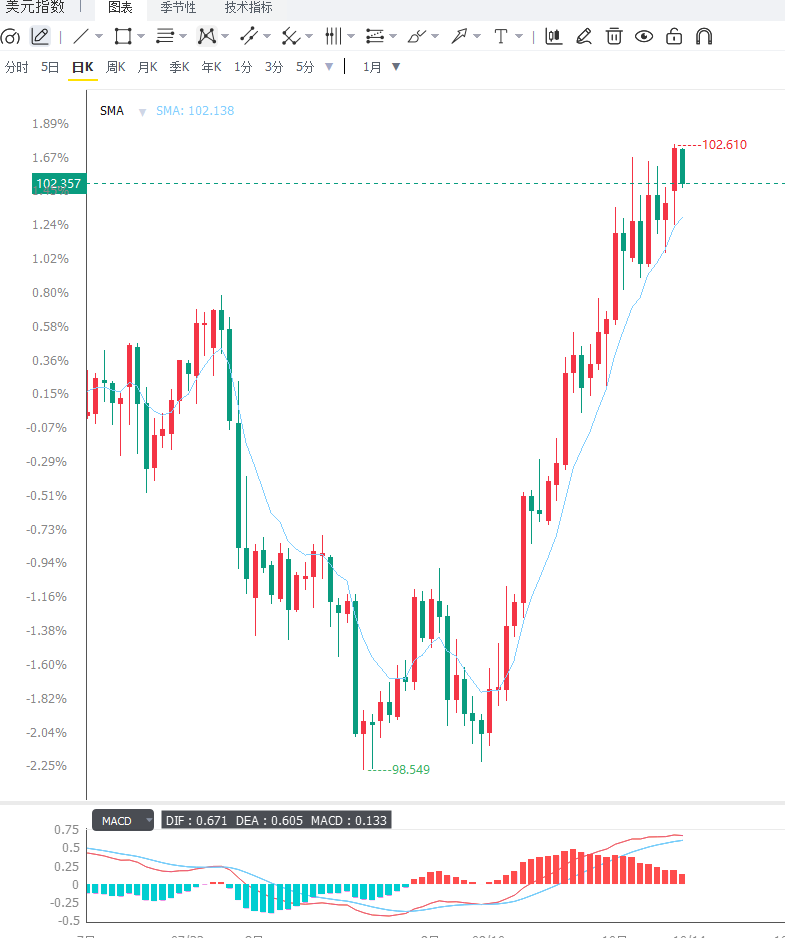 Editor's Summary: The US dollar index is currently driven by both hawkish expectations from the Federal Reserve and safe-haven demand from the Middle East. The technical bullish structure remains intact, but cautious sentiment ahead of the CPI data is limiting further upside potential. This Wednesday's US September CPI data will be the key variable—if inflation is stronger than expected, it could reignite discussions about an October rate hike, potentially allowing the dollar to break through the 102.8-103.0 resistance zone; if the data is weaker, the dollar may face profit-taking pressure and retrace to the 102.0-101.8 support zone. Furthermore, Thursday's PPI data, Friday's Warsh speech, and developments in the Middle East will continue to influence short-term movements. Until major support levels are effectively broken, the current technical structure should focus on finding support during pullbacks rather than directly judging a trend reversal.
Cleveland Federal Reserve President Hamak, speaking at the National Association for Business Economists' annual meeting on Monday, clearly stated that U.S. interest rates need to be raised further to curb inflation. She believes current inflationary pressures have spread beyond the energy sector, with AI investments and tariff costs pushing up corporate pricing. Some companies plan price increases that exceed the rise in input costs, suggesting that an "inflationary mindset" may be solidifying. Regarding the pace of policy adjustments, Hamak prefers a "smaller, more frequent" approach, but emphasizes that timing remains an open question. She has a voting right on the FOMC this year and voted against raising rates at the July meeting, reinforcing the hawkish stance within the Fed. The FXS Fed Sentiment Index rose to 138.92, clearly in hawkish territory. The escalating situation in the Middle East is another major supporting factor. Houthi rebels in Yemen launched multiple attacks on Saudi airports and energy facilities on October 10-11. King Khalid International Airport in Riyadh was attacked for two consecutive days, one of the deadliest attacks on Saudi Arabia in over a decade. Shipping risks in the Strait of Hormuz have intensified simultaneously – in the past two days, the Iranian Revolutionary Guard Navy has struck three oil tankers for illegal operations, and on the 11th, six ships were attacked near the Strait of Hormuz and the Gulf of Oman. Trump indicated that the US might join Saudi Arabia in its strikes against the Houthis, and geopolitical risk premiums have continued to drive safe-haven flows into the US dollar. However, the dollar index has not maintained its strong upward momentum in the short term. The market remained cautious ahead of Wednesday's release of the US September CPI data, with some long positions choosing to take profits. Analysts expect the overall US CPI year-on-year to rise from 3.4% in August to 3.6% to 3.7%, and the core CPI year-on-year to rise from 2.4% to 2.5%. Institutions such as Natixis and Macquarie believe that this round of inflation is mainly driven by energy prices and is unlikely to prompt the Federal Reserve to raise interest rates at its October meeting, but the probability of a 25 basis point rate hike in December has risen to around 70%. Furthermore, Thursday's PPI data and Friday's speech by Federal Reserve Chairman Warsh at the IMF and World Bank annual meetings in Bangkok will also provide new directional guidance for the dollar. From a technical perspective, the US dollar index maintains an uptrend on the daily chart, with the exchange rate steadily trading above the 100-day moving average, and the upward trend over the past four weeks remains intact. The RSI is in the neutral-to-strong zone, not yet reaching extreme overbought levels, indicating that the upward momentum is solid but not excessively extended; the MACD histogram has narrowed, indicating a weakening of the bullish momentum and a short-term need for consolidation at higher levels. The 102.8 to 103.0 range constitutes a key resistance area; if the CPI data is stronger than expected, the dollar is likely to test this resistance zone. On the downside, the 102.0 to 102.2 area is an important short-term support, corresponding to the lower edge of the recent trading range and the dynamic support of the 20-day EMA; if it breaks down effectively, the exchange rate will likely test the previous breakout conversion level of 101.7 to 101.8, with stronger support in the 101.4 to 101.0 area. On the 4-hour chart, the index is oscillating within the 102.4 to 102.6 range, with the short-term moving average system intertwined, and the direction is still unclear. The market awaits a breakout from the CPI data. Editor's Summary: The US dollar index is currently driven by both hawkish expectations from the Federal Reserve and safe-haven demand from the Middle East. The technical bullish structure remains intact, but cautious sentiment ahead of the CPI data is limiting further upside potential. This Wednesday's US September CPI data will be the key variable—if inflation is stronger than expected, it could reignite discussions about an October rate hike, potentially allowing the dollar to break through the 102.8-103.0 resistance zone; if the data is weaker, the dollar may face profit-taking pressure and retrace to the 102.0-101.8 support zone. Furthermore, Thursday's PPI data, Friday's Warsh speech, and developments in the Middle East will continue to influence short-term movements. Until major support levels are effectively broken, the current technical structure should focus on finding support during pullbacks rather than directly judging a trend reversal.
- Risk Warning and Disclaimer
- The market involves risk, and trading may not be suitable for all investors. This article is for reference only and does not constitute personal investment advice, nor does it take into account certain users’ specific investment objectives, financial situation, or other needs. Any investment decisions made based on this information are at your own risk.