Businesses faced pressure from both costs and revenues, while the US dollar helped boost gold prices.
2026-10-13 17:36:25
On Tuesday (October 13), during the Asian and European sessions, gold prices rose slightly, boosted by a pullback in oil prices. Spot gold briefly touched the $4,200 mark and is currently trading around $4,188, up about 0.4%. The recent rebound in gold prices is mainly due to the reinforced narrative of persistently high oil prices (suppressing corporate profits) and the pressure on US economic growth from the significant correction in US equity assets (suppressing US consumption under a K-shaped economic pattern). Meanwhile, market investors are awaiting the upcoming series of US inflation data for the latest clues on the Federal Reserve's interest rate path. 
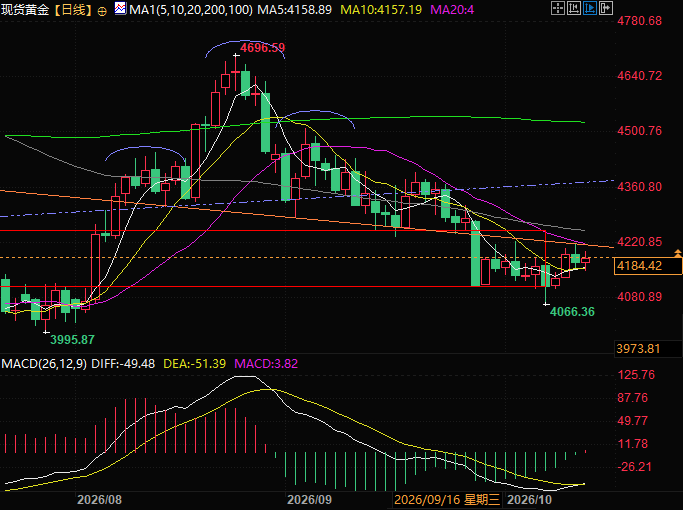 (Spot gold daily chart, source: EasyTrade) At 17:23 Beijing time, spot gold is currently trading at $4184 per ounce.
With inflation data approaching, there are differing expectations regarding Federal Reserve policy.
The US Consumer Price Index (CPI) will be released on Wednesday, while the Producer Price Index (PPI) is scheduled for release on Thursday. Inflation data is the core variable determining the short-term trend of gold. If inflation readings are higher than expected, especially if core inflation remains resilient, it may push up market expectations for a Federal Reserve rate hike, putting downward pressure on gold prices. Sharon Ding, Head of Basic Materials Research at UBS, believes that most of the negative factors facing gold in the previous period have already been digested by the market. Since the beginning of September, inflation concerns have reignited market expectations for further rate hikes by the Federal Reserve, and gold prices have fallen by about 5% at one point. Current prices have fully reflected this round of hawkish expectations repricing. As the market lowers its predictions for a Fed rate hike in October, the headwinds suppressing gold may gradually ease. If subsequent economic data no longer supports further upward revisions to policy expectations, gold prices have more room to stabilize. The continued decline in US Treasury yields will also further support a gold recovery. According to the pricing of the CME FedWatch tool, traders judge the probability of a Fed rate hike in October to be only 19%, but the probability of another rate hike in December is as high as 85%. Cleveland Federal Reserve President Beth Hamack stated that the Fed should shift to a tighter policy stance more quickly to curb inflation, which is now spreading and affecting corporate pricing decisions. Goldman Sachs' precious metals strategy team analyzed that short-term expectations of Fed rate hikes will limit the rebound in gold prices, but will not destroy the long-term structural bull market for gold. Although the bank lowered its year-end 2026 gold price target to $4,900/ounce, mainly due to the delayed timing of Fed rate cuts, it maintained its year-end 2027 target of $5,400.The geopolitical risks in the Middle East have not been completely eliminated.
Geopolitical threats remain a looming threat over the market. Saudi Arabia reported a new round of heavy artillery attacks, and Riyadh airport remains closed. This comes days after the Houthi rebels in Yemen claimed responsibility for Saturday's deadly missile attack on Riyadh airport's departure terminal, indicating that uncertainty surrounding energy supply has not completely disappeared. Oil prices fell more than 1% that day, on track for their first decline in nearly a week. Previously, continued geopolitical tensions in the Middle East had driven up oil prices, exacerbating market concerns about inflation and reinforcing the necessity for the Federal Reserve to maintain its tight monetary policy. While gold is considered an inflation hedge, its non-interest-bearing nature means that during periods of rising interest rates, funds tend to prefer assets with fixed income, thus reducing the attractiveness of precious metals. If oil prices rebound and inflation expectations rise, the market will reprice for the Federal Reserve to maintain high interest rates for an extended period, and a rebound in real interest rates will suppress gold prices.Macroeconomic Logic: Shifting Growth Narratives, Gold Price Increases Face Dual Constraints
Previously, the market's main driver was the resilience of the US economy, fueled by AI capital expenditures, leading to a sustained rise in US stocks. However, the negative effects of high oil prices coupled with high interest rates are gradually emerging. Under the K-shaped economic structure of the US, a stock market correction will weaken the wealth effect of affluent groups and suppress high-end discretionary consumption; ordinary households will continue to suffer from energy cost pressures, resulting in weakening consumption at both ends, and a turning point in US economic growth expectations. Recently, the US dollar index and the real interest rate of US Treasury bonds have been affected and declined, reflecting that the market is beginning to price in an economic slowdown, becoming the underlying force supporting the current rise in gold prices. On the other hand, there is the risk of tail liquidity. Gregory Shearer, head of precious metals strategy at JPMorgan Chase, pointed out that gold is a high-quality asset diversification tool in a stagflation environment, and the medium- to long-term upward logic remains unchanged, but the risks should not be ignored . If US stocks experience a rapid decline, triggering a cross-asset liquidity run, the market will collectively liquidate to meet margin calls and fund redemptions, and gold will face short-term selling, temporarily invalidating the negative correlation between stocks and gold. The inflation stickiness brought about by high oil prices will compress the Fed's room for interest rate cuts, and gold prices will generally show a volatile upward trend, making it difficult to experience a one-sided surge. Such liquidity shocks only cause short-term price disturbances and do not overturn the underlying logic of long-term stagflation. Meanwhile, Goldman Sachs points out that global central banks' continued efforts to diversify their foreign exchange reserves and their ongoing gold purchases are building a solid floor for gold prices. Coupled with geopolitical conflicts and US fiscal pressure, the medium- to long-term investment value of gold continues to rise.Summary and Technical Analysis:
The temporary pullback in oil prices has eased market concerns about persistently tightening inflation, leading to a rebound in gold prices. Market narratives are shifting, with funds beginning to price in a slowing US economy and declining real yields on US Treasury bonds, providing support for gold prices. However, expectations for a Fed rate hike by the end of the year remain high, and geopolitical conflicts in the Middle East could disrupt oil prices at any time. Coupled with the potential for a liquidity shock triggered by a sharp drop in US stocks, the upside potential for gold prices has a clear ceiling. Short-term trading should focus on tracking Wednesday's CPI and Thursday's PPI data, paying close attention to changes in core inflation; simultaneously, continuously monitoring oil prices and Middle East geopolitical developments to assess whether energy inflation will escalate again; and closely monitoring real yields on US Treasury bonds and volatility in US stocks to be wary of the risk of a sudden liquidity crisis. The upcoming CPI inflation data will be the most important litmus test for short-term gold price movements. Technically: Spot gold has risen to the 1/2 mark of its trading range, facing support from a previous large bullish candle and resistance from a recent symmetrical large bearish candle. Currently, the bulls and bears remain in a stalemate, and the price is expected to continue its sideways trend. (Spot gold daily chart, source: EasyTrade) At 17:23 Beijing time, spot gold is currently trading at $4184 per ounce.
- Risk Warning and Disclaimer
- The market involves risk, and trading may not be suitable for all investors. This article is for reference only and does not constitute personal investment advice, nor does it take into account certain users’ specific investment objectives, financial situation, or other needs. Any investment decisions made based on this information are at your own risk.