Crude Oil Trading Alert: Middle East supply risk premium supports oil prices; US crude oil continues to strengthen.
2026-10-14 09:34:23
WTI crude oil prices remained around $95 per barrel in Asian trading on Wednesday, continuing their upward trend. The core issue for crude oil remains the interplay between geopolitical supply risks and the combined pressure of increased OPEC+ production and weakening demand. Houthi rebels attacked Saudi Aramco's headquarters in Dhahran on Tuesday, causing a fire in the office building; Riyadh airport had previously been attacked multiple times, resulting in casualties and flight disruptions. Meanwhile, attacks on ships in the Strait of Hormuz and the Gulf of Oman continue to escalate, with six ships attacked on October 11 alone. Oil shipments through the Strait of Hormuz have decreased by approximately 43% in the past week compared to pre-war levels. Saudi Aramco CEO Nasser stated that global commercial crude oil inventories are below 6 billion barrels, at an "extremely dangerous" low level, and it could take two years to return to normal.  Marginal recovery has emerged on the OPEC+ supply side. The OPEC monthly report shows that broad OPEC+ crude oil production increased by approximately 900,000 barrels per day in September, reaching 39.07 million barrels per day. Saudi Arabia's production rose to around 8.37 million barrels per day in September, an increase of over 2 million barrels per day compared to August. Russian production, however, decreased by approximately 38,000 barrels per day in September, affected by the ongoing attacks on Russian energy infrastructure by Ukraine. Despite the significant increase in Saudi production, shipping risks in the Strait of Hormuz, soaring tanker freight rates, and high insurance costs mean that the actual recovery in exports remains unstable. Demand expectations continue to weaken. OPEC lowered its 2026 global oil demand growth forecast to 180,000 barrels per day, down from the previous 380,000 barrels per day, marking the sixth consecutive downward revision. At the same time, it raised its 2027 demand growth forecast to 2.55 million barrels per day, mainly reflecting post-war inventory rebuilding demand. This means that high oil prices this year will continue to suppress actual consumption, with restocking likely to be the main support next year, but short-term consumption is not strong. The US-Russia diesel agreement has caused some market sentiment disruption, but its substantive impact is limited. The US Treasury Department has issued a temporary general license allowing Russia to export diesel globally until April 2027; Russia expects to supply 3 million to 3.5 million tons per month by the end of the year. However, the Kremlin has explicitly stated that the agreement is not directly related to its position on the Ukraine issue, and the mutual attacks between Russia and Ukraine continue. Considering the uncertainty surrounding the pace of increased Russian diesel supply and delivery capacity, and the fact that current oil prices are mainly driven by supply risks in the Middle East, the agreement is unlikely to significantly lower oil prices in the short term. From a technical perspective, WTI crude oil maintains a bullish structure on the daily chart, having risen for five consecutive trading days and regained the $93-$94 area. Initial resistance is at $95.60-$96.00, corresponding to recent highs and psychological levels; a break above this level could lead to a short-term test of $96.50-$97.00, with stronger resistance at $98.00. The first support level to watch is the psychological level of $93.00. If it breaks down, it may retrace to $92.00 to $91.70. Stronger support lies in the $90.50 to $90.00 area.
 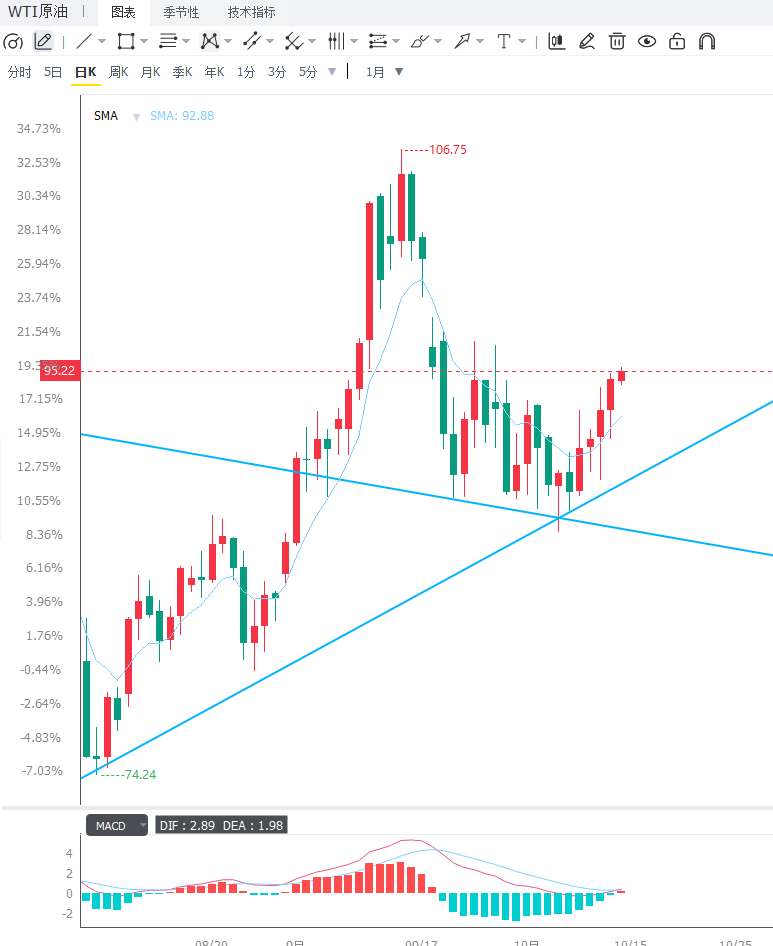 Editor's Summary: Crude oil is currently caught in a tug-of-war between "high Middle East supply risk premiums" and "OPEC+ production increases + weakening demand expectations." The Houthi attack on Saudi Aramco headquarters and the disruption of shipping in the Strait of Hormuz are providing event-driven support to the market; however, OPEC's continuous downward revision of its 2026 demand growth forecast and Saudi Arabia's significant production increase in September also indicate that the supply side is marginally recovering. The US-Russia diesel agreement is unlikely to change the main supply and demand dynamics of crude oil in the short term, but will primarily alleviate pressure on refined oil products. Short-term prospects depend on the progress of shipping recovery in the Strait of Hormuz, geopolitical tensions, and the impact of tonight's US September CPI data on the dollar and interest rate expectations. If geopolitical risks continue to escalate, WTI may test the $96 level; if the Middle East situation eases or the CPI strengthens high interest rate expectations that suppress risk assets, oil prices may retrace to support below $93.
Marginal recovery has emerged on the OPEC+ supply side. The OPEC monthly report shows that broad OPEC+ crude oil production increased by approximately 900,000 barrels per day in September, reaching 39.07 million barrels per day. Saudi Arabia's production rose to around 8.37 million barrels per day in September, an increase of over 2 million barrels per day compared to August. Russian production, however, decreased by approximately 38,000 barrels per day in September, affected by the ongoing attacks on Russian energy infrastructure by Ukraine. Despite the significant increase in Saudi production, shipping risks in the Strait of Hormuz, soaring tanker freight rates, and high insurance costs mean that the actual recovery in exports remains unstable. Demand expectations continue to weaken. OPEC lowered its 2026 global oil demand growth forecast to 180,000 barrels per day, down from the previous 380,000 barrels per day, marking the sixth consecutive downward revision. At the same time, it raised its 2027 demand growth forecast to 2.55 million barrels per day, mainly reflecting post-war inventory rebuilding demand. This means that high oil prices this year will continue to suppress actual consumption, with restocking likely to be the main support next year, but short-term consumption is not strong. The US-Russia diesel agreement has caused some market sentiment disruption, but its substantive impact is limited. The US Treasury Department has issued a temporary general license allowing Russia to export diesel globally until April 2027; Russia expects to supply 3 million to 3.5 million tons per month by the end of the year. However, the Kremlin has explicitly stated that the agreement is not directly related to its position on the Ukraine issue, and the mutual attacks between Russia and Ukraine continue. Considering the uncertainty surrounding the pace of increased Russian diesel supply and delivery capacity, and the fact that current oil prices are mainly driven by supply risks in the Middle East, the agreement is unlikely to significantly lower oil prices in the short term. From a technical perspective, WTI crude oil maintains a bullish structure on the daily chart, having risen for five consecutive trading days and regained the $93-$94 area. Initial resistance is at $95.60-$96.00, corresponding to recent highs and psychological levels; a break above this level could lead to a short-term test of $96.50-$97.00, with stronger resistance at $98.00. The first support level to watch is the psychological level of $93.00. If it breaks down, it may retrace to $92.00 to $91.70. Stronger support lies in the $90.50 to $90.00 area. Editor's Summary: Crude oil is currently caught in a tug-of-war between "high Middle East supply risk premiums" and "OPEC+ production increases + weakening demand expectations." The Houthi attack on Saudi Aramco headquarters and the disruption of shipping in the Strait of Hormuz are providing event-driven support to the market; however, OPEC's continuous downward revision of its 2026 demand growth forecast and Saudi Arabia's significant production increase in September also indicate that the supply side is marginally recovering. The US-Russia diesel agreement is unlikely to change the main supply and demand dynamics of crude oil in the short term, but will primarily alleviate pressure on refined oil products. Short-term prospects depend on the progress of shipping recovery in the Strait of Hormuz, geopolitical tensions, and the impact of tonight's US September CPI data on the dollar and interest rate expectations. If geopolitical risks continue to escalate, WTI may test the $96 level; if the Middle East situation eases or the CPI strengthens high interest rate expectations that suppress risk assets, oil prices may retrace to support below $93.
- Risk Warning and Disclaimer
- The market involves risk, and trading may not be suitable for all investors. This article is for reference only and does not constitute personal investment advice, nor does it take into account certain users’ specific investment objectives, financial situation, or other needs. Any investment decisions made based on this information are at your own risk.