The European Central Bank's Governing Council signaled the possibility of further interest rate hikes.
2026-10-14 15:56:19
On Wednesday, October 14th, the euro was fluctuating around 1.120 against the US dollar, remaining in a low range. Meanwhile, members of the European Central Bank's Governing Council signaled further interest rate hikes at the IMF's annual meeting in Bangkok. The Eurozone's September HICP inflation rate rose to 3.8%, with the energy component at an annualized rate of 18.8%, core inflation at 2.5%, and services inflation at 3.2%. The deposit facility rate remains at 2.50%, and market pricing indicates the possibility of further rate hikes before the end of the year. However, uncertainties related to energy and AI mean that the decision-making process will remain data-dependent. 
Policy Signals and Interest Rate Path Observations
Belgian central bank governor Pierre Winsch stated that the European Central Bank (ECB) "will likely need to raise interest rates again." He pointed out that inflation is too high, market expectations have been adjusted, and the October action is no longer being factored in, but emphasized the meeting's reliance on data and not ruling out any specific timing. Governing Council members unanimously stressed that two rate hikes have already been implemented this year, and another would bring the deposit facility rate to 2.75%, a level assessed as beginning to have a restrictive impact on economic activity. ECB President Christine Lagarde noted on the same day that inflation driven by high energy prices has not yet transmitted to the broader economy, and no signs of a second-round effect have been observed, but indirect impacts and indicators such as wages need to be closely monitored. French central bank governor Moulin added that rising yields have put pressure on financial conditions and may partially replace the effect of policy tightening, and stated that medium-term inflation expectations remain well anchored, and the reaction function has been understood by the market. This statement placed the timing of the rate hike (October or December) in a secondary position, with the core focus being on confirming the necessity of further action. Economists generally expect the final action to occur in December, consistent with Winsch's assessment that "market pricing indicates the need for further action, which is reasonable as a baseline scenario." Uncertainties related to the energy frontier and AI are explicitly cited as reasons for not taking bets; decisions remain strictly tied to subsequent data, rather than a predetermined path.Inflation Composition and Energy Pressure Characteristics
The Eurozone's HICP rose to 3.8% in September from 3.2% in August, with energy contributing the most, jumping from 14.3% to 18.8% year-on-year. Services inflation moderately rose to 3.2%, food, alcohol, and tobacco to 1.4%, and non-energy industrial goods to 1.1%. Core inflation (excluding energy and food) remained at 2.5%, indicating that price pressures are currently mainly concentrated in energy, with no widespread second-round effect yet. Governing Council members repeatedly emphasized that no significant spread of wage acceleration or corporate price increases has been observed, and medium-term inflation expectations (for businesses and households) remain anchored near the target. The Middle East conflict-driven energy prices are the main external driver, but growth has shown resilience to this shock. Lagarde warned that rising yields could drag down activity more than previously expected; Mullan, however, believes that rising yields have already accomplished part of the policy task, potentially leading to a more moderate response to inflation shocks. Winsch added that market pressures contribute to fiscal constraints to some extent, as higher debt interest costs reinforce the need to reduce deficits, but achieving this politically is not easy. Policymakers are currently focused on assessing the extent of the transmission of indirect effects through the economy and determining whether there are early signs of a second round of effects.Financial conditions and instrument boundaries
French government bond yields have risen significantly recently, with the 10-year yield hovering around 4.8%, tightening financial conditions in the Eurozone. This shift has prompted market attention to the European Central Bank's crisis response tools, including the Transmission Protection Instrument (TPI) designed for 2022. Winsch stated that he does not intend to speculate on whether or when to intervene; the tool exists and can be used in the event of inappropriate market volatility, but there are gray areas. Moulan explicitly pointed out that the ECB is not intended to address national fiscal problems. The conditions for deploying the TPI are currently considered difficult to meet, as investor reactions stem at least partly from budgetary political gridlock. Rising yields are prevalent in developed economies and were a key topic at the Bangkok meeting. The IMF Managing Director previously called on policymakers to take urgent action to reduce high debt and budget deficits. Within the Eurozone, rising yields increase financing costs and also dampen demand through financial conditions, acting as a substitute for policy rates to some extent. This dynamic requires the ECB to consider the already completed tightening effects in the market when assessing the extent of further interest rate hikes.Euro/Dollar Daily Chart Structure
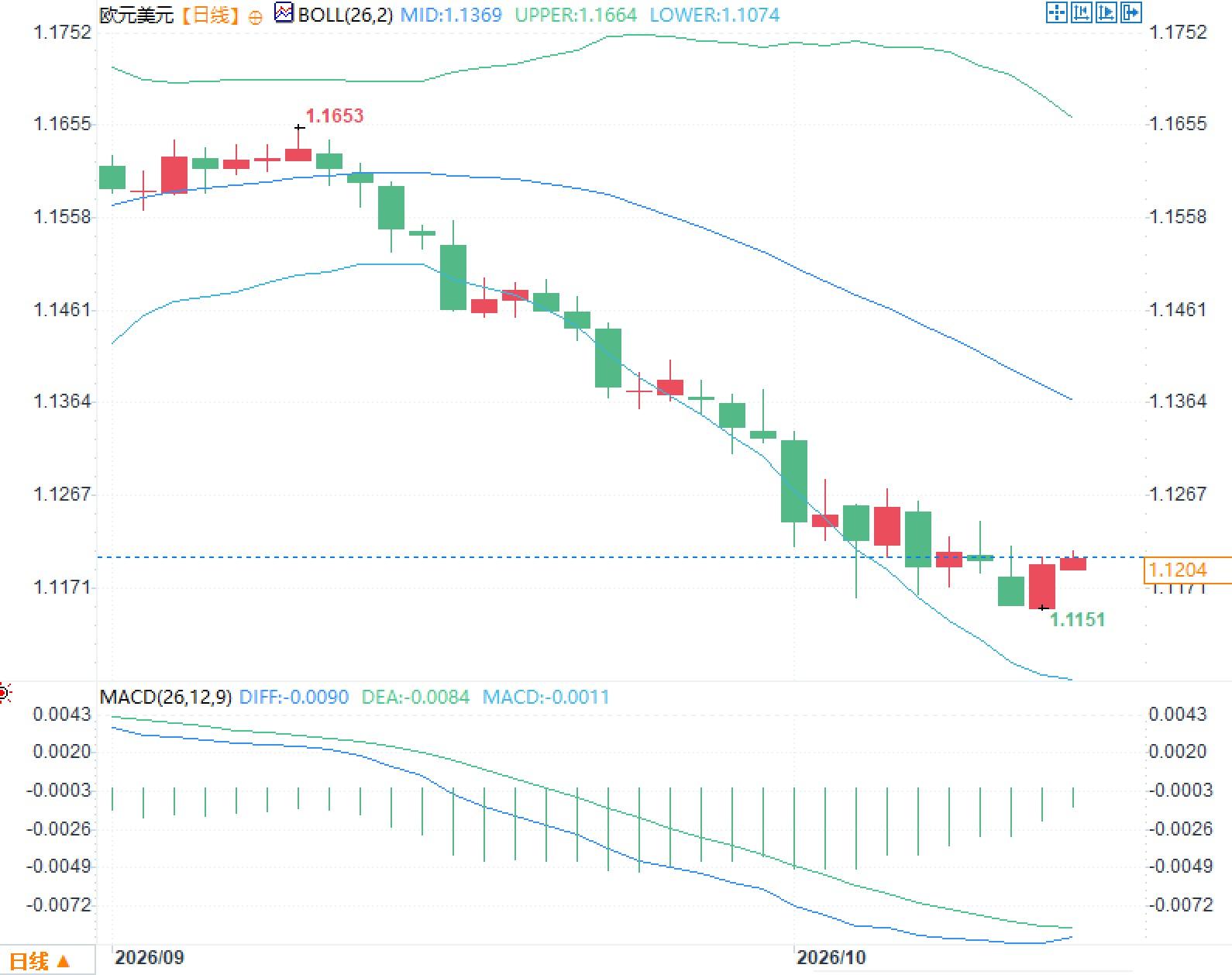
The daily chart shows that the EUR/USD pair has been consistently trading below the Bollinger Band middle line at 1.1369, with the upper band at 1.1664 and the lower band at 1.1074. The price has retreated from its September high, with a recent low near 1.1151, and is currently trading around 1.120, showing an overall downward trend. The MACD shows a DIFF of -0.0090, a DEA of -0.0084, and a MACD histogram of -0.0011, with the indicators below the zero line. The price's deviation from the middle band and the MACD's negative territory reflect weak recent price momentum.Frequently Asked Questions
Question 1: Why did Winsch emphasize that "another rate hike may be necessary" but refuse to give a specific timing? Answer: He clearly stated that inflation is too high, and the market has already priced in further action as the baseline scenario. However, the uncertainties surrounding energy and AI are too high. Therefore, he insists on data-driven approaches and assessments at each meeting. The specific choice in October or December is not the core issue. Question 2: After Eurozone inflation rose to 3.8%, why did he still emphasize that no second-round effect has been seen? Answer: Price pressures are currently mainly concentrated in the energy sector (18.8% annualized), with core inflation at 2.5% and services at 3.2%. Business and household medium-term expectations remain anchored. The Governing Council has not yet observed signs of spread such as wage acceleration and needs to continue monitoring indirect transmission. Question 3: What is the boundary between rising French yields and the TPI tool? Answer: Rising yields have put pressure on financial conditions, partly due to budgetary politics. The TPI aims to address inappropriate market volatility rather than solve fiscal problems. Currently, the conditions are difficult to meet, and the tool exists as a backup but does not constitute automatic intervention.- Risk Warning and Disclaimer
- The market involves risk, and trading may not be suitable for all investors. This article is for reference only and does not constitute personal investment advice, nor does it take into account certain users’ specific investment objectives, financial situation, or other needs. Any investment decisions made based on this information are at your own risk.