Geopolitical tensions deteriorated, with the Houthis launching a surprise attack on Saudi oil and gas hubs, but oil prices failed to rise despite the positive news after breaking through resistance levels.
2026-10-14 16:14:18
On Wednesday (October 14th) during the Asian and European sessions, international oil prices rose slightly before falling back. Last night, oil prices broke through a key recent level, but today's Houthi bombing of Saudi Aramco has resulted in a failure to rise despite positive news, suggesting a potential correction. The recent oil price increase has been primarily driven by a confluence of risks in the Middle East: the ongoing US-Iran standoff, escalating tensions between the Houthis and Saudi Arabia, a missile attack on Saudi Arabia's domestic oil and gas hubs, and simultaneous pressure on the Strait of Hormuz and the Bab el-Mandeb Strait, two crucial global oil shipping routes. The market is reassessing the stability of Gulf oil exports, with geopolitical risk premiums becoming a core variable influencing oil prices. Rising shipping costs and low global crude oil inventories further amplify market volatility. 
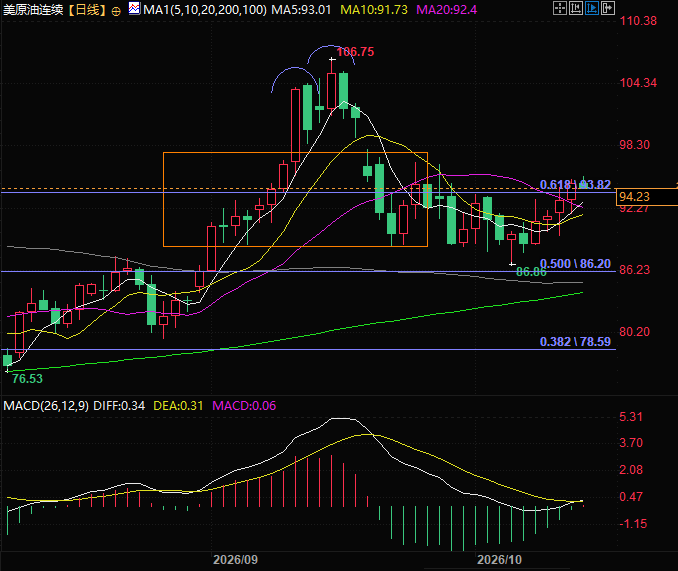 (WTI crude oil futures daily chart, source: EasyTrade) At 15:47 Beijing time, WTI crude oil futures are currently trading at $94.15 per barrel.
Expensive air defense systems are no match for asymmetric attacks, and the Sahu confrontation is escalating rapidly.
Saudi Arabia, equipped with advanced US-made weaponry such as F-15 fighter jets and Patriot air defense systems, with a military budget reaching $83 billion by 2026, and having signed joint defense agreements with Pakistan and Turkey, is still struggling to defend against the Houthi saturation attacks using long-range missiles and drones. Houthi missiles have a maximum range of 1600 kilometers, some warheads can change course in mid-air, and they excel at simultaneous multi-directional launches, overwhelming air defense radars. Andreas Krieg of King's College London points out that the Houthis have mastered radar saturation attack tactics, using large numbers of drones and missiles in coordinated strikes; expensive air defense systems are inherently vulnerable to this low-cost tactic. This tactic, honed in combat against Israel's air defense system, is now directly targeting Saudi Arabia. The Houthis have no intention of occupying Saudi Arabia; their focus is on attacking economic lifelines such as oil and gas facilities and airports, using the threat to shipping in the Bab el-Mandeb Strait to restrict oil exports. Farea Al-Muslimi of Chatham House comments that consecutive victories have boosted the Houthis' confidence, but continued attacks on Saudi oil and gas facilities may provoke a strong Saudi retaliation. The surge in oil prices stems from the recent rapid escalation of hostilities. In the past 24 hours, the Saudi-led coalition launched 104 airstrikes, bringing the total to 2,281 since the conflict began. The Houthis retaliated, with ballistic missiles striking the Saudi Aramdalan headquarters campus, causing fires in high-rise office buildings. This campus is a core hub for Saudi oil and gas, coordinating drilling, pipelines, and crude oil export terminals. The attack was the catalyst for the continued strength of international oil prices last night. The rise in oil prices is essentially due to increased geopolitical risk premiums, not an immediate large-scale disruption of crude oil production. The market has realized that the Red Sea alternative export route, originally used to avoid risks in the Strait of Hormuz, is also exposed to Houthi attacks. Both energy choke points are under pressure simultaneously, and funds are beginning to price in the potential risk of disrupted crude oil exports. This, coupled with already weak global crude oil inventory buffers, further amplifies the upward pressure on prices. Saudi air defenses intercepted incoming munitions in multiple locations, with debris falling into residential areas. A week ago, an attack on Riyadh airport killed 13 people, the deadliest attack on Saudi Arabia in nearly a decade, leading to widespread flight cancellations. The Houthis warned oil workers to stay away from high-risk facilities in advance, and the Saudi cabinet also stated that the Houthis would bear the consequences of the attacks.Both major crude oil shipping routes are under pressure, reshaping the pattern of crude oil transportation from the Gulf.
This round of turmoil is a spillover from the US-Iran standoff, which has lasted for over 220 days. Since the risk in the Strait of Hormuz increased in February, Saudi crude oil has been diverted to domestic pipelines, passing through the Bab el-Mandeb Strait for safer transport—a route within the Houthi attack zone. Two of these vital energy routes have been repeatedly threatened. Attacks on ships in the Strait of Hormuz have been frequent, with six attacks on October 11 alone, prompting the market to adopt ship-to-ship crude oil transshipment. Fujairah in the UAE, a key oil storage and replenishment port outside the strait, has repeatedly faced long-range munitions threats, temporarily restricting loading and unloading operations. The International Energy Agency (IEA) warns that the pressure on both the Strait of Hormuz and the Bab el-Mandeb Strait poses a significant threat to global energy security; alternative pipelines have limited capacity and have not yet withstood high-intensity combat testing. Simultaneously, rising shipping costs are putting pressure on the supply chain, causing oil prices to fluctuate with geopolitical news. Red Sea shipping insurance and tanker freight rates have risen simultaneously. If shipowners choose to detour around the Cape of Good Hope, the extended voyages will consume global tanker capacity, further supporting the market. However, this round of price increases is driven by expectations. If both sides cease attacks on energy infrastructure, the risk premium will quickly decline, and oil prices may give back some of their gains. The International Monetary Fund (IMF) believes that the Middle East conflict and shipping disruptions will drag down the regional economy. If energy facilities continue to be attacked, rising oil prices will also push up global inflation. Therefore, the IMF has lowered its growth forecast for the Middle East.People's livelihoods in Gulf countries are under pressure, and external allies have limited willingness to intervene.
While businesses, airports, and schools in the UAE have not yet shut down, residents face secondary shocks such as flight delays, rising prices, and energy costs. UAE officials are urging the public to trust authoritative information and stockpile emergency supplies. The UAE has expressed solidarity with Saudi Arabia, condemned the attack on merchant ships, and warned against external forces attempting to sow discord among Gulf states. Saudi Arabia's allies, Pakistan and Turkey, are choosing to remain on the sidelines. The United States is evaluating options for striking the Houthis, but will not launch a large-scale attack on Iran before the November midterm elections, maintaining only a naval blockade and unwilling to become deeply involved in the Yemeni conflict. Iran has expressed a willingness to mediate, preserving diplomatic space for the situation. Neil Quilliam of the Chatham House analyzes that the Houthis have extended their battle lines to the Red Sea; the wait-and-see attitude of allies increases the pressure on Saudi Arabia to defend itself alone, raising the risk of spillover effects from the conflict.Core risk in the energy market: Potential disruptions to crude oil alternative export channels.
Saudi Arabia's resumption of military operations in Yemen aims to prevent the Houthis from advancing towards the Bab el-Mandeb Strait. While the Yemeni government forces have temporarily pushed the Houthis away from the strait's front lines, the Houthis still possess the capability to launch long-range strikes against Red Sea shipping lanes and Saudi oil and gas facilities. The core market risk lies in the Houthis' continued targeting of Saudi oil and gas infrastructure. If the oil pipelines traversing Saudi Arabia and Red Sea ports continue to be attacked, this alternative oil route risks disruption. Coupled with the tensions in the Strait of Hormuz, the security risks in the Bab el-Mandeb Strait will continue to drive up the geopolitical premium for oil, further fragility of the global energy supply chain. The International Energy Agency (IEA) warns that Saudi Arabia's East-West oil pipeline is the most important alternative route for Gulf oil, but it is itself within the Houthi attack range; if the pipeline is damaged, global oil buffer inventories will be rapidly depleted, putting significant upward pressure on oil prices.Summary and Technical Analysis:
Currently, as long as geopolitical issues do not clearly ease, even if there are no problems with crude oil supply, high transportation and insurance costs will make it difficult for terminal oil prices to fall. At the same time, high oil prices also increase the bargaining power of Iran and the Houthis, making peace talks or a de-escalation of the conflict more likely. Technical Analysis: Yesterday's article suggested a potential breakout in oil prices, and indeed, prices broke through last night . Currently, we are watching to see if oil prices can hold the 0.618 Fibonacci retracement level at 93.82. However, due to the recent continuous rise in oil prices, the chances of US intervention at this level are increasing. (WTI crude oil futures daily chart, source: EasyTrade) At 15:47 Beijing time, WTI crude oil futures are currently trading at $94.15 per barrel.
- Risk Warning and Disclaimer
- The market involves risk, and trading may not be suitable for all investors. This article is for reference only and does not constitute personal investment advice, nor does it take into account certain users’ specific investment objectives, financial situation, or other needs. Any investment decisions made based on this information are at your own risk.