The yen remained range-bound, while the euro rebounded after a sharp decline against the yen.
2026-10-14 15:46:20
After stabilizing at last week's lows, the EUR/JPY cross pair continued its modest rebound in early European trading on Wednesday, trading in the range of approximately 177.30 to 177.35, recovering somewhat from its previous lows. This rebound was primarily driven by changes in policy expectations on the yen side – Bank of Japan officials are inclined to avoid a rare series of rate hikes this month, believing that unless there is a sudden and significant increase in upside risks to inflation, policymakers see no need for consecutive actions. The central bank will continue to assess economic data to determine whether further action is necessary at its December meeting.  The Bank of Japan (BOJ) raised its policy rate by 25 basis points to 1.25% at its September meeting, the highest level since 1995. This was the second rate hike in three months, the fastest pace since 1990. However, the BOJ has never raised rates for two consecutive months since 1980, a long-standing practice reflecting policymakers' tendency to observe the impact of previous actions on the economic and financial environment before adjusting policy again. Sources emphasized that the final policy decision at the October 30 meeting could still be subject to change at the last minute. Market pricing is highly aligned with this expectation. Overnight swap market data showed that traders priced in only about a 10% probability of a BOJ rate hike in October, while pricing in an 88% probability of a December rate hike. The market widely expects the BOJ to further raise rates to 1.50% by the end of the year or early next year, followed by a possible rise to 1.75% in March or April next year. SMBC Nikko Securities economist Yoshimasa Maruyama points out that given the latest inflation data showing accelerating inflation, the Bank of Japan needs to reach its neutral interest rate more quickly. He predicts the policy rate will rise to 1.50% in December 2026 and to a terminal rate of 1.75% in March 2027. Bank of Japan Governor Kazuo Ueda stated in parliament that Japan's underlying inflation rate is very close to the 2% target, but the key is to stabilize the price trend around 2%, not just to temporarily reach that level. The Bank of Japan may hint in its October quarterly outlook that underlying inflation has roughly reached the 2% target—a significant symbolic shift signifying increased confidence in the sustainability of inflation and providing a theoretical basis for further interest rate hikes in the coming months. Latest price data shows that Japan's corporate price index rose 6.8% year-on-year in September, lower than August's 7.6% and market expectations, and fell 0.3% month-on-month, marking the second consecutive month of decline. However, the import price index denominated in yen surged 24.5% year-on-year, with chemical products rising 13.3%, plastic products 12.8%, and non-ferrous metal products soaring 40.2%, reflecting the combined effect of yen depreciation and Middle East geopolitical risks pushing up raw material costs. Sompo Research Institute senior economist Rihito Koike stated that the Middle East conflict brings high uncertainty, international oil prices remain high, and there is a possibility that Japanese inflation may accelerate again. The Bank of Japan's household survey shows that 88.6% of households expect prices to rise in the coming year, indicating that inflation expectations remain deeply entrenched. It is worth noting that the balance of power between hawks and doves within the Bank of Japan is undergoing subtle changes. Newly appointed council member Ayano Sato recently expressed support for a phased interest rate hike approach, although she was one of the two dissenters against a rate hike at the September meeting. Appointed by Prime Minister Sanae Takaichi, who advocates for loose monetary policy, Sato's shift in stance has reduced market concerns about dovish members blocking rate hikes, providing internal support for expectations of a December rate hike within the central bank. In its latest World Economic Outlook report, the IMF raised its 2026 economic growth forecast for Japan to 1.3% and explicitly stated that the Bank of Japan may still gradually raise interest rates to bring them closer to a neutral level. However, the IMF also pointed out that monetary policy can only refrain from reacting to the direct impact on inflation if the shock is temporary; if inflation expectations show signs of rising, the central bank may still need to raise nominal interest rates to maintain the stability of real borrowing costs. The policy environment on the euro side is generally hawkish. ECB Governing Council member Stournaras stated that the ECB may continue to gradually raise interest rates to address inflationary pressures from high energy prices. The ECB kept its deposit rate at 2.50% in September, but the market has already priced in a high probability of a rate hike to 2.75% in December. ECB Governing Council member Pacharides pointed out that monetary policy cannot solve the inflationary shock caused by war, suggesting limited room for policy action. ECB President Lagarde is scheduled to speak later today, and the market will closely watch her latest assessment of the inflation outlook and policy path. The US September CPI data released tonight at 20:30 will indirectly affect the direction of the euro/yen exchange rate. If CPI data is strong, it could push the US dollar higher and US Treasury yields higher, increasing downward pressure on yen cross rates through the USD/JPY channel. Conversely, if the data is weak, a weaker US dollar could lead to a simultaneous rebound in both EUR/USD and EUR/JPY. From a technical perspective, EUR/JPY maintains a clear bearish pattern on the daily chart, with the exchange rate consistently trading below the Bollinger Band middle line and the 100-day simple moving average, indicating a continued medium-term bearish bias. The 10-day simple moving average at approximately 177.37 provides immediate dynamic support, and the exchange rate is currently trading near this level. The 20-day moving average at approximately 178.42 forms the first resistance level for any short-term rebound. The 50-day moving average at approximately 181.17, the 100-day moving average at approximately 183.12, and the 250-day moving average at approximately 183.19 form a dense medium-term resistance zone, reflecting that the continuous downward trend since the August high of 187.37 has not yet reversed. The 14-day Relative Strength Index (RSI) is around 33.27, in the weak zone but not yet in the typical oversold range, indicating that downward momentum is continuing but may gradually weaken. The MACD indicator is below the zero line, releasing a bearish signal, but the histogram shows signs of narrowing, suggesting that selling pressure is weakening marginally. The Bollinger Bands are widening, reflecting increased short-term volatility and continued pressure on the exchange rate. On the upside resistance side, the middle Bollinger Band at approximately 178.45 forms the first key resistance level, which is also the area where the 20-day moving average is located; a successful break above this level would further challenge the psychological level of 180.00; stronger resistance further up lies at the upper Bollinger Band at approximately 181.05 and the 100-day moving average at approximately 183.05, forming a stronger structural barrier. On the downside, the lower Bollinger Band at around 175.90 forms the most immediate downside defense, followed by the low of 175.34 on October 20, 2025, and then the low of 172.27 on October 2, 2025. If the exchange rate continues to fall below these levels, it will further strengthen the current bearish tone and open up deeper downside potential.
 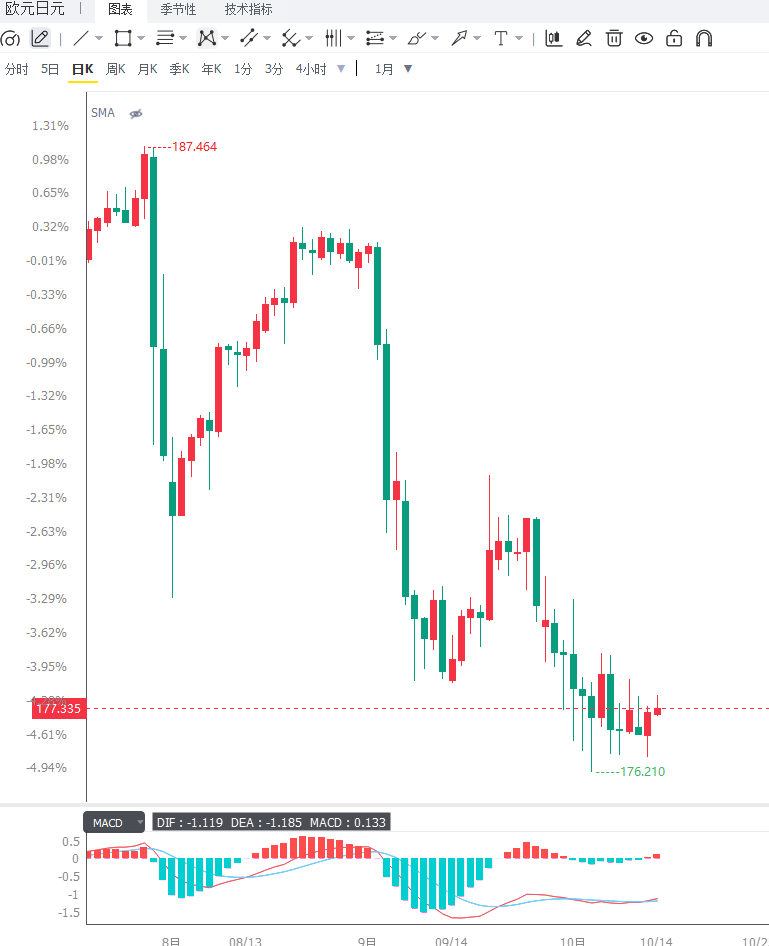 Editor's Summary: The EUR/JPY pair is currently oscillating between expectations of a pause in interest rate hikes by the Bank of Japan (BOJ) and support from hawkish Eurozone policies. Market surveys indicate that the market is pricing in a BOJ in holding rates steady in October and a rate hike in December with an 88% probability, putting temporary downward pressure on the yen and pushing the exchange rate to rebound moderately from its lows. However, this rebound is more akin to short covering and technical correction than a trend reversal—the exchange rate remains deeply below the 100-day moving average, the RSI is in weak territory, and the medium-term bearish structure remains intact. Regarding the euro, the ECB's hawkish stance provides support from interest rate differentials, but the continued escalation of French fiscal risks and the IMF's downward revision of French growth forecasts limit the euro's upside potential. Short-term direction will depend on three key variables: the indirect transmission of tonight's US CPI data to the EUR/JPY pair through the dollar channel, the ECB policy signals conveyed in Lagarde's speech, and whether the BOJ's quarterly outlook at its October 30th meeting formally acknowledges that "underlying inflation is approaching 2%." If the US CPI is relatively soft, causing the dollar to weaken, coupled with the European Central Bank maintaining a hawkish stance, the euro/yen pair is expected to challenge the Bollinger Band middle line at 178.45, and a further breakout could lead to the psychological level of 180.00. Conversely, if the CPI is relatively strong, causing the dollar to strengthen, or if the French fiscal risks escalate again, the exchange rate may fall back to the Bollinger Band lower line at 175.90 or even 175.34.
The Bank of Japan (BOJ) raised its policy rate by 25 basis points to 1.25% at its September meeting, the highest level since 1995. This was the second rate hike in three months, the fastest pace since 1990. However, the BOJ has never raised rates for two consecutive months since 1980, a long-standing practice reflecting policymakers' tendency to observe the impact of previous actions on the economic and financial environment before adjusting policy again. Sources emphasized that the final policy decision at the October 30 meeting could still be subject to change at the last minute. Market pricing is highly aligned with this expectation. Overnight swap market data showed that traders priced in only about a 10% probability of a BOJ rate hike in October, while pricing in an 88% probability of a December rate hike. The market widely expects the BOJ to further raise rates to 1.50% by the end of the year or early next year, followed by a possible rise to 1.75% in March or April next year. SMBC Nikko Securities economist Yoshimasa Maruyama points out that given the latest inflation data showing accelerating inflation, the Bank of Japan needs to reach its neutral interest rate more quickly. He predicts the policy rate will rise to 1.50% in December 2026 and to a terminal rate of 1.75% in March 2027. Bank of Japan Governor Kazuo Ueda stated in parliament that Japan's underlying inflation rate is very close to the 2% target, but the key is to stabilize the price trend around 2%, not just to temporarily reach that level. The Bank of Japan may hint in its October quarterly outlook that underlying inflation has roughly reached the 2% target—a significant symbolic shift signifying increased confidence in the sustainability of inflation and providing a theoretical basis for further interest rate hikes in the coming months. Latest price data shows that Japan's corporate price index rose 6.8% year-on-year in September, lower than August's 7.6% and market expectations, and fell 0.3% month-on-month, marking the second consecutive month of decline. However, the import price index denominated in yen surged 24.5% year-on-year, with chemical products rising 13.3%, plastic products 12.8%, and non-ferrous metal products soaring 40.2%, reflecting the combined effect of yen depreciation and Middle East geopolitical risks pushing up raw material costs. Sompo Research Institute senior economist Rihito Koike stated that the Middle East conflict brings high uncertainty, international oil prices remain high, and there is a possibility that Japanese inflation may accelerate again. The Bank of Japan's household survey shows that 88.6% of households expect prices to rise in the coming year, indicating that inflation expectations remain deeply entrenched. It is worth noting that the balance of power between hawks and doves within the Bank of Japan is undergoing subtle changes. Newly appointed council member Ayano Sato recently expressed support for a phased interest rate hike approach, although she was one of the two dissenters against a rate hike at the September meeting. Appointed by Prime Minister Sanae Takaichi, who advocates for loose monetary policy, Sato's shift in stance has reduced market concerns about dovish members blocking rate hikes, providing internal support for expectations of a December rate hike within the central bank. In its latest World Economic Outlook report, the IMF raised its 2026 economic growth forecast for Japan to 1.3% and explicitly stated that the Bank of Japan may still gradually raise interest rates to bring them closer to a neutral level. However, the IMF also pointed out that monetary policy can only refrain from reacting to the direct impact on inflation if the shock is temporary; if inflation expectations show signs of rising, the central bank may still need to raise nominal interest rates to maintain the stability of real borrowing costs. The policy environment on the euro side is generally hawkish. ECB Governing Council member Stournaras stated that the ECB may continue to gradually raise interest rates to address inflationary pressures from high energy prices. The ECB kept its deposit rate at 2.50% in September, but the market has already priced in a high probability of a rate hike to 2.75% in December. ECB Governing Council member Pacharides pointed out that monetary policy cannot solve the inflationary shock caused by war, suggesting limited room for policy action. ECB President Lagarde is scheduled to speak later today, and the market will closely watch her latest assessment of the inflation outlook and policy path. The US September CPI data released tonight at 20:30 will indirectly affect the direction of the euro/yen exchange rate. If CPI data is strong, it could push the US dollar higher and US Treasury yields higher, increasing downward pressure on yen cross rates through the USD/JPY channel. Conversely, if the data is weak, a weaker US dollar could lead to a simultaneous rebound in both EUR/USD and EUR/JPY. From a technical perspective, EUR/JPY maintains a clear bearish pattern on the daily chart, with the exchange rate consistently trading below the Bollinger Band middle line and the 100-day simple moving average, indicating a continued medium-term bearish bias. The 10-day simple moving average at approximately 177.37 provides immediate dynamic support, and the exchange rate is currently trading near this level. The 20-day moving average at approximately 178.42 forms the first resistance level for any short-term rebound. The 50-day moving average at approximately 181.17, the 100-day moving average at approximately 183.12, and the 250-day moving average at approximately 183.19 form a dense medium-term resistance zone, reflecting that the continuous downward trend since the August high of 187.37 has not yet reversed. The 14-day Relative Strength Index (RSI) is around 33.27, in the weak zone but not yet in the typical oversold range, indicating that downward momentum is continuing but may gradually weaken. The MACD indicator is below the zero line, releasing a bearish signal, but the histogram shows signs of narrowing, suggesting that selling pressure is weakening marginally. The Bollinger Bands are widening, reflecting increased short-term volatility and continued pressure on the exchange rate. On the upside resistance side, the middle Bollinger Band at approximately 178.45 forms the first key resistance level, which is also the area where the 20-day moving average is located; a successful break above this level would further challenge the psychological level of 180.00; stronger resistance further up lies at the upper Bollinger Band at approximately 181.05 and the 100-day moving average at approximately 183.05, forming a stronger structural barrier. On the downside, the lower Bollinger Band at around 175.90 forms the most immediate downside defense, followed by the low of 175.34 on October 20, 2025, and then the low of 172.27 on October 2, 2025. If the exchange rate continues to fall below these levels, it will further strengthen the current bearish tone and open up deeper downside potential. Editor's Summary: The EUR/JPY pair is currently oscillating between expectations of a pause in interest rate hikes by the Bank of Japan (BOJ) and support from hawkish Eurozone policies. Market surveys indicate that the market is pricing in a BOJ in holding rates steady in October and a rate hike in December with an 88% probability, putting temporary downward pressure on the yen and pushing the exchange rate to rebound moderately from its lows. However, this rebound is more akin to short covering and technical correction than a trend reversal—the exchange rate remains deeply below the 100-day moving average, the RSI is in weak territory, and the medium-term bearish structure remains intact. Regarding the euro, the ECB's hawkish stance provides support from interest rate differentials, but the continued escalation of French fiscal risks and the IMF's downward revision of French growth forecasts limit the euro's upside potential. Short-term direction will depend on three key variables: the indirect transmission of tonight's US CPI data to the EUR/JPY pair through the dollar channel, the ECB policy signals conveyed in Lagarde's speech, and whether the BOJ's quarterly outlook at its October 30th meeting formally acknowledges that "underlying inflation is approaching 2%." If the US CPI is relatively soft, causing the dollar to weaken, coupled with the European Central Bank maintaining a hawkish stance, the euro/yen pair is expected to challenge the Bollinger Band middle line at 178.45, and a further breakout could lead to the psychological level of 180.00. Conversely, if the CPI is relatively strong, causing the dollar to strengthen, or if the French fiscal risks escalate again, the exchange rate may fall back to the Bollinger Band lower line at 175.90 or even 175.34.
- Risk Warning and Disclaimer
- The market involves risk, and trading may not be suitable for all investors. This article is for reference only and does not constitute personal investment advice, nor does it take into account certain users’ specific investment objectives, financial situation, or other needs. Any investment decisions made based on this information are at your own risk.