Gold prices may still bottom out in the short term, given the resilience of real interest rates and the foreign exchange reserve crisis.
2026-10-14 17:42:18
The global macroeconomic environment is entering a paradoxical phase: global economic growth is slowing, and US Treasury yields are beginning to decline, theoretically creating a bullish environment for gold. However, gold prices have failed to strengthen and are even continuing to face downward pressure. The core contradiction lies in the market's pessimistic expectations regarding tonight's CPI and tomorrow's PPI inflation guidance, which may ultimately lead to the Federal Reserve accelerating its interest rate hikes. Simultaneously, the stickiness of cost-based inflation from energy sources is hindering the decline of real interest rates. Furthermore, the foreign exchange shortages in some emerging economies present a potential supply shock of selling gold to obtain dollar liquidity. 
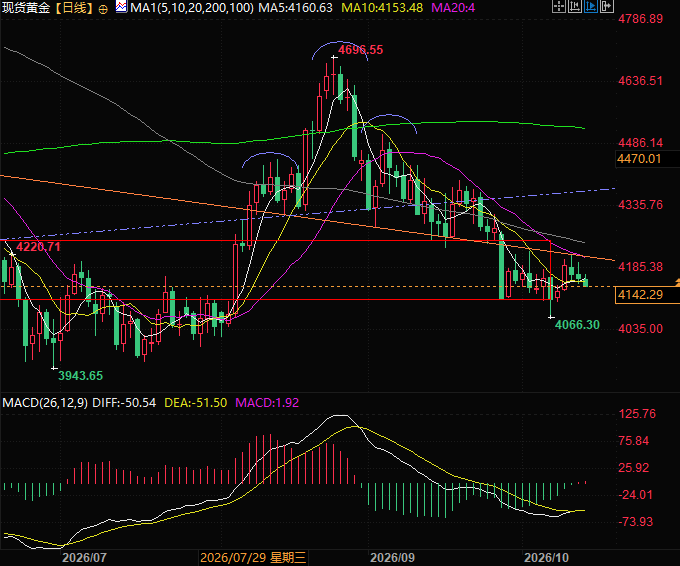 (Spot gold daily chart, source: EasyTrade) At 17:39 Beijing time, spot gold is currently trading at $4142 per ounce.
Energy inflation and AI concerns combine to create challenges for global economic growth.
The IMF recently identified three deep-seated weaknesses in the global economy, and high oil prices are amplifying these structural contradictions, thus lowering the global growth ceiling. The US fiscal deficit continues to deplete national savings, forcing the US to rely on continuous debt issuance to fill the gap. Europe has ample savings resources, but market mechanisms hinder capital flows to high-return projects, resulting in insufficient effective investment. Under the external shock of rising energy prices, the existing weaknesses of these three major economies have been further exposed, putting pressure on global economic growth. Meanwhile, market expectations for AI, the main driver of global economic growth, are beginning to soften. The commercialization of OpenAI is progressing slower than expected, raising concerns about a longer payback period for computing power capital expenditures. The price increase momentum in the HBM (Hardware-Built-Out) supply chain is slowing, prompting the market to reassess the ceiling of global computing power demand. AI has been a core pillar of the US economy in recent years; once AI capital expenditures cool down and long-term growth expectations are revised downwards, it will further suppress global demand for industrial goods and household income levels. This is generally good for gold, but the initial stage of a global economic slowdown can also lead to problems with the income and expenditure of tourist countries. Coupled with the energy crisis and the rapid depletion of foreign exchange reserves, they will have to sell gold to exchange for currency. At the same time, the slowdown in AI has led to a sharp correction in the global equity market, and institutional demand for safe havens tends to sell assets with good liquidity first, such as gold.Declining incomes coupled with rising fuel costs are causing foreign exchange reserves to plummet in tourism-dependent countries.
Weakening household income coupled with rising fuel costs will directly impact economies heavily reliant on inbound tourism for foreign exchange earnings, such as the Maldives and Turkey. These countries are highly dependent on overseas tourists for foreign exchange income, and their domestic crude oil is almost entirely imported. Rising oil prices increase international airfares, local power generation, and transportation costs, suppressing overseas tourists' willingness to travel and leading to a continued decline in tourism-related foreign exchange earnings. However, the dollar expenditure on energy imports is rigid; declining income coupled with difficulty in reducing expenditures results in a rapid depletion of foreign exchange reserves, triggering foreign exchange risk warnings. Sri Lanka's sovereign debt crisis in 2022 was precisely due to the collapse of tourism revenue coupled with soaring energy bills, ultimately exhausting its foreign exchange reserves. When dollar cash is on the verge of depletion, these countries facing a shortage of foreign exchange reserves will use their gold reserves as a last resort for liquidity, being forced to sell gold to obtain dollars, potentially putting supply pressure on gold prices.Market divergence: US 10-year nominal yield falls, but gold prices struggle to rebound.
The recent pullback in the US 10-year nominal Treasury yield has not resulted in a significant rebound in gold prices. The core reason is the extremely limited decline in real interest rates. The decline in nominal long-term bond yields is mainly due to market downward revisions of the US's long-term potential growth rate and a cooling of AI expectations, rather than a substantial improvement in expectations for interest rate cuts. Meanwhile, the situation in the Middle East has pushed up oil prices, raising market inflation expectations. According to the formula: Nominal Yield = Real Interest Rate + Inflation Expectations. A slight decline in nominal interest rates and a simultaneous rise in inflation expectations offset each other, resulting in only a slight decrease in the TIPS real interest rate. Gold is a non-interest-bearing asset, and its pricing is primarily anchored to real interest rates. As long as real interest rates remain resilient, the positive effect of declining nominal long-term bond yields will be significantly reduced, creating a divergence in the market where "long-term bonds fall, gold struggles to strengthen."The pre-release pricing of sticky inflation expectations suppressed gold prices.
The market is currently concerned about the strong stickiness of cost-pull inflation driven by crude oil, a logic similar to the rise in domestic PPI. Rising oil prices push up upstream industrial product prices, with costs slowly being passed down the value chain to the midstream and downstream sectors. Even though the probability of a US rate hike in October is low, the market's main focus is not on an immediate rate hike, but rather on the slowdown in the decline of core CPI due to energy inflation, thus delaying rate cuts and prolonging high interest rates. Before the official release of CPI and PPI data, the market had already priced in the risk of inflation being less controlled than expected, a significant factor driving the early adjustment in gold prices. The market is worried that the cost-driven PPI increase driven by crude oil will be difficult to subside quickly, forcing the Federal Reserve to maintain high interest rates for an extended period, thus suppressing gold valuations.In summary: The bullish logic has temporarily failed, and gold prices may still be searching for a bottom.
Gold prices are currently in a phase of intense tug-of-war between bulls and bears. In the medium to long term, Middle East geopolitical conflicts, global central bank gold purchases, and concerns about a global economic recession provide underlying bullish support. However, in the short term, multiple bearish factors continue to suppress prices: slow declines in real interest rates, market-priced delays in interest rate cuts, and potential gold sell-off risks due to foreign exchange shortages in tourism-related emerging economies, coupled with profit-taking by previous bullish positions. The bullish logic has temporarily failed, and gold prices may continue to seek lower levels. Two key signals to watch are: first, US PPI and CPI data to verify the stickiness of energy inflation; and second, the duration of high oil prices and the rate at which foreign exchange reserves are depleted in tourism-exporting countries like the Maldives. If these countries liquidate their gold reserves en masse, gold prices will face a new round of shocks. Technically, spot gold continues to be suppressed by the bearish alignment of moving averages and the neckline of a previous head and shoulders pattern. If CPI data fails to effectively boost gold prices, the price trend may continue to explore lower levels. (Spot gold daily chart, source: EasyTrade) At 17:39 Beijing time, spot gold is currently trading at $4142 per ounce.
- Risk Warning and Disclaimer
- The market involves risk, and trading may not be suitable for all investors. This article is for reference only and does not constitute personal investment advice, nor does it take into account certain users’ specific investment objectives, financial situation, or other needs. Any investment decisions made based on this information are at your own risk.