Silver prices rebounded after three consecutive days of decline, but the better-than-expected US CPI became a stumbling block.
2026-10-15 14:16:20
Spot silver rebounded slightly after three consecutive days of decline, with falling oil prices, a weaker dollar, and declining bond yields all easing market pressures. However, better-than-expected US CPI data quickly curbed the rise and reinforced hawkish expectations from the Federal Reserve, leaving the outlook for silver prices mixed. 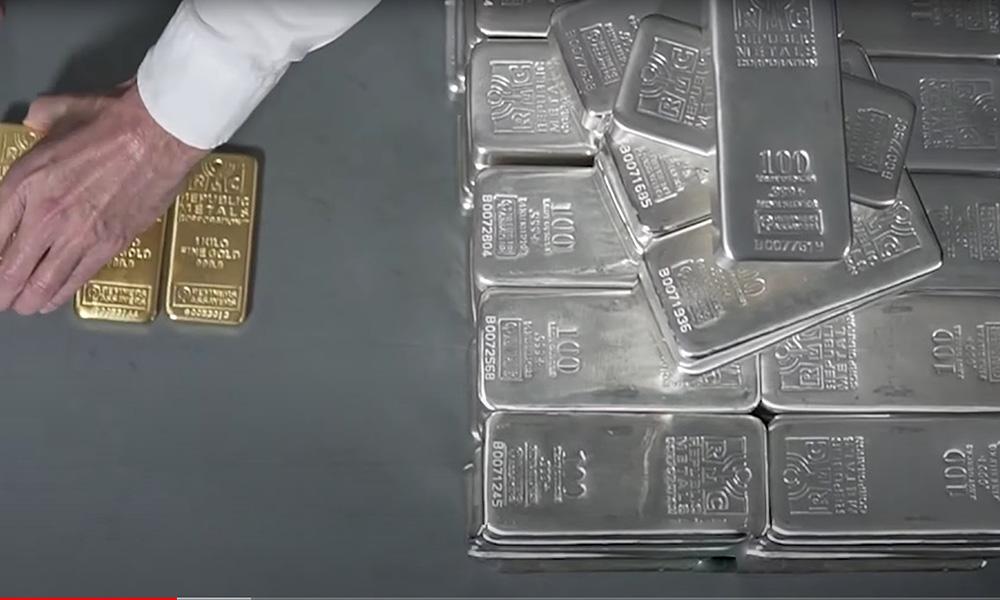
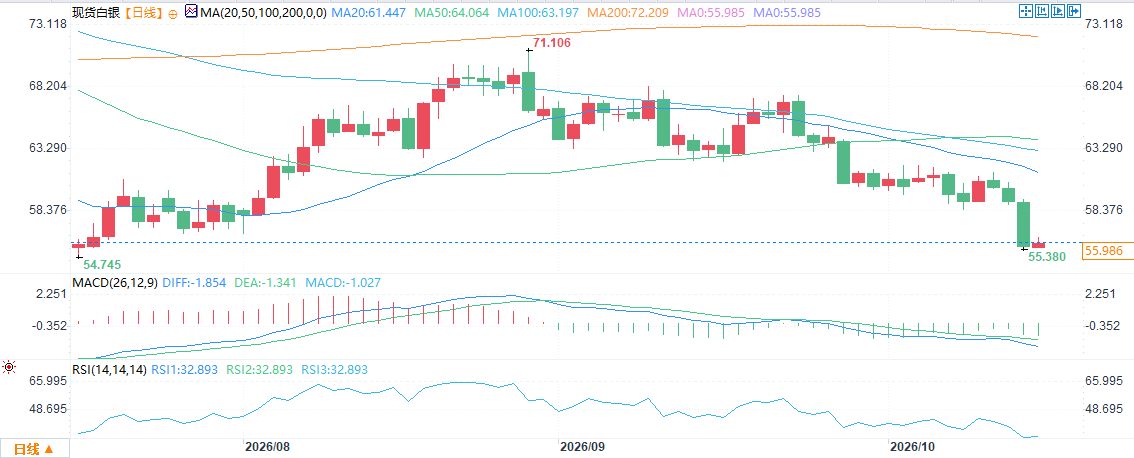 (Spot silver daily chart, source: EasyTrade) At 14:15 Beijing time, spot silver was trading at $56.00 per ounce.
Market Overview: Multiple positive factors boost silver prices to rebound
Spot silver rebounded after three consecutive days of decline, trading around $56.00 per ounce in Asian trading on Thursday (October 15). This rise in silver, a non-interest-bearing asset, mainly benefited from the decline in crude oil prices and the easing of other market pressures. A weaker dollar and lower bond yields provided additional support for precious metals, creating a more favorable environment for non-interest-bearing assets. As a commodity with both precious and industrial metal attributes, silver's price movements are often highly sensitive to changes in macro liquidity, the US dollar index, and the energy market. The recent decline in crude oil prices has reduced market concerns about persistently high inflation and eased some selling pressure on risky assets, indirectly creating breathing room for silver. At the same time, a weaker dollar index lowered the holding cost of dollar-denominated assets, while the decline in US Treasury yields further reduced the opportunity cost of holding non-interest-bearing assets. On the industrial demand side, the medium- to long-term positive outlook for downstream sectors such as photovoltaics and electronics remains, also providing fundamental support for silver. In the short term, if crude oil continues to be under pressure and the US dollar remains weak, silver is expected to continue its rebound; however, caution should be exercised regarding volatility triggered by US economic data or statements from Federal Reserve officials. Overall, with multiple positive factors converging, silver's rebound from three consecutive days of decline reflects the market's pricing in marginal improvements in the macroeconomic environment.Inflationary shock: Higher-than-expected CPI limits silver price gains
However, a stronger-than-expected U.S. inflation report quickly capped silver's gains. The data reinforced market expectations that the Federal Reserve might shift to a more hawkish stance, providing further arguments for a rate hike at the Federal Open Market Committee (FOMC) meeting on October 27-28. Following the data release, according to the CME Group's FedWatch tool, futures traders raised the probability of a rate hike at the end of October meeting to approximately 31.6%. A report released Wednesday by the U.S. Bureau of Labor Statistics (BLS) detailed this economic pressure. The U.S. Consumer Price Index (CPI)—a measure of the cost of a broad range of goods and services in the economy—rose 0.6% month-over-month in September, pushing the 12-month overall inflation rate to 3.7%. Both figures were higher than economists' expectations of 0.6% and 3.6%, respectively. Meanwhile, the core CPI, excluding the volatile food and energy sub-categories, rose 0.3% month-over-month and 2.6% year-over-year, also exceeding market expectations of 0.2% and 2.5%, respectively.Daly leans hawkish but calls for patience as the market digests the CPI shock.
Federal Reserve Bank of California President Mary Daly's remarks were slightly hawkish. She emphasized that overall CPI, driven by gasoline prices, is rising, while core inflation remains stubborn. She noted that further rate hikes may be necessary, but the timing should be carefully considered—a statement highlighting a cautiously hawkish stance that prioritizes clear communication and market stability over rapid action. Her concerns about the risks of persistently high inflation, a robust labor market, and the reassuring fact that markets have calmed after the CPI shock reinforced the signal of patience within a framework that remains focused on price stability. As president of the San Francisco Fed, Daly's comments have significant guiding implications for the market. On the one hand, she acknowledged that overall CPI has rebounded due to energy prices, and that core inflation remains sticky, suggesting that policy rates may need further adjustment; on the other hand, she explicitly called for "patience" and "clear communication" to avoid the market overinterpreting this as a signal of aggressive rate hikes. This statement maintained the Fed's primary objective of price stability while also taking into account considerations of avoiding sharp fluctuations in financial markets. The market experienced brief fluctuations after the recent CPI data release, but quickly returned to calm, indicating that investors have partially priced in the sticky nature of inflation and tend to believe that the Federal Reserve will adopt a data-dependent, gradual policy path. A robust labor market provides the Fed with room to maneuver, preventing it from rushing into a significant tightening. For precious metals, Daly's cautiously hawkish stance suggests that real interest rates and the dollar are unlikely to see significant easing in the short term, but if subsequent data softens, holding cost pressures are expected to ease.Institutional Views
UBS maintains its positive medium-term view on silver, forecasting prices to reach $70/oz in December 2026, rise to $75 in March and June 2027, and further to $80 in September. UBS notes that while recent price corrections have been pressured by rising US real yields and speculative positioning, structural supply-demand gaps and the correlation with gold continue to provide support. UBS emphasizes that as a high-beta commodity, silver is expected to gradually recover before gold prices stabilize and the physical market tightens. Short-term price movements may continue to be influenced by the interest rate environment and position liquidation, but the medium- to long-term outlook is positive for industrial demand (electronics and new energy related) and the return of investment allocation. UBS recommends viewing the current correction as a buying opportunity, with a target path pointing to a gradual rise from 2027, provided that the Fed's policy expectations shift and the physical market tightness does not completely subside.Summarize
Silver's recent rebound was primarily driven by falling oil prices, a weaker dollar, and declining yields. However, better-than-expected CPI data quickly reversed some of the gains and strengthened expectations of a Fed rate hike at the October FOMC meeting. While Daly's remarks were hawkish, he emphasized patience, and sentiment indicators also suggest that the hawkish stance remains unchanged but has softened slightly. Overall, silver prices will likely continue to fluctuate between multiple positive factors and pressure from Fed policy in the short term, with future price movements depending on the evolution of inflation data and the Fed's actual actions. (Spot silver daily chart, source: EasyTrade) At 14:15 Beijing time, spot silver was trading at $56.00 per ounce.
- Risk Warning and Disclaimer
- The market involves risk, and trading may not be suitable for all investors. This article is for reference only and does not constitute personal investment advice, nor does it take into account certain users’ specific investment objectives, financial situation, or other needs. Any investment decisions made based on this information are at your own risk.