Expectations of a Bank of Japan interest rate hike have increased, causing the dollar to weaken slightly against the yen.
2026-10-15 15:06:19
The USD/JPY currency pair encountered strong selling pressure after hitting a three-week high of around 159.00 on Wednesday, and continued its pullback in Asian trading on Thursday, falling as much as a one-week low of around 157.60, a drop of more than 1.4%. This pullback was not driven by a single factor, but rather by the combined effects of strengthened policy signals on the yen side, increased intervention risks, and profit-taking on the dollar side. 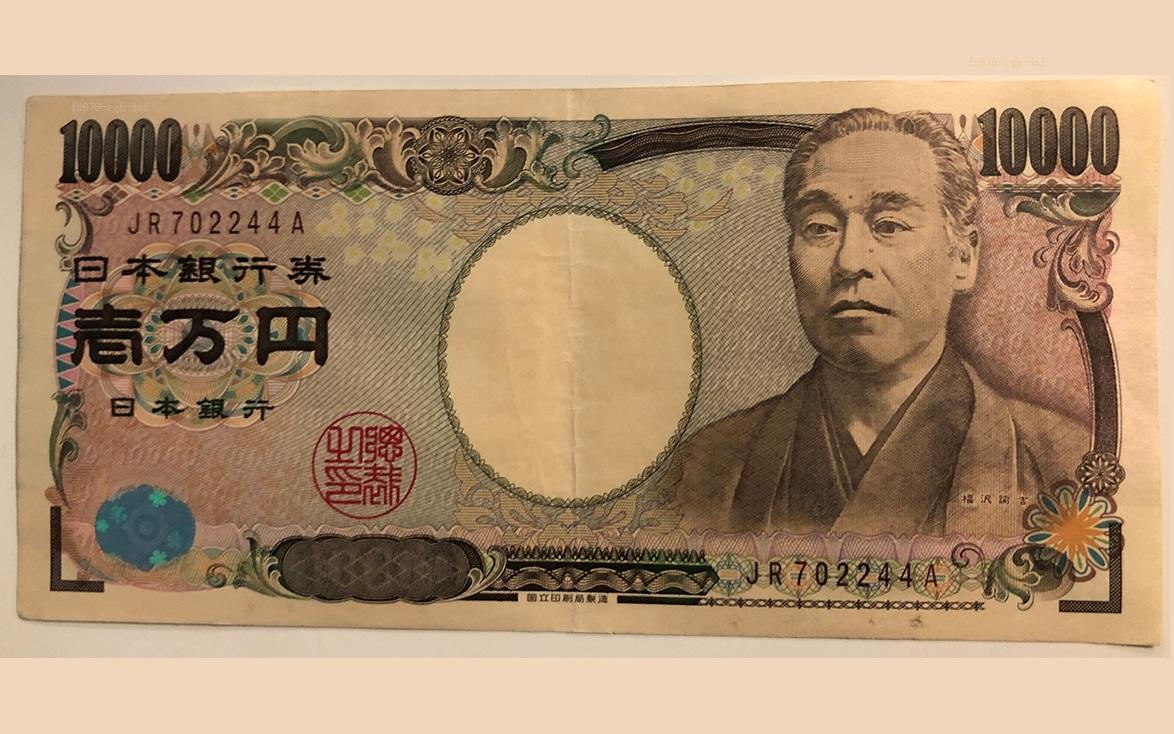 The yen is supported by multiple factors. Bank of Japan policy board member Junko Koeda stated on Thursday that the central bank should "adjust policy rates in a timely manner, taking into account economic and price conditions, and incorporating the estimated neutral interest rate range." This statement was interpreted by the market as a firm endorsement of the path to monetary policy normalization, boosting confidence among yen bulls. The Bank of Japan raised its policy rate by 25 basis points to 1.25% at its September meeting, reaching its highest level in 31 years since 1995, marking the second rate hike in three months and the fastest pace since 1990. Although market surveys indicate that Bank of Japan officials tend to avoid a rare series of rate hikes at the October meeting, the pricing probability of a December rate hike remains as high as 88% to 90%, and market expectations for the general direction of policy normalization have not wavered. More importantly, speculation about Japanese authorities intervening in the foreign exchange market continues to provide "implicit support" for the yen. Traders remain highly vigilant about potential official intervention to support the yen. Japanese Prime Minister Sanae Takaichi previously reiterated in parliament that the finance ministers of the US and Japan "continue to maintain close communication on foreign exchange issues," and the yen issue was mentioned "in a general manner" at the latest US-Japan summit. She also acknowledged that "a weak yen has both advantages and disadvantages," highlighting the policy trade-offs faced by the authorities. Analysts at MUFG Bank pointed out that since the joint US-Japan intervention at the end of July, the yen "has remained at a stronger level," proving that the intervention measures have effectively prevented further yen weakness in recent months. The market generally considers the 160 level as a sensitive area for intervention—when the exchange rate approached 159.00 on Wednesday, the rising expectations of intervention became a direct catalyst for profit-taking by long positions. The downward pressure on the dollar side mainly came from the "buy the rumor, sell the fact" reaction after the CPI data release. The US September CPI surged to 3.7% year-on-year, higher than the expected 3.6% and the previous value of 3.4%; core CPI rose to 2.6% year-on-year, also exceeding the expected 2.5%. However, the market's initial reaction to this data quickly shifted—despite higher-than-expected inflation, traders still considered a Fed rate hike skipping in October the baseline scenario, with the probability of an October rate hike rising only from about 22% before the data release to 31.6%, far from reaching the majority level. Meg, head of metals trading at High Ridge Futures, pointed out, "This currently means the Fed is more likely to raise rates," but most institutions still favor a December move. This assessment led to a pullback in US Treasury yields after a brief surge, with the 10-year yield remaining around 5.15%, failing to break through the previous multi-year high of 5.36%. The dollar index closed at 102.51 on Wednesday and weakened slightly in Asian trading on Thursday, triggering some dollar long positions to take profits, thus putting additional downward pressure on the dollar/yen. However, the downside for the dollar is also constrained. The market is still pricing in a probability of over 85% for a Fed rate hike before the end of the year, and inflation risks—especially the uncertainty brought about by energy price volatility—provide fundamental support for further tightening. The ongoing geopolitical tensions in the Middle East, including attacks on Saudi infrastructure by Houthi rebels and the sinking of a container ship in the Strait of Hormuz, have maintained safe-haven demand for the US dollar. Furthermore, reports that the Bank of Japan is leaning towards a non-consecutive rate hike in October have deprived the yen of a catalyst for sustained strength based on rate hike expectations, providing a floor for a potential pullback in USD/JPY. Tonight, the market will see the release of the US September PPI data, which will reveal the depth of energy cost transmission downstream from the wholesale level and serve as an important supplement to the CPI data in verifying whether inflation is expanding. If the PPI also exceeds expectations, it could reignite hawkish expectations and drive a dollar rebound; if the data is moderate, it could further confirm the assessment that "the CPI is a one-off energy shock rather than overall inflation," accelerating a dollar pullback. In addition, Federal Reserve Chairman Warsh is scheduled to speak at the IMF and World Bank annual meetings in Bangkok on Friday. As his last public appearance before the October policy meeting, his latest assessment of the inflation outlook and policy path could be a key variable determining the next direction of USD/JPY. From a technical perspective, USD/JPY has shown clear signs of weakening trend on the 4-hour chart. The exchange rate broke below the key support level of approximately 157.97, the 100-period simple moving average, which has repeatedly acted as dynamic support during pullbacks. This breach signifies a breakdown of the short-term bullish structure. From a Fibonacci retracement perspective, the 23.6% Fibonacci retracement level of approximately 157.61, based on the recent upward wave (from a low of approximately 152.88 to a high of approximately 159.07), has been effectively broken, and bears are awaiting confirmation below this level. If the decline continues, the 38.2% retracement level of approximately 156.71 will become the next key support; a deeper pullback could expose the 50.0% retracement level of approximately 155.98 and the 61.8% retracement level of approximately 155.25. Further structural bottoms are located at the 78.6% retracement level of approximately 154.21 and the 100.0% retracement level of approximately 152.88. On the upside resistance front, the 100-period moving average at approximately 157.97 has transformed from a previous support level into immediate resistance. If the price fails to recover this level, the short-term downtrend will continue. Further strong resistance points to the previous high of 159.07; only a break above this level will confirm a return to bullish control. On the daily chart, the price has retreated rapidly from near the upper Bollinger Band but remains around the 20-day EMA at approximately 157.60, which provides immediate support. The RSI has fallen from its previous bullish zone to near neutral, and the MACD histogram is narrowing with the fast and slow lines converging, indicating a significant weakening of bullish momentum, though it has not yet turned negative.
 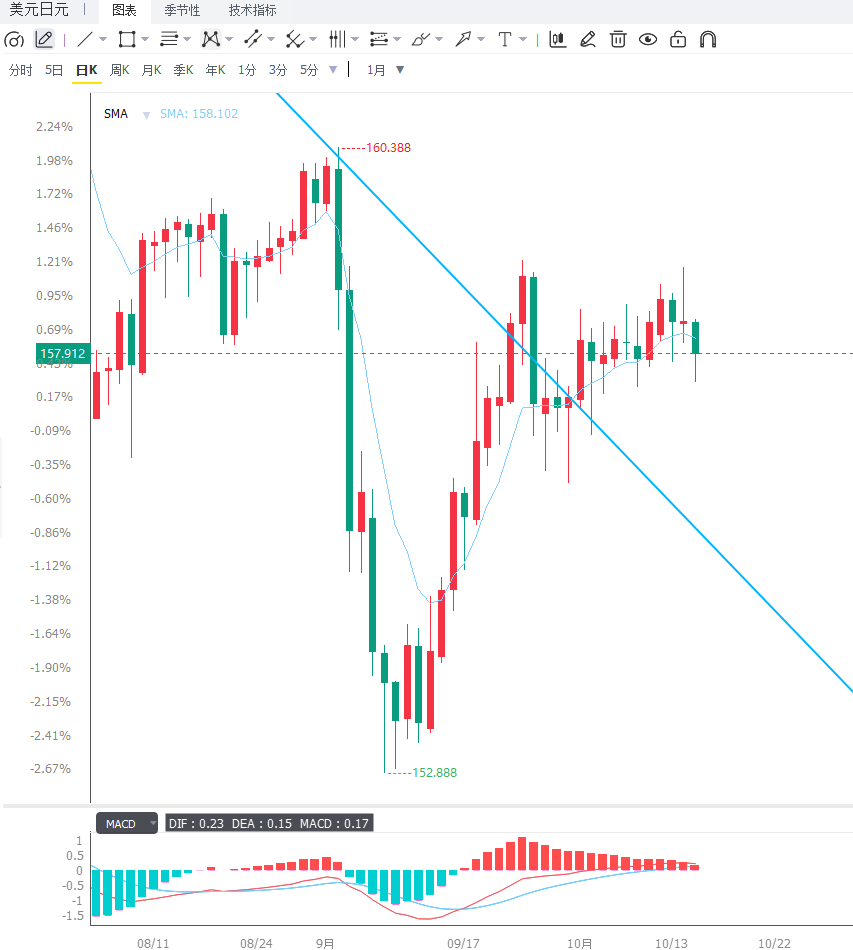 Editor's Summary: The USD/JPY pair is currently in a transitional phase between "profit-taking at the three-week high" and "the continued existence of a medium-term bullish structure." The hawkish comments from Bank of Japan board member Junko Koeda regarding "timely rate hikes," continued speculation about Japanese government intervention in the foreign exchange market, and the market's continued preference for skipping a rate hike in October despite the better-than-expected US CPI, collectively pushed the exchange rate down rapidly from 159.00 to 157.60. However, the market's pricing in a Fed rate hike by more than 85% before the end of the year, the continued safe-haven demand due to Middle East geopolitical risks, and the expectation of a non-consecutive rate hike by the Bank of Japan in October provide a buffer on the downside. Looking ahead, tonight's US PPI data and Friday's Warsh speech will determine the short-term direction—a moderate PPI coupled with Warsh's dovish stance could lead to a further pullback towards 156.71 or even 155.98; a strong PPI coupled with Warsh's hawkish stance could see the exchange rate rebound above 158.00 and retest the 159.00 level.
The yen is supported by multiple factors. Bank of Japan policy board member Junko Koeda stated on Thursday that the central bank should "adjust policy rates in a timely manner, taking into account economic and price conditions, and incorporating the estimated neutral interest rate range." This statement was interpreted by the market as a firm endorsement of the path to monetary policy normalization, boosting confidence among yen bulls. The Bank of Japan raised its policy rate by 25 basis points to 1.25% at its September meeting, reaching its highest level in 31 years since 1995, marking the second rate hike in three months and the fastest pace since 1990. Although market surveys indicate that Bank of Japan officials tend to avoid a rare series of rate hikes at the October meeting, the pricing probability of a December rate hike remains as high as 88% to 90%, and market expectations for the general direction of policy normalization have not wavered. More importantly, speculation about Japanese authorities intervening in the foreign exchange market continues to provide "implicit support" for the yen. Traders remain highly vigilant about potential official intervention to support the yen. Japanese Prime Minister Sanae Takaichi previously reiterated in parliament that the finance ministers of the US and Japan "continue to maintain close communication on foreign exchange issues," and the yen issue was mentioned "in a general manner" at the latest US-Japan summit. She also acknowledged that "a weak yen has both advantages and disadvantages," highlighting the policy trade-offs faced by the authorities. Analysts at MUFG Bank pointed out that since the joint US-Japan intervention at the end of July, the yen "has remained at a stronger level," proving that the intervention measures have effectively prevented further yen weakness in recent months. The market generally considers the 160 level as a sensitive area for intervention—when the exchange rate approached 159.00 on Wednesday, the rising expectations of intervention became a direct catalyst for profit-taking by long positions. The downward pressure on the dollar side mainly came from the "buy the rumor, sell the fact" reaction after the CPI data release. The US September CPI surged to 3.7% year-on-year, higher than the expected 3.6% and the previous value of 3.4%; core CPI rose to 2.6% year-on-year, also exceeding the expected 2.5%. However, the market's initial reaction to this data quickly shifted—despite higher-than-expected inflation, traders still considered a Fed rate hike skipping in October the baseline scenario, with the probability of an October rate hike rising only from about 22% before the data release to 31.6%, far from reaching the majority level. Meg, head of metals trading at High Ridge Futures, pointed out, "This currently means the Fed is more likely to raise rates," but most institutions still favor a December move. This assessment led to a pullback in US Treasury yields after a brief surge, with the 10-year yield remaining around 5.15%, failing to break through the previous multi-year high of 5.36%. The dollar index closed at 102.51 on Wednesday and weakened slightly in Asian trading on Thursday, triggering some dollar long positions to take profits, thus putting additional downward pressure on the dollar/yen. However, the downside for the dollar is also constrained. The market is still pricing in a probability of over 85% for a Fed rate hike before the end of the year, and inflation risks—especially the uncertainty brought about by energy price volatility—provide fundamental support for further tightening. The ongoing geopolitical tensions in the Middle East, including attacks on Saudi infrastructure by Houthi rebels and the sinking of a container ship in the Strait of Hormuz, have maintained safe-haven demand for the US dollar. Furthermore, reports that the Bank of Japan is leaning towards a non-consecutive rate hike in October have deprived the yen of a catalyst for sustained strength based on rate hike expectations, providing a floor for a potential pullback in USD/JPY. Tonight, the market will see the release of the US September PPI data, which will reveal the depth of energy cost transmission downstream from the wholesale level and serve as an important supplement to the CPI data in verifying whether inflation is expanding. If the PPI also exceeds expectations, it could reignite hawkish expectations and drive a dollar rebound; if the data is moderate, it could further confirm the assessment that "the CPI is a one-off energy shock rather than overall inflation," accelerating a dollar pullback. In addition, Federal Reserve Chairman Warsh is scheduled to speak at the IMF and World Bank annual meetings in Bangkok on Friday. As his last public appearance before the October policy meeting, his latest assessment of the inflation outlook and policy path could be a key variable determining the next direction of USD/JPY. From a technical perspective, USD/JPY has shown clear signs of weakening trend on the 4-hour chart. The exchange rate broke below the key support level of approximately 157.97, the 100-period simple moving average, which has repeatedly acted as dynamic support during pullbacks. This breach signifies a breakdown of the short-term bullish structure. From a Fibonacci retracement perspective, the 23.6% Fibonacci retracement level of approximately 157.61, based on the recent upward wave (from a low of approximately 152.88 to a high of approximately 159.07), has been effectively broken, and bears are awaiting confirmation below this level. If the decline continues, the 38.2% retracement level of approximately 156.71 will become the next key support; a deeper pullback could expose the 50.0% retracement level of approximately 155.98 and the 61.8% retracement level of approximately 155.25. Further structural bottoms are located at the 78.6% retracement level of approximately 154.21 and the 100.0% retracement level of approximately 152.88. On the upside resistance front, the 100-period moving average at approximately 157.97 has transformed from a previous support level into immediate resistance. If the price fails to recover this level, the short-term downtrend will continue. Further strong resistance points to the previous high of 159.07; only a break above this level will confirm a return to bullish control. On the daily chart, the price has retreated rapidly from near the upper Bollinger Band but remains around the 20-day EMA at approximately 157.60, which provides immediate support. The RSI has fallen from its previous bullish zone to near neutral, and the MACD histogram is narrowing with the fast and slow lines converging, indicating a significant weakening of bullish momentum, though it has not yet turned negative. Editor's Summary: The USD/JPY pair is currently in a transitional phase between "profit-taking at the three-week high" and "the continued existence of a medium-term bullish structure." The hawkish comments from Bank of Japan board member Junko Koeda regarding "timely rate hikes," continued speculation about Japanese government intervention in the foreign exchange market, and the market's continued preference for skipping a rate hike in October despite the better-than-expected US CPI, collectively pushed the exchange rate down rapidly from 159.00 to 157.60. However, the market's pricing in a Fed rate hike by more than 85% before the end of the year, the continued safe-haven demand due to Middle East geopolitical risks, and the expectation of a non-consecutive rate hike by the Bank of Japan in October provide a buffer on the downside. Looking ahead, tonight's US PPI data and Friday's Warsh speech will determine the short-term direction—a moderate PPI coupled with Warsh's dovish stance could lead to a further pullback towards 156.71 or even 155.98; a strong PPI coupled with Warsh's hawkish stance could see the exchange rate rebound above 158.00 and retest the 159.00 level.
- Risk Warning and Disclaimer
- The market involves risk, and trading may not be suitable for all investors. This article is for reference only and does not constitute personal investment advice, nor does it take into account certain users’ specific investment objectives, financial situation, or other needs. Any investment decisions made based on this information are at your own risk.