Eight months into the Iran-Iraq war, traders are betting on high oil prices to reach 2028, fueling soaring global inflationary pressures.
2026-10-15 15:10:19
The oil market initially viewed the Iranian conflict as a short-term shock, believing that prices would rise before returning to a long-term bearish trajectory. Traders have now adjusted their expectations, betting that oil prices will remain high until at least 2028, leading to a reassessment of the global inflation outlook. With the war now in its eighth month, the initial buffer of energy shocks—inventory and shipping capacity—is rapidly shrinking, with onshore crude oil inventories particularly strained. The recovery of crude oil exports from the Strait of Hormuz remains fragile, global refining capacity is damaged, and hopes for a credible diplomatic end to the conflict have further diminished. The market is paying a premium for supply disruptions to become the norm. 
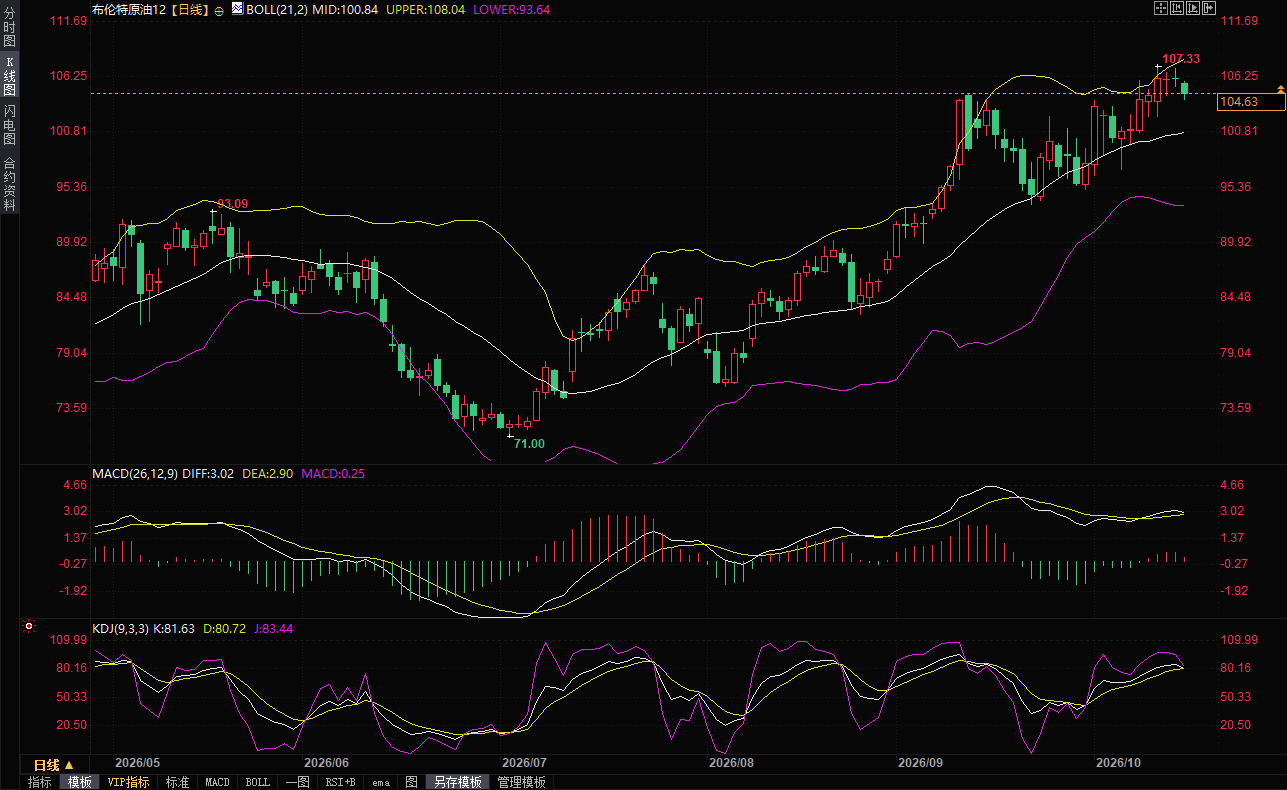 (Brent crude oil December futures daily chart, source: FX678)
The forward curve shows the long-term risk of market repricing.
Brent crude futures clearly reflect this shift. The December 2027 delivery contract has risen more than 13% since early September to $86 a barrel, a record high for the contract; the December 2026 contract has risen about 12% over the same period, recently trading in the $104-$107/barrel range. While the forward curve is not a precise forecast, it reflects the willingness of refiners, airlines, commodity traders, and asset managers to lock in high oil prices for months or even years to come. Market participants are effectively paying an additional cost for the possibility of current supply disruptions becoming a long-term phenomenon.Supply expectations and market bets are in stark contrast.
Industry experts had previously widely anticipated a recovery in global oil supply next year. The latest report from the International Energy Agency (IEA) shows that global oil supply is projected to fall to 100.7 million barrels per day (bpd) in 2026 (a decrease of approximately 5.8 million bpd from the previous year), but is expected to rebound to approximately 108.4 million bpd in 2027 (an increase of approximately 7.7 million bpd). On the demand side, demand is projected at 102.4 million bpd in 2026, with a slight increase in 2027 but still slightly below 2025 levels. Based on this balance, a significant supply surplus should have emerged next year, which would normally suppress oil prices. However, the continued rise in forward prices indicates that investors are increasingly skeptical that the anticipated supply recovery can be fully realized, and even if it does, it will be difficult to sustain. The standoff between Washington and Tehran over control of the Strait of Hormuz continues, and the conflict has spilled over into the wider Gulf region. Against this backdrop, every barrel of oil shipped from the Gulf region carries a higher security premium. Complex logistics, high freight costs, insurance expenses, and military escort costs now account for nearly one-third of total transportation costs, compared to only about 3% before the war. If the Taiwan Strait issue cannot be resolved sustainably, these costs will continue to be reflected in oil prices for the foreseeable future.The diesel market is facing greater pressure and the risk of inflation transmission is rising.
The tension in the diesel market is particularly pronounced. Supply disruptions in the Middle East and Russia have led to severe shortages, pushing European diesel futures to a record high of $1,480 per tonne in mid-September, equivalent to about $210 per barrel. Forward contracts also rose, with the December 2027 delivery price breaking $1,000 per tonne for the first time this week, compared to pre-war levels of around $644. The repricing of fuel prices may have a more macroeconomic impact than the rise in crude oil itself. Trucks, ships, factories, and farms are heavily reliant on diesel, and these sectors are crucial to global business activity. Historically, persistently high diesel prices have gradually transmitted to the overall economy by pushing up transportation, manufacturing, and food costs. The US overall inflation rate in September was 3.7%, nearly double the Fed's 2% target, and core inflation is also slowly rising. Persistently high diesel prices remain a key focus for policymakers in the US and globally.Structurally high costs may become the new normal.
For most of this year, the energy market has continued to draw parallels between the Iran conflict and past geopolitical crises—intense but brief periods of chaos followed by a rapid return to normalcy. However, a growing number of investors are concluding that the issue is no longer simply how much oil can pass through the Strait of Hormuz, but rather whether the global energy system can quickly rebuild the inventories, refining capacity, and supply chains damaged by months of conflict. Until then, the world may face structurally high energy costs, a situation that could persist for an extended period even if the fighting eventually ends.Editor's Summary
The Iranian conflict has lasted far longer than initially expected, evolving from a short-term supply shock into a structural factor that could influence medium- to long-term oil prices and inflation paths. The simultaneous rise in forward crude oil and diesel prices indicates a lack of market confidence in a full supply recovery. Narrowing onshore inventory buffers, rising security premiums in the Taiwan Strait, and damaged refining capacity are collectively pushing up transportation and production costs. While the International Energy Agency predicts a significant supply rebound in 2027, the ongoing geopolitical stalemate increases uncertainty regarding the realization of this expectation. If high oil prices persist for an extended period, they will gradually transmit through energy-intensive industries to broader price levels, increasing the difficulty for global policymakers to stabilize inflation. Current market pricing has already perpetuated some risks; future trends will depend on whether a credible solution to the conflict emerges and the actual progress of supply recovery. (Brent crude oil December futures daily chart, source: FX678)Frequently Asked Questions
Q: Why did the market initially believe the Iran war would only temporarily boost oil prices? A: Historically, most Middle Eastern geopolitical conflicts have had short-term impacts on oil prices, with supply subsequently recovering through increased production in other regions, inventory releases, or diplomatic easing. The market initially judged this conflict to be similarly short-lived, with the long-term supply and demand fundamentals still leaning towards surplus, thus keeping the forward curve relatively moderate. However, as the war entered its eighth month and the diplomatic deadlock remained unresolved, investors reassessed the sustainability of the supply disruptions. Q: What does the more than 13% rise in the Brent crude oil December 2027 contract mean? A: The contract price reaching $86, a record high, reflects market participants' willingness to pay a premium for supply risks over the next year and beyond. It is not a precise price prediction, but rather a reflection of refiners, airlines, and funds locking in high costs. This indicates that concerns about the potential normalization of supply disruptions are deeply ingrained in pricing, rather than merely remaining at the level of short-term fluctuations. Q: The International Energy Agency predicts a significant increase in supply in 2027, so why are forward oil prices still rising? A: The IEA projects supply to fall to 100.7 million barrels per day in 2026 and rebound to about 7.7 million barrels per day in 2027, with demand recovering slightly but still below 2025 levels, theoretically leading to a surplus. However, the market doubts the sustainability of the recovery in exports from the Strait of Hormuz, the speed of refining capacity recovery, and the risk of conflict spillover. Even with improved supply data, security premiums and logistics costs may remain embedded in prices for a long time, leading to higher forward contracts. Q: Why is the surge in diesel prices attracting more attention than crude oil? A: Diesel is a core fuel for road transport, shipping, industry, and agriculture. Its price increases directly push up logistics and production costs, ultimately affecting food and consumer goods. European diesel futures have hit a record high of $1,480 per ton, with forward contracts exceeding $1,000, far exceeding pre-war levels. This structural tension often has a more lasting and widespread impact on inflation than crude oil. Q: How will current security premiums and inventory levels affect future oil prices? A: Before the war, security-related costs accounted for only about 3% of transportation costs; now they are approaching one-third, including freight, insurance, and escort. Onshore crude oil inventories have rapidly narrowed their buffer, further weakening their ability to cope with shocks. If the Taiwan Strait issue cannot be resolved sustainably, these additional costs will continue to be reflected in oil prices. Even if nominal supply recovers, actual landed costs may remain high, prolonging the impact of high oil prices on the economy and inflation. At 15:07 Beijing time, Brent crude oil futures for December delivery were trading at $104.61 per barrel.- Risk Warning and Disclaimer
- The market involves risk, and trading may not be suitable for all investors. This article is for reference only and does not constitute personal investment advice, nor does it take into account certain users’ specific investment objectives, financial situation, or other needs. Any investment decisions made based on this information are at your own risk.