The Bank of England's chief economist questioned the pace of interest rate hikes; the pound/dollar pair held steady above 1.3230, awaiting UK GDP guidance.
2026-10-15 15:28:22
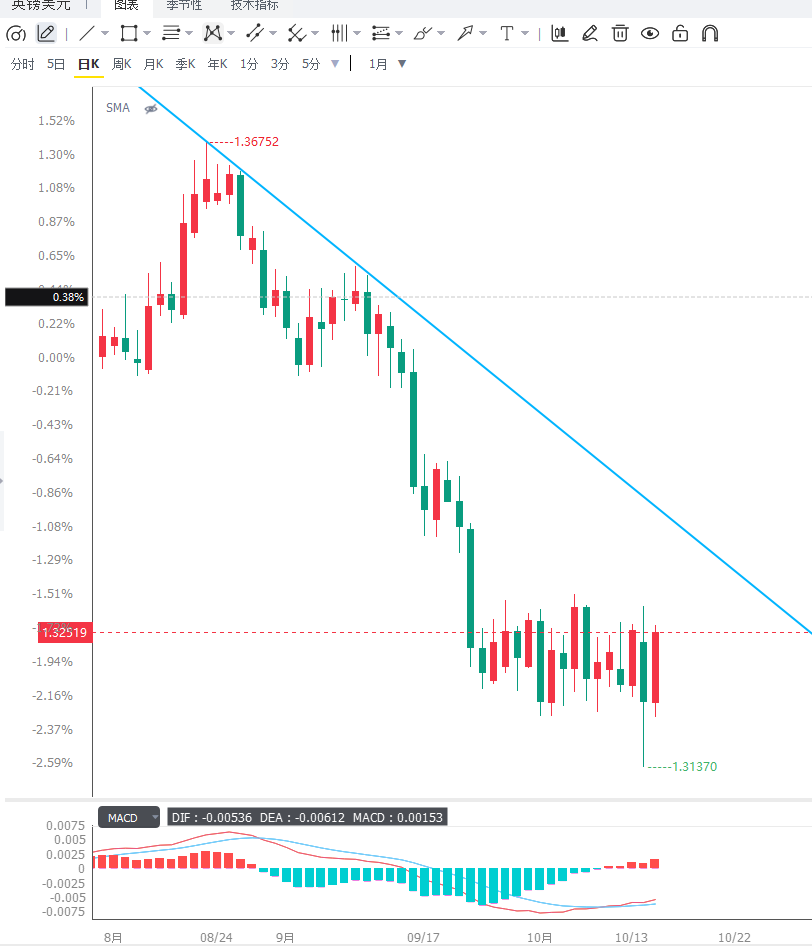
The GBP/USD pair strengthened slightly in Asian trading on Thursday after consolidating in a narrow range on Wednesday, trading around 1.3230. Despite the US September CPI data released the previous trading day significantly exceeding expectations, the dollar failed to receive a sustained boost, reflecting a subtle shift in market perception of the Federal Reserve's policy path—while inflation remains stubborn, skipping a rate hike in October is still considered the baseline scenario, with the rate hike window pushed back to December or even further.  Data released by the U.S. Bureau of Labor Statistics on Wednesday showed that the overall CPI rose 0.6% month-on-month in September (previous value 0.4%), and surged to 3.7% year-on-year (previous value 3.4%), exceeding market expectations of 3.6% and reaching its highest level in four months. Core CPI rose 0.3% month-on-month and to 2.6% year-on-year, also higher than the expected 2.5%. This data should have been a powerful weapon for the dollar bulls, but the market reaction was surprisingly restrained. The CME FedWatch Tool showed that the probability of keeping interest rates unchanged at the October 27-28 meeting was about 75.1%, a significant jump from 53% a month ago; the market priced in a cumulative tightening of about 79 basis points by the end of 2027, reflecting that investors are pushing their rate hike expectations further into the future rather than focusing on short-term actions. This pricing logic of "inflation exceeding expectations but not changing the short-term policy path" weakened the immediate boost to the dollar from the CPI data. Policy signals from the Bank of England also presented a complex mix of hawkish and dovish sentiment. Chief Economist Hugh Peele spoke on Wednesday, expressing skepticism about the market pricing in four rate hikes over the next year. Peele's speech received a 7.0 rating out of 10, slightly below his historical average of 7.4, signaling a "mildly hawkish but questioning pace of tightening." He stated that the resilience of UK output and the labor market has been acknowledged, but excessively rapid growth has been downplayed, and more concrete evidence is needed to justify a 100-basis-point tightening. Peele also noted that earlier action by the central bank would have demonstrated it was not "passively waiting and hoping," while arguing that "it would be a mistake not to react to uncertainty"—a statement highlighting his preference for a data-driven, gradual tightening path rather than the aggressive pace of rate hikes priced in by the market. However, Bank of England Governor Bailey's speech on Tuesday was more cautionary. Bailey emphasized that the energy shock's pressure on broader inflation in the UK has been "so far relatively mild," but "the longer it lasts, the more difficult it will be to control." This statement was interpreted by the market as a sign of the central bank's high vigilance regarding the transmission effects of second-degree inflation, suggesting that if the Middle East conflict continues to push up energy costs, the necessity for interest rate hikes will increase significantly. Monetary Policy Committee member Green previously stated that the UK economy is growing faster than expected, supporting the prospect of a tighter monetary policy. The IMF has raised its 2026 UK economic growth forecast from 1.0% to 1.3%, further reinforcing the hawkish narrative. Market surveys show that the market has priced in a near certainty of a 25 basis point rate hike by the Bank of England in November, followed by three more rate hikes expected by September 2027. Scotiabank strategists provided a detailed assessment of the pound's performance in their latest report. They noted that the pound has "strengthened moderately against the dollar," but the increase is "only comparable to its core major currency counterparts," with policy signals and growth data jointly supporting the pound. Scotiabank specifically mentioned Green's comments that "faster economic growth supports the prospect of a tighter monetary policy," and the fact that the IMF has raised its UK growth forecast. From a technical perspective, Scotiabank describes the short-term outlook for GBP/USD as "neutral"—"The pair has formed a clear trading range over the past few weeks, with solid support below 1.32 and resistance at the upper 1.32/lower 1.33 area." The bank adds that "the trend momentum on the intraday chart is neutral, supporting the outlook for more sideways movement," although "broader bearish pressure remains intact" but "may be easing." Key support lies in the 1.3140/50 area. Today, the market will face the test of two important data releases. The UK's August GDP data will be released, providing the latest clues to the momentum of UK economic growth—a robust figure would strengthen the fundamental basis for a Bank of England rate hike in November, providing support for the pound; a weak figure could weaken the persuasiveness of a hawkish narrative. US September PPI and retail sales data will be released on the same day. The PPI will verify the extent of inflation spread reflected in the CPI from the wholesale side, while retail sales will test the resilience of US consumer spending. The combined effect of these three data points may disrupt the current equilibrium within the 1.32-1.33 range. From a technical perspective, the GBP/USD pair maintains a bearish but moderately bearish pattern on the daily chart. The exchange rate continues to trade below the 100-day simple moving average and the 20-day Bollinger Band middle line, maintaining a strong bearish tone. However, the price is also holding above the lower Bollinger Band, indicating that while downward pressure has not subsided, it has eased somewhat. The 14-day Relative Strength Index (RSI) is around 42.9, below the 50 neutral line but well above the oversold zone, suggesting that selling pressure persists but has not yet reached extreme levels. The MACD indicator is below the zero line, but the histogram is narrowing, indicating a marginal weakening of bearish momentum. On the upside, the Bollinger Band middle line at approximately 1.3255 forms the first key resistance level, coinciding with the vicinity of the 10-day moving average. Subsequent resistance levels to watch are the upper Bollinger Band at approximately 1.3360 and the 100-day moving average at approximately 1.3390, which together form a dense supply area. Only a decisive break above 1.3390 would confirm a substantial easing of the bearish trend. On the downside, the lower Bollinger Band at approximately 1.3145 forms the most immediate downside defense, highly coinciding with the key support levels of 1.3140/50 marked by Scotiabank. A daily close below this area would open up further downside potential, with targets at 1.3100 and even 1.3044. Looking at the 4-hour chart, the price is oscillating within a range of 1.3200 to 1.3275, with short-term moving averages flattening, Bollinger Bands narrowing, and volatility continuing to converge, indicating the market awaits a directional breakout. The first short-term resistance level is 1.3255, which corresponds to the immediate level of the Bollinger Band middle line on the daily chart. The short-term support level is the psychological level of 1.3200. If this level is held, the exchange rate is expected to continue to test the resistance zone of 1.3255 to 1.3300. Once it falls below 1.3200, it may trigger an accelerated pullback towards the lower Bollinger Band at 1.3145.
  Editor's Summary: GBP/USD is currently in a delicate balance between "US inflation exceeding expectations but rate hikes delayed" and "robust UK growth but the central bank questioning the pace of tightening." US September CPI surged to 3.7% and core CPI rose to 2.6%, both exceeding expectations, but the market still considers a skipped rate hike in October as the baseline scenario (75.1% probability), and the dollar has failed to gain sustained support. In the UK, the IMF raised its growth forecast to 1.3%, Green emphasized that growth supports tightening, and Bailey warned of increasing risks to inflation transmission, all reinforcing market expectations that a November rate hike is near certainty; however, Chief Economist Peale's questioning of the market pricing in four rate hikes sets a "speed limit" on the pound's upside potential. Scotiabank characterizes the current pattern as "neutral range trading," with solid support below 1.32 and clear resistance above 1.33. Looking ahead, today's UK GDP and US PPI/retail data will be key catalysts for breaking the range equilibrium. If UK GDP remains robust and US PPI remains moderate, GBP/USD could challenge the resistance zone of 1.3255 to 1.3360. However, if UK data is weak and US inflation is confirmed to be spreading, the exchange rate could fall back to the lower Bollinger Band at 1.3145 or even 1.3100.
Data released by the U.S. Bureau of Labor Statistics on Wednesday showed that the overall CPI rose 0.6% month-on-month in September (previous value 0.4%), and surged to 3.7% year-on-year (previous value 3.4%), exceeding market expectations of 3.6% and reaching its highest level in four months. Core CPI rose 0.3% month-on-month and to 2.6% year-on-year, also higher than the expected 2.5%. This data should have been a powerful weapon for the dollar bulls, but the market reaction was surprisingly restrained. The CME FedWatch Tool showed that the probability of keeping interest rates unchanged at the October 27-28 meeting was about 75.1%, a significant jump from 53% a month ago; the market priced in a cumulative tightening of about 79 basis points by the end of 2027, reflecting that investors are pushing their rate hike expectations further into the future rather than focusing on short-term actions. This pricing logic of "inflation exceeding expectations but not changing the short-term policy path" weakened the immediate boost to the dollar from the CPI data. Policy signals from the Bank of England also presented a complex mix of hawkish and dovish sentiment. Chief Economist Hugh Peele spoke on Wednesday, expressing skepticism about the market pricing in four rate hikes over the next year. Peele's speech received a 7.0 rating out of 10, slightly below his historical average of 7.4, signaling a "mildly hawkish but questioning pace of tightening." He stated that the resilience of UK output and the labor market has been acknowledged, but excessively rapid growth has been downplayed, and more concrete evidence is needed to justify a 100-basis-point tightening. Peele also noted that earlier action by the central bank would have demonstrated it was not "passively waiting and hoping," while arguing that "it would be a mistake not to react to uncertainty"—a statement highlighting his preference for a data-driven, gradual tightening path rather than the aggressive pace of rate hikes priced in by the market. However, Bank of England Governor Bailey's speech on Tuesday was more cautionary. Bailey emphasized that the energy shock's pressure on broader inflation in the UK has been "so far relatively mild," but "the longer it lasts, the more difficult it will be to control." This statement was interpreted by the market as a sign of the central bank's high vigilance regarding the transmission effects of second-degree inflation, suggesting that if the Middle East conflict continues to push up energy costs, the necessity for interest rate hikes will increase significantly. Monetary Policy Committee member Green previously stated that the UK economy is growing faster than expected, supporting the prospect of a tighter monetary policy. The IMF has raised its 2026 UK economic growth forecast from 1.0% to 1.3%, further reinforcing the hawkish narrative. Market surveys show that the market has priced in a near certainty of a 25 basis point rate hike by the Bank of England in November, followed by three more rate hikes expected by September 2027. Scotiabank strategists provided a detailed assessment of the pound's performance in their latest report. They noted that the pound has "strengthened moderately against the dollar," but the increase is "only comparable to its core major currency counterparts," with policy signals and growth data jointly supporting the pound. Scotiabank specifically mentioned Green's comments that "faster economic growth supports the prospect of a tighter monetary policy," and the fact that the IMF has raised its UK growth forecast. From a technical perspective, Scotiabank describes the short-term outlook for GBP/USD as "neutral"—"The pair has formed a clear trading range over the past few weeks, with solid support below 1.32 and resistance at the upper 1.32/lower 1.33 area." The bank adds that "the trend momentum on the intraday chart is neutral, supporting the outlook for more sideways movement," although "broader bearish pressure remains intact" but "may be easing." Key support lies in the 1.3140/50 area. Today, the market will face the test of two important data releases. The UK's August GDP data will be released, providing the latest clues to the momentum of UK economic growth—a robust figure would strengthen the fundamental basis for a Bank of England rate hike in November, providing support for the pound; a weak figure could weaken the persuasiveness of a hawkish narrative. US September PPI and retail sales data will be released on the same day. The PPI will verify the extent of inflation spread reflected in the CPI from the wholesale side, while retail sales will test the resilience of US consumer spending. The combined effect of these three data points may disrupt the current equilibrium within the 1.32-1.33 range. From a technical perspective, the GBP/USD pair maintains a bearish but moderately bearish pattern on the daily chart. The exchange rate continues to trade below the 100-day simple moving average and the 20-day Bollinger Band middle line, maintaining a strong bearish tone. However, the price is also holding above the lower Bollinger Band, indicating that while downward pressure has not subsided, it has eased somewhat. The 14-day Relative Strength Index (RSI) is around 42.9, below the 50 neutral line but well above the oversold zone, suggesting that selling pressure persists but has not yet reached extreme levels. The MACD indicator is below the zero line, but the histogram is narrowing, indicating a marginal weakening of bearish momentum. On the upside, the Bollinger Band middle line at approximately 1.3255 forms the first key resistance level, coinciding with the vicinity of the 10-day moving average. Subsequent resistance levels to watch are the upper Bollinger Band at approximately 1.3360 and the 100-day moving average at approximately 1.3390, which together form a dense supply area. Only a decisive break above 1.3390 would confirm a substantial easing of the bearish trend. On the downside, the lower Bollinger Band at approximately 1.3145 forms the most immediate downside defense, highly coinciding with the key support levels of 1.3140/50 marked by Scotiabank. A daily close below this area would open up further downside potential, with targets at 1.3100 and even 1.3044. Looking at the 4-hour chart, the price is oscillating within a range of 1.3200 to 1.3275, with short-term moving averages flattening, Bollinger Bands narrowing, and volatility continuing to converge, indicating the market awaits a directional breakout. The first short-term resistance level is 1.3255, which corresponds to the immediate level of the Bollinger Band middle line on the daily chart. The short-term support level is the psychological level of 1.3200. If this level is held, the exchange rate is expected to continue to test the resistance zone of 1.3255 to 1.3300. Once it falls below 1.3200, it may trigger an accelerated pullback towards the lower Bollinger Band at 1.3145. Editor's Summary: GBP/USD is currently in a delicate balance between "US inflation exceeding expectations but rate hikes delayed" and "robust UK growth but the central bank questioning the pace of tightening." US September CPI surged to 3.7% and core CPI rose to 2.6%, both exceeding expectations, but the market still considers a skipped rate hike in October as the baseline scenario (75.1% probability), and the dollar has failed to gain sustained support. In the UK, the IMF raised its growth forecast to 1.3%, Green emphasized that growth supports tightening, and Bailey warned of increasing risks to inflation transmission, all reinforcing market expectations that a November rate hike is near certainty; however, Chief Economist Peale's questioning of the market pricing in four rate hikes sets a "speed limit" on the pound's upside potential. Scotiabank characterizes the current pattern as "neutral range trading," with solid support below 1.32 and clear resistance above 1.33. Looking ahead, today's UK GDP and US PPI/retail data will be key catalysts for breaking the range equilibrium. If UK GDP remains robust and US PPI remains moderate, GBP/USD could challenge the resistance zone of 1.3255 to 1.3360. However, if UK data is weak and US inflation is confirmed to be spreading, the exchange rate could fall back to the lower Bollinger Band at 1.3145 or even 1.3100.
- Risk Warning and Disclaimer
- The market involves risk, and trading may not be suitable for all investors. This article is for reference only and does not constitute personal investment advice, nor does it take into account certain users’ specific investment objectives, financial situation, or other needs. Any investment decisions made based on this information are at your own risk.