Better-than-expected US CPI data boosted expectations of a Federal Reserve rate hike, causing the USD/CAD exchange rate to continue its high-level consolidation.
2026-10-15 15:26:18
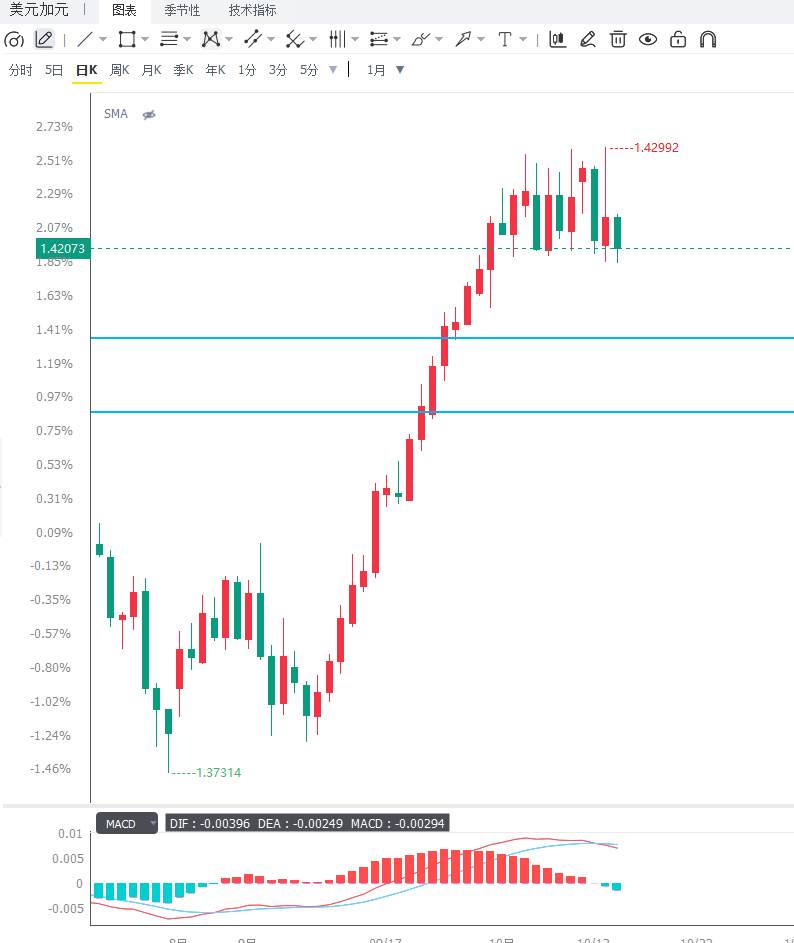
The USD/CAD pair retreated during Thursday's Asian session, trading around 1.4200 after a modest rise in the previous session, giving back some of Wednesday's gains. This movement reflects the complex interplay in the current market – while strong US inflation data failed to drive the US dollar higher as expected; meanwhile, the Canadian dollar is under independent pressure due to falling oil prices, limiting its downside potential.  Data released Wednesday by the U.S. Bureau of Labor Statistics became the core driver of market repricing. The overall CPI rose 0.6% month-over-month in September, surging to 3.7% year-over-year, exceeding market expectations of 3.6%; core CPI rose 0.3% month-over-month (expected 0.2%), and to 2.6% year-over-year (expected 2.5%). This "double-worst-than-expected" inflation reading directly prompted a recalibration of Federal Reserve rate hike expectations—the CME FedWatch Tool showed that the probability of a rate hike at the October 27-28 meeting rose from about 22% before the data release to 31.6%, while the probability of a December rate hike remained high at about 89.7%. However, the immediate market reaction did not translate into a sustained strengthening of the dollar. TD Securities noted in its latest report that "the Treasury market has seen a clear flattening of the bear market, with the market pricing in more rate hikes," but the bank maintained its policy judgment—"Despite the significant increase in pricing, we do not expect a rate hike in October." TD also warned that "stronger data suggests the risk of more rate hikes in the coming months, maintaining upward pressure on interest rates." This policy path judgment of "skipping the short term and becoming more hawkish in the long term" has put the dollar in an awkward position—it cannot surge due to rising expectations of an October rate hike, nor can it weaken due to the baseline scenario of "holding rates steady." Ultimately, it has manifested as mild fluctuations after the CPI exceeded expectations, rather than a trend breakout. The latest statements from Federal Reserve officials have further reinforced the policy tone of "gradual tightening." San Francisco Fed President Daly said on Wednesday that the Fed "may need to raise rates further" to curb excessive inflation, but also hinted that there is no need to rush into action at the October meeting. Her speech received a tracking score of 6.8 out of 10, slightly higher than its historical average of 6.1, signaling a "hawkish but patient" stance. Daly emphasized that overall CPI, driven by gasoline, is rising, core inflation remains stubborn, and further rate hikes "are possible," but the timing should be "cautious and well-considered." The Federal Reserve's sentiment index dipped slightly by 0.84 points to 128.17, showing a marginal decline but remaining firmly above the 100 neutral line, indicating that the Fed's overall communication remains in a clearly hawkish zone. Independent headwinds for the Canadian dollar came from policy changes in the energy market. The Trump administration is considering easing sanctions on "shadow fleet" tankers, which have historically been used to transport crude oil and petroleum products from sanctioned countries such as Russia, Iran, and Venezuela. Market surveys indicate that a US official confirmed this potential policy shift on Wednesday, with the aim of lowering currently record-high global shipping rates. This discussion follows Trump's recent decision to temporarily lift sanctions on Russian diesel fuel, a move that has drawn strong criticism from Ukrainian President Zelensky, several European allies, and a number of Republican senators. Oil prices reacted immediately—WTI crude retreated from its five-day high, trading around $93 per barrel in Asian trading on Thursday, compared to a settlement price of $95.09 in the previous session. Rising expectations of easing supply have weakened the upward momentum of oil prices, and as a major net oil exporter, the Canadian dollar is typically highly positively correlated with crude oil prices. Falling oil prices directly weakened the Canadian dollar's commodity currency support, limiting the downside potential of USD/CAD against a weakening US dollar. This transmission mechanism has resulted in a relative pattern of "weak US dollar, weaker Canadian dollar," with the 1.4200 level becoming a temporary equilibrium accepted by both bulls and bears. From a broader interest rate perspective, the "bear market flattening" of the US Treasury yield curve is the most significant structural change currently signaling a shift in the market. TD Securities points out that stronger inflation data is driving up short-term interest rate expectations, while long-term yields are relatively stable due to the compression of term premiums, forming a typical flattening pattern. This pattern typically occurs when the market reprices a "higher and longer" interest rate path—investors believe the Federal Reserve will take further tightening action but do not believe it will lead to a recession, thus limiting the upside potential of long-term yields. For USD/CAD, the US-Canada interest rate differential remains the core pricing variable. The Federal Reserve maintained its policy rate in the 3.75% to 4.00% range, while the Bank of Canada kept its rate at 2.25%. This significant interest rate differential of 150 to 175 basis points fundamentally reduced the attractiveness of Canadian dollar assets relative to US dollar assets, providing medium-term support for the exchange rate. Tonight, the market will face a crucial test with the release of US September PPI and retail sales data. The PPI will verify the extent of inflation spread reflected in the CPI from the wholesale perspective—if the PPI also exceeds expectations, it will further reinforce the hawkish narrative that "inflation is expanding," potentially pushing the dollar higher and boosting the exchange rate; if the PPI is moderate, it may alleviate market fears of broad-based inflation, weakening the dollar's interest rate advantage. Retail sales data will test the resilience of US consumer spending—continued strong consumption will provide evidence for the Fed's assessment of "demand-driven inflation," while weak spending could activate expectations of an economic downturn, making the policy path of "skipping October and betting on December" clearer. From a technical perspective, the USD/CAD pair maintains a medium-term bullish structure on the daily chart, but short-term momentum is showing signs of weakening. The exchange rate is trading steadily above the 20-day exponential moving average (RMB) at approximately 1.4163. This moving average has consistently provided dynamic support since the end of September, with multiple pullbacks finding support here, indicating that the medium-term bullish framework remains intact. The 14-day Relative Strength Index (RSI) is around 59.0, in positive territory but not yet overbought, suggesting that buyers remain in control and there is still room for further gains before the upward momentum becomes excessive. The MACD indicator is above the zero line, but the red bars are narrowing, and the fast and slow lines are showing signs of convergence, indicating that upward momentum is gradually weakening but has not turned negative. The Bollinger Bands remain upward-opening, with the price trading in a relatively strong area between the middle and upper bands. On the upside resistance front, the 1.4245-1.4250 area represents the midpoint of the recent trading range and is gaining increasing technical importance. Further up, the area around 1.4300 forms a key psychological level and a previous swing high; only a sustained hold above this level can confirm the continuation of the bullish structure and open up further upside potential. A breakout could target 1.4310 (the 61.8% Fibonacci retracement level of the decline in the first half of last year). On the downside, the 20-day EMA around 1.4163 forms the first line of support; a break below this level would signal a deeper correction. The next support level to watch is the 1.4150-1.4145 area, followed by the psychological level of 1.4100 and the 1.4050 area. However, until the major support levels are effectively broken, the current technical structure should focus on finding support during pullbacks rather than directly judging a trend reversal.
  Editor's Summary: The USD/CAD pair is currently in a state of equilibrium between two opposing forces: "US inflation exceeding expectations but interest rate hikes postponed" and "falling oil prices dragging down the Canadian dollar." While the US September CPI surged to 3.7% and core CPI rose to 2.6%, increasing the probability of an October rate hike to 31.6% and triggering a flattening of the US Treasury yield curve, TD Securities and San Francisco Fed President Daly both favor the Fed holding rates steady this month and delaying action until December, thus preventing a sustained boost to the US dollar. Regarding the Canadian dollar, the Trump administration's consideration of easing sanctions on "shadow fleets" to lower shipping rates and downward pressure on oil prices weakened support for commodity currencies, allowing the exchange rate to maintain relative resilience against the backdrop of a weakening US dollar. The 150-175 basis point USD/CAD interest rate differential continues to provide medium-term bottom support for the exchange rate. Looking ahead, tonight's US PPI and retail sales data will be key variables for short-term direction. Strong PPI coupled with resilient consumption could reignite hawkish expectations, pushing the exchange rate to retest 1.4245 or even 1.4300. Moderate PPI coupled with a slowdown in retail sales could reinforce the policy path of "skipping October," causing the exchange rate to consolidate towards the 20-day EMA at 1.4163 or even 1.4100. In the medium term, oil price movements remain the core variable determining the Canadian dollar's independent direction. If the easing of sanctions on the "shadow fleet" leads to a continued decline in oil prices, the Canadian dollar will face additional depreciation pressure, and the exchange rate is expected to maintain a relatively strong position. Conversely, if renewed geopolitical risks in the Middle East drive a rebound in oil prices, the Canadian dollar may receive some support.
Data released Wednesday by the U.S. Bureau of Labor Statistics became the core driver of market repricing. The overall CPI rose 0.6% month-over-month in September, surging to 3.7% year-over-year, exceeding market expectations of 3.6%; core CPI rose 0.3% month-over-month (expected 0.2%), and to 2.6% year-over-year (expected 2.5%). This "double-worst-than-expected" inflation reading directly prompted a recalibration of Federal Reserve rate hike expectations—the CME FedWatch Tool showed that the probability of a rate hike at the October 27-28 meeting rose from about 22% before the data release to 31.6%, while the probability of a December rate hike remained high at about 89.7%. However, the immediate market reaction did not translate into a sustained strengthening of the dollar. TD Securities noted in its latest report that "the Treasury market has seen a clear flattening of the bear market, with the market pricing in more rate hikes," but the bank maintained its policy judgment—"Despite the significant increase in pricing, we do not expect a rate hike in October." TD also warned that "stronger data suggests the risk of more rate hikes in the coming months, maintaining upward pressure on interest rates." This policy path judgment of "skipping the short term and becoming more hawkish in the long term" has put the dollar in an awkward position—it cannot surge due to rising expectations of an October rate hike, nor can it weaken due to the baseline scenario of "holding rates steady." Ultimately, it has manifested as mild fluctuations after the CPI exceeded expectations, rather than a trend breakout. The latest statements from Federal Reserve officials have further reinforced the policy tone of "gradual tightening." San Francisco Fed President Daly said on Wednesday that the Fed "may need to raise rates further" to curb excessive inflation, but also hinted that there is no need to rush into action at the October meeting. Her speech received a tracking score of 6.8 out of 10, slightly higher than its historical average of 6.1, signaling a "hawkish but patient" stance. Daly emphasized that overall CPI, driven by gasoline, is rising, core inflation remains stubborn, and further rate hikes "are possible," but the timing should be "cautious and well-considered." The Federal Reserve's sentiment index dipped slightly by 0.84 points to 128.17, showing a marginal decline but remaining firmly above the 100 neutral line, indicating that the Fed's overall communication remains in a clearly hawkish zone. Independent headwinds for the Canadian dollar came from policy changes in the energy market. The Trump administration is considering easing sanctions on "shadow fleet" tankers, which have historically been used to transport crude oil and petroleum products from sanctioned countries such as Russia, Iran, and Venezuela. Market surveys indicate that a US official confirmed this potential policy shift on Wednesday, with the aim of lowering currently record-high global shipping rates. This discussion follows Trump's recent decision to temporarily lift sanctions on Russian diesel fuel, a move that has drawn strong criticism from Ukrainian President Zelensky, several European allies, and a number of Republican senators. Oil prices reacted immediately—WTI crude retreated from its five-day high, trading around $93 per barrel in Asian trading on Thursday, compared to a settlement price of $95.09 in the previous session. Rising expectations of easing supply have weakened the upward momentum of oil prices, and as a major net oil exporter, the Canadian dollar is typically highly positively correlated with crude oil prices. Falling oil prices directly weakened the Canadian dollar's commodity currency support, limiting the downside potential of USD/CAD against a weakening US dollar. This transmission mechanism has resulted in a relative pattern of "weak US dollar, weaker Canadian dollar," with the 1.4200 level becoming a temporary equilibrium accepted by both bulls and bears. From a broader interest rate perspective, the "bear market flattening" of the US Treasury yield curve is the most significant structural change currently signaling a shift in the market. TD Securities points out that stronger inflation data is driving up short-term interest rate expectations, while long-term yields are relatively stable due to the compression of term premiums, forming a typical flattening pattern. This pattern typically occurs when the market reprices a "higher and longer" interest rate path—investors believe the Federal Reserve will take further tightening action but do not believe it will lead to a recession, thus limiting the upside potential of long-term yields. For USD/CAD, the US-Canada interest rate differential remains the core pricing variable. The Federal Reserve maintained its policy rate in the 3.75% to 4.00% range, while the Bank of Canada kept its rate at 2.25%. This significant interest rate differential of 150 to 175 basis points fundamentally reduced the attractiveness of Canadian dollar assets relative to US dollar assets, providing medium-term support for the exchange rate. Tonight, the market will face a crucial test with the release of US September PPI and retail sales data. The PPI will verify the extent of inflation spread reflected in the CPI from the wholesale perspective—if the PPI also exceeds expectations, it will further reinforce the hawkish narrative that "inflation is expanding," potentially pushing the dollar higher and boosting the exchange rate; if the PPI is moderate, it may alleviate market fears of broad-based inflation, weakening the dollar's interest rate advantage. Retail sales data will test the resilience of US consumer spending—continued strong consumption will provide evidence for the Fed's assessment of "demand-driven inflation," while weak spending could activate expectations of an economic downturn, making the policy path of "skipping October and betting on December" clearer. From a technical perspective, the USD/CAD pair maintains a medium-term bullish structure on the daily chart, but short-term momentum is showing signs of weakening. The exchange rate is trading steadily above the 20-day exponential moving average (RMB) at approximately 1.4163. This moving average has consistently provided dynamic support since the end of September, with multiple pullbacks finding support here, indicating that the medium-term bullish framework remains intact. The 14-day Relative Strength Index (RSI) is around 59.0, in positive territory but not yet overbought, suggesting that buyers remain in control and there is still room for further gains before the upward momentum becomes excessive. The MACD indicator is above the zero line, but the red bars are narrowing, and the fast and slow lines are showing signs of convergence, indicating that upward momentum is gradually weakening but has not turned negative. The Bollinger Bands remain upward-opening, with the price trading in a relatively strong area between the middle and upper bands. On the upside resistance front, the 1.4245-1.4250 area represents the midpoint of the recent trading range and is gaining increasing technical importance. Further up, the area around 1.4300 forms a key psychological level and a previous swing high; only a sustained hold above this level can confirm the continuation of the bullish structure and open up further upside potential. A breakout could target 1.4310 (the 61.8% Fibonacci retracement level of the decline in the first half of last year). On the downside, the 20-day EMA around 1.4163 forms the first line of support; a break below this level would signal a deeper correction. The next support level to watch is the 1.4150-1.4145 area, followed by the psychological level of 1.4100 and the 1.4050 area. However, until the major support levels are effectively broken, the current technical structure should focus on finding support during pullbacks rather than directly judging a trend reversal. Editor's Summary: The USD/CAD pair is currently in a state of equilibrium between two opposing forces: "US inflation exceeding expectations but interest rate hikes postponed" and "falling oil prices dragging down the Canadian dollar." While the US September CPI surged to 3.7% and core CPI rose to 2.6%, increasing the probability of an October rate hike to 31.6% and triggering a flattening of the US Treasury yield curve, TD Securities and San Francisco Fed President Daly both favor the Fed holding rates steady this month and delaying action until December, thus preventing a sustained boost to the US dollar. Regarding the Canadian dollar, the Trump administration's consideration of easing sanctions on "shadow fleets" to lower shipping rates and downward pressure on oil prices weakened support for commodity currencies, allowing the exchange rate to maintain relative resilience against the backdrop of a weakening US dollar. The 150-175 basis point USD/CAD interest rate differential continues to provide medium-term bottom support for the exchange rate. Looking ahead, tonight's US PPI and retail sales data will be key variables for short-term direction. Strong PPI coupled with resilient consumption could reignite hawkish expectations, pushing the exchange rate to retest 1.4245 or even 1.4300. Moderate PPI coupled with a slowdown in retail sales could reinforce the policy path of "skipping October," causing the exchange rate to consolidate towards the 20-day EMA at 1.4163 or even 1.4100. In the medium term, oil price movements remain the core variable determining the Canadian dollar's independent direction. If the easing of sanctions on the "shadow fleet" leads to a continued decline in oil prices, the Canadian dollar will face additional depreciation pressure, and the exchange rate is expected to maintain a relatively strong position. Conversely, if renewed geopolitical risks in the Middle East drive a rebound in oil prices, the Canadian dollar may receive some support.
- Risk Warning and Disclaimer
- The market involves risk, and trading may not be suitable for all investors. This article is for reference only and does not constitute personal investment advice, nor does it take into account certain users’ specific investment objectives, financial situation, or other needs. Any investment decisions made based on this information are at your own risk.