Warsh rejected forward guidance, and the dollar index fell to a one-week low.
2026-10-16 14:04:20
On Friday (October 16) during Asian trading hours, the US dollar index continued its decline, falling to around 101.80, a new low since October 7. Market attention is currently focused on Federal Reserve Chairman Kevin Warsh's speech in Bangkok. Warsh stated on Friday that he would not pre-determine the actions he might take at the remaining meetings in 2026, calling the October and December meetings "key junctures." He also stated that since the September rate hike, global developments have largely met the Fed's expectations. Without guidance from the chairman, short-term US Treasury bonds and the dollar will be more data-driven, and market reactions to economic data may be amplified. 
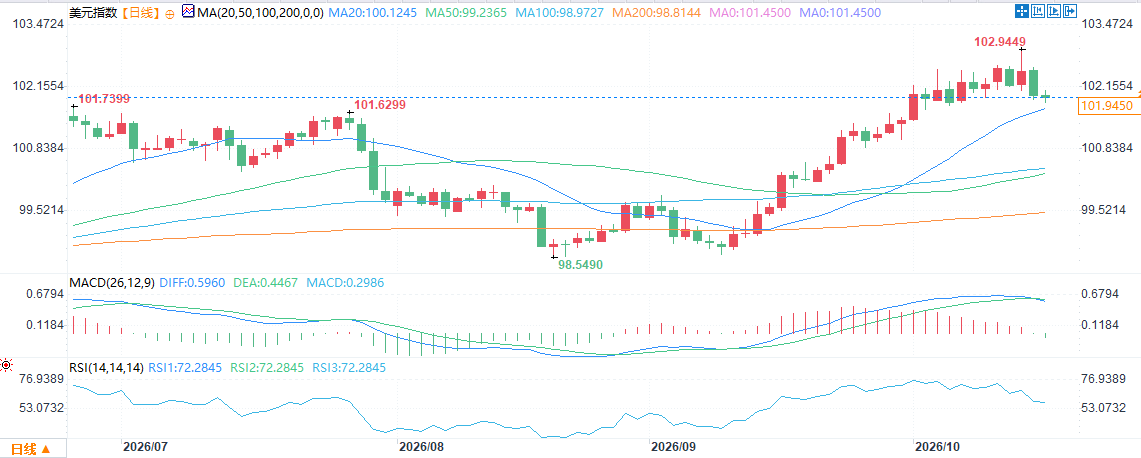 (US Dollar Index Daily Chart, Source: FX678) At 14:00 Beijing time, the US Dollar Index was at 101.92.
Key statement: Rejecting forward guidance; October and December are key milestones.
Federal Reserve Chairman Kevin Warsh declined to signal the central bank's next move on Friday. He said he didn't believe it should be stated what actions might be taken at the remainder of 2026 meetings, noting that the Fed's October and December meetings were crucial for policymakers to assess the situation. Warsh made the remarks in Bangkok during the International Monetary Fund (IMF) meetings, which are held alongside the IMF and World Bank annual meetings. He stated that global developments have largely met the Fed's expectations since the September policy meeting. He said the Fed has made it clear it will achieve price stability, but he doesn't believe in predicting meeting outcomes in advance. Policymakers will make their judgments at the October and December meetings, which he described as key junctures for assessing output, employment, and inflation. His refusal to provide guidance was not surprising. Warsh has repeatedly argued that the Fed should reduce its pronouncements on its intentions, allowing markets to form their own views on the economy, and he has opposed prematurely signaling policy decisions. Friday's comments put this into practice, leaving investors reliant on upcoming data ahead of the October 27-28 meeting.Policy implications: The situation is in line with expectations, leaning slightly hawkish.
Warsh's statement that the current economic and inflation situation is broadly in line with expectations remains worthy of close market attention. In September, the Federal Reserve raised the target range for the federal funds rate by 25 basis points to 3.75% to 4.00%, the first rate hike since 2023, marking a significant turning point in monetary policy. The dot plot shows that most officials expect at least one more rate hike this year. While Warsh did not directly specify the subsequent path, his statement that "the situation is in line with expectations" effectively conveys a strong signal of policy continuity: if employment, inflation, and growth data continue along their current trajectory, he sees so far almost no sufficient reason to deviate from the established rate hike path. This means that unless there are significant data surprises, the Fed is more inclined to proceed with tightening step by step rather than prematurely shifting to a wait-and-see approach or a dovish adjustment. From a policy perspective, this stance leans slightly hawkish, as it reduces the market's optimistic pricing of a "one-time rate hike and it's over" scenario and reinforces expectations that "further tightening is still necessary." Investors need to closely monitor subsequent inflation stickiness, the pace of labor market cooling, and changes in Warsh's own wording in public. Any redefinition of the "in line with expectations" boundary could trigger a repricing of the interest rate path. Overall, Warsh's remarks reinforced the hawkish tone following the September rate hike, reminding the market not to underestimate the Fed's willingness to continue acting with data support.Investment and AI: Structural investment surges, AI drives demand first, then supply.
Warsh devoted considerable time to discussing investment and artificial intelligence. He described the surge in structural investment as the most significant upside for the global economy, attributing it to sound policy. Regarding AI, he stated that the technology will make the economy more productive and create more wealth, but the road will be bumpy, and its near-term impact on employment remains uncertain. He said AI is likely to boost demand before delivering supply-side gains that can alleviate inflation, which should also help central banks build confidence in their data. This sequence is crucial for policy. If AI-related investments boost spending now, while productivity gains come later, this will increase near-term inflationary pressures. This aligns with Warsh's previous argument that current interest rates are not suppressing economic activity. Warsh also stated that Fed policy spills over to the rest of the world, but policies in other countries also flow back to the United States. He added that, as part of its working group, the Fed will hold an on-site hearing on AI in the San Francisco Bay Area on November 16.Market Impact: Data-Driven, Oil Prices and Hawkish Tendencies are Key
Without guidance from the chairman, short-term US Treasury bonds and the US dollar will seek direction from data ahead of the October 27-28 meeting, meaning the market may react more strongly to economic data. His comments that the situation was broadly in line with expectations were slightly hawkish, as his September forecast pointed to another rate hike this year. Oil prices remain a key input: fuel-driven inflation related to the Iran war is a major source of upward price pressure, so crude oil prices will directly impact rate hike pricing. A hawkish Fed tends to suppress rather than support gold.Other officials: Harmack questions whether the policy is tight enough.
Earlier, Hammark was less restrained in his forward guidance. As a Federal Reserve official, he publicly questioned whether the current policy stance was sufficiently tight amid renewed inflation risks. Hammark emphasized that although previous rate hikes had significantly raised real interest rates, upward pressure on inflation expectations, stickiness in the prices of some core services, and potential demand resilience could render the current tightening insufficient to quickly pull inflation back to the 2% target. His remarks contrasted with the more cautious communication style of some officials, indicating that internal disagreements remained regarding the "adequacy of policy." Hammark was particularly concerned about the clarity and credibility of forward guidance, believing that if the market underestimated the possibility of further tightening, it could weaken the policy transmission effect. Amid rising inflation risks, he called for vigilance and caution against prematurely signaling easing. This questioning not only reflects his cautious interpretation of data but also reminds the market to pay attention to the influence of hawkish voices within the Fed. If subsequent inflation data continues to exceed expectations, Hammark's questioning could push for further upward revisions to the dot plot or reinforce the narrative of "higher and longer" interest rates.US Dollar Index: Lacking Forward Guidance, Data Dominates Dollar's Direction
Warsh's refusal to provide forward guidance for the remainder of the 2026 meeting means the market has lost a crucial policy clue. The dollar index will be more driven by economic data ahead of the October 27-28 meeting, with its reaction to each inflation, employment, and growth report potentially amplified, leading to increased volatility. In terms of direction, Warsh's statement that "the situation is broadly in line with expectations" leans slightly hawkish. The Fed raised interest rates to 3.75% to 4.00% in September, and most officials expect at least one more rate hike this year. If this path remains unchanged, the dollar index will still have some support in terms of interest rate differentials, especially when other central banks (such as the Reserve Bank of Australia and the European Central Bank) cool their rate hike expectations or face dilemmas, further highlighting the dollar's policy divergence advantage. However, Warsh's deliberate lack of guidance also means the market cannot increase its bets based on this, limiting the dollar's upside potential. Another key variable is oil prices. Warsh explicitly pointed out that fuel-driven inflation related to the Iran war is the main source of upward price pressure, and oil price movements will directly impact interest rate pricing. If oil prices continue to rise, market expectations for a Fed rate hike will increase, potentially supporting the dollar index. Conversely, if oil prices fall and inflationary pressures ease, the dollar's interest rate advantage will be weakened. Overall, the dollar index is likely to maintain a volatile but slightly bullish trend in the short term, with the direction of any breakout depending on data performance, oil price movements, and whether other Fed officials can fill the guidance gap left by the chairman's silence.Summarize
On Friday, Warsh declined to provide forward guidance for the remainder of the 2026 meetings, highlighting October and December as key periods for assessing output, employment, and inflation. He stated that the global situation since the September rate hike has largely met expectations. This slightly hawkish stance suggests that he sees little reason to deviate from the path of another rate hike this year. In the absence of guidance from the chairman, short-term US Treasury bonds and the dollar will be more data-driven, with market reactions to data potentially amplified, and oil price movements directly impacting rate hike pricing. Warsh also highlighted the surge in structural investment and AI, believing that AI will first drive demand and then supply, potentially increasing inflationary pressures in the near term. The focus will shift to US data ahead of the October 27-28 meeting, and whether other Fed officials can fill the void left by the chairman's silence. (US Dollar Index Daily Chart, Source: FX678) At 14:00 Beijing time, the US Dollar Index was at 101.92.
- Risk Warning and Disclaimer
- The market involves risk, and trading may not be suitable for all investors. This article is for reference only and does not constitute personal investment advice, nor does it take into account certain users’ specific investment objectives, financial situation, or other needs. Any investment decisions made based on this information are at your own risk.