Silver has rebounded after a sharp drop, and the overall trend remains unchanged; it awaits a stress test.
2026-10-16 14:40:22
Spot silver traded around $57.80 per ounce in Asian trading on Friday, continuing its upward trend from the previous trading day's close and recording gains for the second consecutive day. The core driver of this rebound is the triple resonance of "safe-haven demand + declining yields + CTA short covering," but the medium-term trend structure has not yet been completely reversed, and the battle between bulls and bears remains intense. 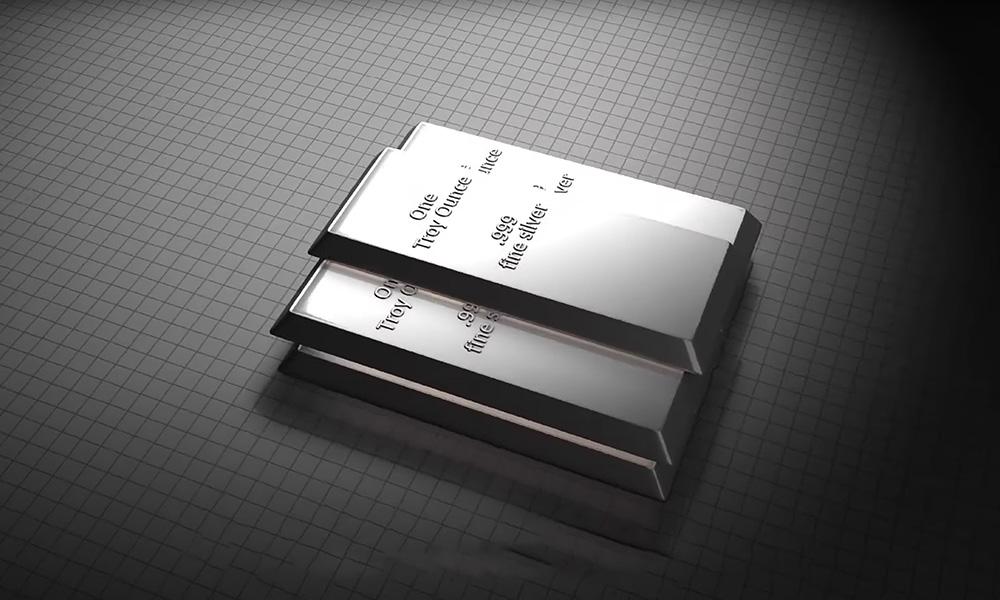 Risk aversion is the primary driver of this round of silver's rebound. The escalating geopolitical situation in the Middle East—the conflict between the Houthi rebels and the Saudi-backed Yemeni government forces intensifying—has reignited market concerns about shipping safety in the Strait of Hormuz. The Strait of Hormuz handles approximately 20% of global seaborne crude oil transport, and any disruption to shipping could quickly spill over into the energy and precious metals markets. Simultaneously, a sharp correction in global stock markets triggered a flow of funds into safe-haven assets, with a significant drop in US Treasury yields, reducing the opportunity cost of holding non-interest-bearing assets like silver and providing broad support for precious metals. Changes in fund flows are also noteworthy. According to TD Securities analysis, CTA strategy funds were extremely active across asset classes today, with large-scale short covering in interest rate products spilling over into the precious metals sector. This position adjustment helped CTAs reverse yesterday's large-scale sell-off in gold, and silver, platinum, and palladium also saw CTA short covering, easing the systemic selling pressure that had previously weighed on precious metals. However, whether this fund-driven rebound can be sustained depends on whether there is a substantial shift in macroeconomic policy expectations. The Federal Reserve's policy path remains the core anchor for silver's medium-term pricing. Despite recent strong US inflation data—both September CPI and PPI exceeded expectations—the market has priced in an October rate hike to around 28%, but the probability of at least one rate hike in December remains as high as 92%. The Fed's sentiment index remains around 127.51, well above the neutral 100 level, indicating that the overall policy stance remains clearly hawkish. This means that macroeconomic policy expectations continue to exert headwinds on precious metals, limiting the upside potential of silver's rebound. Technically, spot silver is still trading below the 9-day and 50-day exponential moving averages on the daily chart, indicating that the medium-term downtrend structure has not been completely broken, and rebounds are still suppressed by the moving averages. The daily RSI is around 38.9, in the low-neutral zone, showing that downward pressure remains but has not yet reached extreme oversold levels, leaving room for technical correction. The MACD histogram continues to narrow, and the fast and slow lines are converging, indicating that the bearish momentum is weakening, but the bulls have not yet formed a valid counterattack signal. On the 4-hour chart, silver prices are fluctuating between 57.50 and 58.80, with short-term moving averages intertwined, making the direction unclear. Resistance levels are at 58.81, 60.00, and 62.46, while support levels are at 57.00, 56.00, and 55.00. A decisive break above 58.81 and a sustained hold above 60.00 could alleviate the short-term bearish bias, potentially leading to a challenge of the 62.46 area. Conversely, a break below 57.00 could result in a further pullback to the 56.00-55.00 area.
 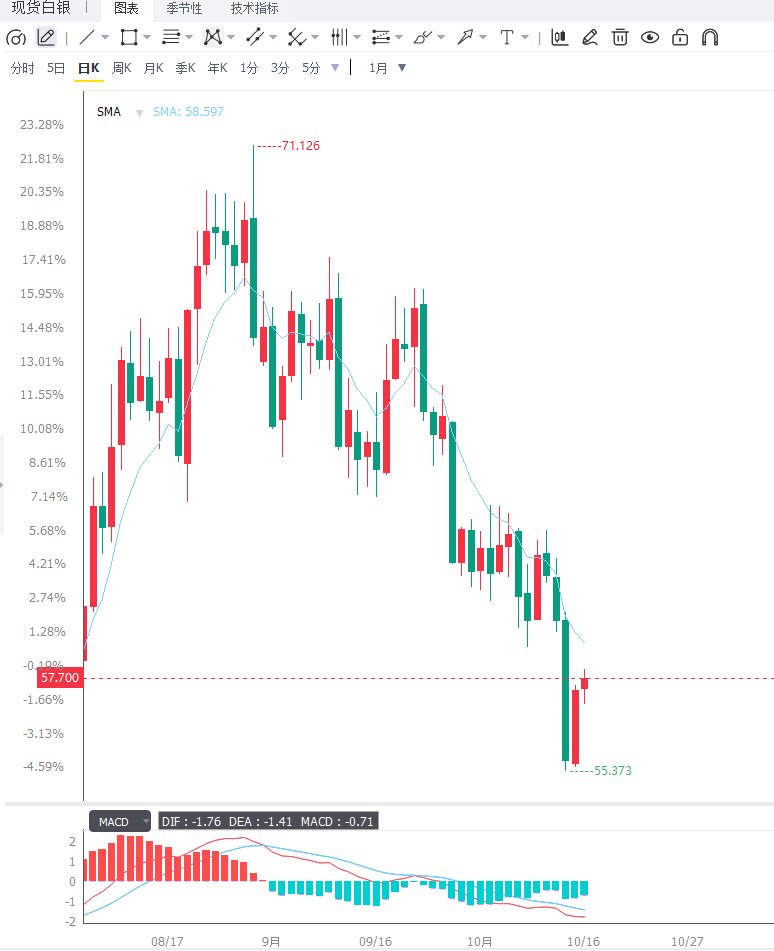 Editor's Summary: Spot silver is currently caught in a short-term tug-of-war between "safe-haven demand" and "macroeconomic policy headwinds." Escalating geopolitical tensions in the Middle East and stock market corrections triggered safe-haven buying, coupled with short covering in CTAs, jointly driving a short-term rebound in silver prices. However, the daily technical structure remains bearish, with significant resistance from moving averages, and high expectations for a December rate hike by the Federal Reserve, all contributing to macroeconomic policy headwinds for precious metals. The key focus going forward will be on the Fed's interest rate meeting at the end of October, subsequent US employment and inflation data, and the evolving geopolitical situation in the Middle East. Until the resistance zone of 58.81 to 62.46 is effectively broken, the sustainability of the silver rebound remains questionable, and it is more likely to maintain range-bound consolidation, awaiting new policy and geopolitical catalysts.
Risk aversion is the primary driver of this round of silver's rebound. The escalating geopolitical situation in the Middle East—the conflict between the Houthi rebels and the Saudi-backed Yemeni government forces intensifying—has reignited market concerns about shipping safety in the Strait of Hormuz. The Strait of Hormuz handles approximately 20% of global seaborne crude oil transport, and any disruption to shipping could quickly spill over into the energy and precious metals markets. Simultaneously, a sharp correction in global stock markets triggered a flow of funds into safe-haven assets, with a significant drop in US Treasury yields, reducing the opportunity cost of holding non-interest-bearing assets like silver and providing broad support for precious metals. Changes in fund flows are also noteworthy. According to TD Securities analysis, CTA strategy funds were extremely active across asset classes today, with large-scale short covering in interest rate products spilling over into the precious metals sector. This position adjustment helped CTAs reverse yesterday's large-scale sell-off in gold, and silver, platinum, and palladium also saw CTA short covering, easing the systemic selling pressure that had previously weighed on precious metals. However, whether this fund-driven rebound can be sustained depends on whether there is a substantial shift in macroeconomic policy expectations. The Federal Reserve's policy path remains the core anchor for silver's medium-term pricing. Despite recent strong US inflation data—both September CPI and PPI exceeded expectations—the market has priced in an October rate hike to around 28%, but the probability of at least one rate hike in December remains as high as 92%. The Fed's sentiment index remains around 127.51, well above the neutral 100 level, indicating that the overall policy stance remains clearly hawkish. This means that macroeconomic policy expectations continue to exert headwinds on precious metals, limiting the upside potential of silver's rebound. Technically, spot silver is still trading below the 9-day and 50-day exponential moving averages on the daily chart, indicating that the medium-term downtrend structure has not been completely broken, and rebounds are still suppressed by the moving averages. The daily RSI is around 38.9, in the low-neutral zone, showing that downward pressure remains but has not yet reached extreme oversold levels, leaving room for technical correction. The MACD histogram continues to narrow, and the fast and slow lines are converging, indicating that the bearish momentum is weakening, but the bulls have not yet formed a valid counterattack signal. On the 4-hour chart, silver prices are fluctuating between 57.50 and 58.80, with short-term moving averages intertwined, making the direction unclear. Resistance levels are at 58.81, 60.00, and 62.46, while support levels are at 57.00, 56.00, and 55.00. A decisive break above 58.81 and a sustained hold above 60.00 could alleviate the short-term bearish bias, potentially leading to a challenge of the 62.46 area. Conversely, a break below 57.00 could result in a further pullback to the 56.00-55.00 area. Editor's Summary: Spot silver is currently caught in a short-term tug-of-war between "safe-haven demand" and "macroeconomic policy headwinds." Escalating geopolitical tensions in the Middle East and stock market corrections triggered safe-haven buying, coupled with short covering in CTAs, jointly driving a short-term rebound in silver prices. However, the daily technical structure remains bearish, with significant resistance from moving averages, and high expectations for a December rate hike by the Federal Reserve, all contributing to macroeconomic policy headwinds for precious metals. The key focus going forward will be on the Fed's interest rate meeting at the end of October, subsequent US employment and inflation data, and the evolving geopolitical situation in the Middle East. Until the resistance zone of 58.81 to 62.46 is effectively broken, the sustainability of the silver rebound remains questionable, and it is more likely to maintain range-bound consolidation, awaiting new policy and geopolitical catalysts.
- Risk Warning and Disclaimer
- The market involves risk, and trading may not be suitable for all investors. This article is for reference only and does not constitute personal investment advice, nor does it take into account certain users’ specific investment objectives, financial situation, or other needs. Any investment decisions made based on this information are at your own risk.