US CPI and PPI both exceeded expectations, and the dollar index, which had been a positive factor for the dollar, experienced a short-term surge followed by a pullback.
2026-10-16 14:50:19
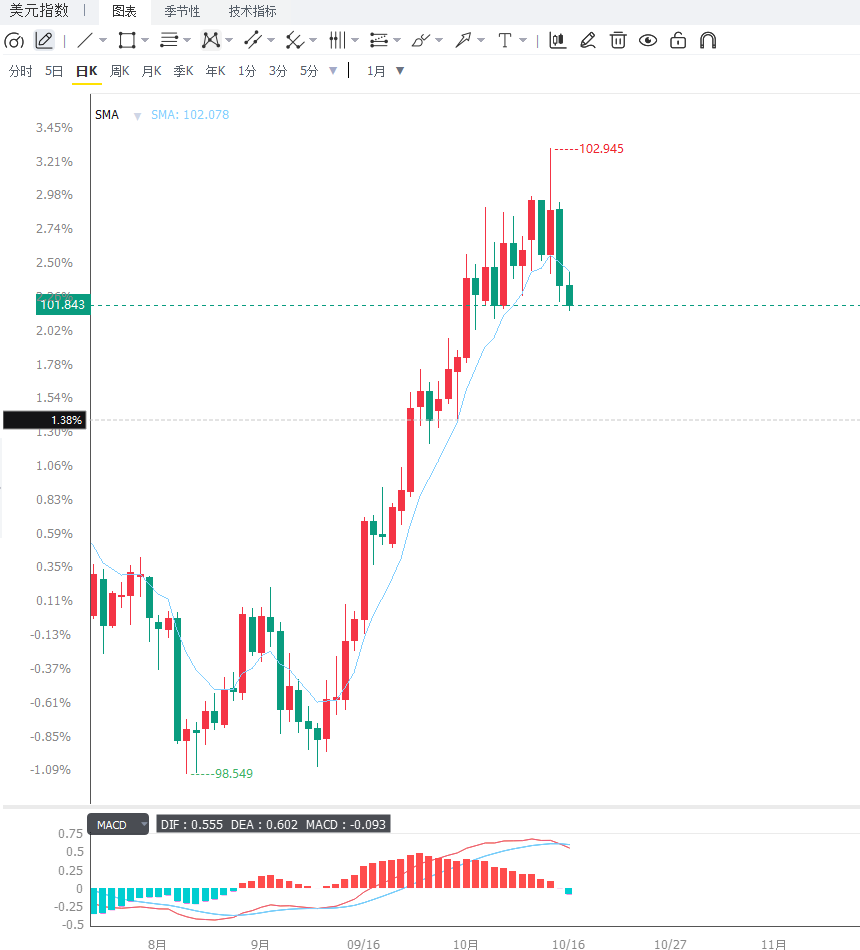
The US dollar index traded around 101.80 in Asian trading on Friday, down about 0.15% from the previous day's close of around 102.00, hitting a 10-day low. This week, the dollar index weakened against most major currencies, falling 0.70% against the New Zealand dollar, 0.69% against the Canadian dollar, and 0.52% against the British pound, with only a slight increase against the Australian dollar. The core driver was Federal Reserve Chairman Warsh's fireside talk during the IMF annual meetings in Bangkok—he explicitly refused to predict interest rate decisions in advance, breaking the market's linear expectation that "inflation exceeding expectations = certainty of interest rate hikes."  In a conversation with IMF Managing Director Kristalina Georgieva, Warsh stated, "I will not predict the outcome of the meeting. I do not advocate saying what I might do at the upcoming meeting." He emphasized that the Federal Reserve has begun a new chapter, no longer announcing policy decisions in advance. Following this statement, the market's expectation of a rate hike in October plummeted from over 25% on Thursday to about 15%. It is worth noting that Warsh's "dovish omission" occurred against the backdrop of this week's overwhelmingly stronger-than-expected US inflation data. The US September CPI rose 0.6% month-on-month, and the core CPI rose 0.33% month-on-month, recording strong growth for the second consecutive month; the PPI released on Thursday rose 6.3% year-on-year and 1.3% month-on-month, both the highest since 2022. Logically, this should have provided Warsh with ample ammunition to reinforce his hawkish stance, but he deliberately reserved his options and did not reiterate his position that "inflation is too high." Kristina Clifton, senior strategist at Commonwealth Bank of Australia, said that Warsh's failure to reiterate his view that inflation is too high disappointed the market, thus pushing the dollar weaker. Warsh devoted considerable space to the economic impact of artificial intelligence, calling it "the most profound economic transformation of my lifetime," and announced that the Federal Reserve's Productivity and Employment Working Group would hold an in-person hearing in the San Francisco Bay Area on November 16. This statement provided policy-level confidence support for the technology growth sector and explained why risk assets rebounded despite the weakening dollar, indicating that the dollar's medium-term support has not completely disappeared. The Fed's sentiment index remained around 127.51, well above the neutral 100 level, indicating that the overall policy stance remains clearly hawkish. The market still prices in at least one rate hike in December at nearly 90%, with some senior forecasters even suggesting a possible 50 basis point rate hike in December. In addition, the escalating geopolitical situation in the Middle East—the Houthi attack on the presidential palace in Aden, the attack on oil tankers in the Strait of Hormuz, etc.—strengthened the demand for the safe-haven dollar, providing implicit support for the dollar index. From a technical perspective, the dollar index is trading above the 20-day exponential moving average on the daily chart, and the medium-term bullish structure has not been completely destroyed, but short-term downward pressure is evident. The price is currently fluctuating around 101.80, a level that coincides with the intersection of the previous breakout conversion point and the 20-day EMA dynamic support. The daily RSI is around 56.8, in a neutral-to-strong zone, but the upward slope is clearly weakening, indicating a potential top divergence. The MACD histogram is narrowing, and the fast and slow lines are converging, suggesting weakening bullish momentum. On the 4-hour chart, the index is oscillating between 101.80 and 102.00, with short-term moving averages intertwined, making the direction unclear. Resistance levels are at 102.00, 102.35, and 102.60, while support levels are at 101.63, 101.30, and 101.00. A break below 101.63 could weaken the short-term bullish structure, potentially leading to a further pullback to the 101.30-101.00 area.
  Editor's Summary: The US dollar index is currently caught in a short-term tug-of-war between "inflation resilience" and "Wash's reluctance to predict interest rate decisions," which weakens the premium for rate hikes. Warsh's refusal to predict interest rate decisions signifies a shift in the Fed's policy communication framework from "expectation management" to a purely "data-dependent" model. This shift will increase asset price volatility in the short term, but in the medium to long term, it will help eliminate pricing distortions caused by over-interpreting officials' statements. The key focus going forward will be on the Fed's interest rate meeting at the end of October, subsequent US employment and inflation data, and the evolving geopolitical situation in the Middle East.
In a conversation with IMF Managing Director Kristalina Georgieva, Warsh stated, "I will not predict the outcome of the meeting. I do not advocate saying what I might do at the upcoming meeting." He emphasized that the Federal Reserve has begun a new chapter, no longer announcing policy decisions in advance. Following this statement, the market's expectation of a rate hike in October plummeted from over 25% on Thursday to about 15%. It is worth noting that Warsh's "dovish omission" occurred against the backdrop of this week's overwhelmingly stronger-than-expected US inflation data. The US September CPI rose 0.6% month-on-month, and the core CPI rose 0.33% month-on-month, recording strong growth for the second consecutive month; the PPI released on Thursday rose 6.3% year-on-year and 1.3% month-on-month, both the highest since 2022. Logically, this should have provided Warsh with ample ammunition to reinforce his hawkish stance, but he deliberately reserved his options and did not reiterate his position that "inflation is too high." Kristina Clifton, senior strategist at Commonwealth Bank of Australia, said that Warsh's failure to reiterate his view that inflation is too high disappointed the market, thus pushing the dollar weaker. Warsh devoted considerable space to the economic impact of artificial intelligence, calling it "the most profound economic transformation of my lifetime," and announced that the Federal Reserve's Productivity and Employment Working Group would hold an in-person hearing in the San Francisco Bay Area on November 16. This statement provided policy-level confidence support for the technology growth sector and explained why risk assets rebounded despite the weakening dollar, indicating that the dollar's medium-term support has not completely disappeared. The Fed's sentiment index remained around 127.51, well above the neutral 100 level, indicating that the overall policy stance remains clearly hawkish. The market still prices in at least one rate hike in December at nearly 90%, with some senior forecasters even suggesting a possible 50 basis point rate hike in December. In addition, the escalating geopolitical situation in the Middle East—the Houthi attack on the presidential palace in Aden, the attack on oil tankers in the Strait of Hormuz, etc.—strengthened the demand for the safe-haven dollar, providing implicit support for the dollar index. From a technical perspective, the dollar index is trading above the 20-day exponential moving average on the daily chart, and the medium-term bullish structure has not been completely destroyed, but short-term downward pressure is evident. The price is currently fluctuating around 101.80, a level that coincides with the intersection of the previous breakout conversion point and the 20-day EMA dynamic support. The daily RSI is around 56.8, in a neutral-to-strong zone, but the upward slope is clearly weakening, indicating a potential top divergence. The MACD histogram is narrowing, and the fast and slow lines are converging, suggesting weakening bullish momentum. On the 4-hour chart, the index is oscillating between 101.80 and 102.00, with short-term moving averages intertwined, making the direction unclear. Resistance levels are at 102.00, 102.35, and 102.60, while support levels are at 101.63, 101.30, and 101.00. A break below 101.63 could weaken the short-term bullish structure, potentially leading to a further pullback to the 101.30-101.00 area. Editor's Summary: The US dollar index is currently caught in a short-term tug-of-war between "inflation resilience" and "Wash's reluctance to predict interest rate decisions," which weakens the premium for rate hikes. Warsh's refusal to predict interest rate decisions signifies a shift in the Fed's policy communication framework from "expectation management" to a purely "data-dependent" model. This shift will increase asset price volatility in the short term, but in the medium to long term, it will help eliminate pricing distortions caused by over-interpreting officials' statements. The key focus going forward will be on the Fed's interest rate meeting at the end of October, subsequent US employment and inflation data, and the evolving geopolitical situation in the Middle East.
- Risk Warning and Disclaimer
- The market involves risk, and trading may not be suitable for all investors. This article is for reference only and does not constitute personal investment advice, nor does it take into account certain users’ specific investment objectives, financial situation, or other needs. Any investment decisions made based on this information are at your own risk.