Warsh discusses inflation and AI variables; with interest rates remaining high, gold prices lack a clear catalyst in the short term.
2026-10-16 17:42:19
On Friday (October 16), during the Asian and European sessions, international gold prices rebounded slightly, holding onto all of Thursday's gains. The recent weakening of US Treasury bonds and the US dollar provided a respite for gold prices. Today, Warsh delivered a speech regarding the Fed's future work plans. Against the backdrop of persistently sticky inflation and the Fed facing new macroeconomic variables, gold is caught in a volatile pattern of bullish and bearish forces. Fed Chairman Warsh's latest speech at the IMF annual meeting in Bangkok clearly demonstrated the current dilemma of Fed policy: it must adhere to its price stability goal to combat stubborn inflation, while also needing time to assess the two-way macroeconomic impact of the unique variable of AI. The high-interest-rate environment is likely to continue until the end of the year, with the US dollar and US Treasury yields remaining resilient, and gold prices temporarily lacking a catalyst for a one-sided market movement. Meanwhile, the recent rapid decline in US Treasury bonds and the US dollar over 3-5 days is likely a result of capital flows, and the fundamental changes may not be significant.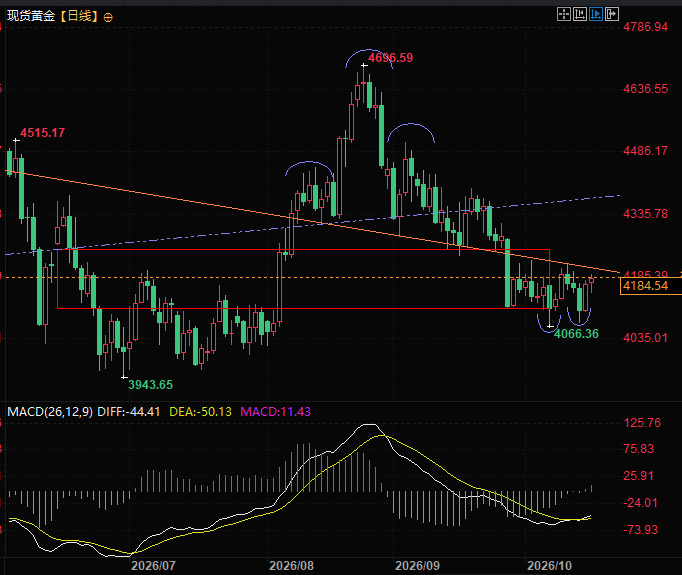 (Real interest rate (10-year TIPS yield), Source: Federal Reserve)
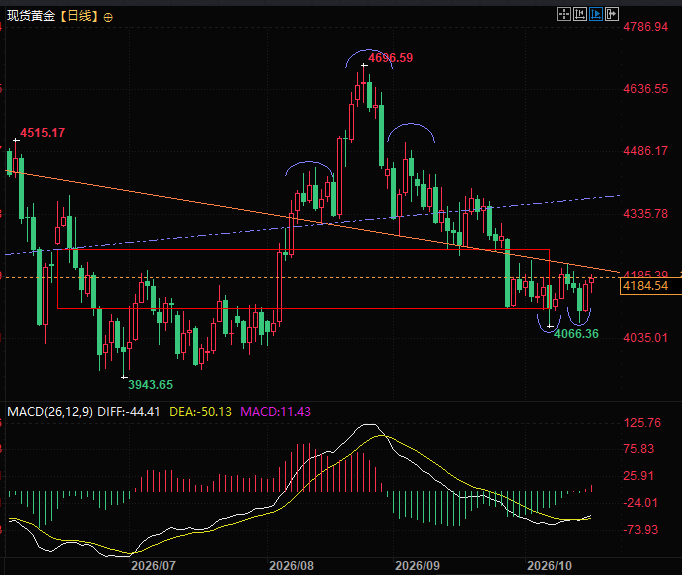 (Spot gold daily chart, source: EasyTrade) Beijing time: 17:37, spot gold is currently trading at $4181 per ounce.
Warsh speaks in Bangkok: AI's dual effects prompt the Fed to pause setting a predetermined interest rate path.
Global inflation remains stubbornly high, and Federal Reserve Chairman Walsh, in a fireside chat at the IMF annual meeting in Bangkok, outlined the current policy dilemma. AI is the most complex variable in this macroeconomic cycle: in the long term, AI can unleash significant productivity dividends, ultimately suppressing inflation; however, in the short term, the AI capital expenditure boom will boost aggregate demand, bringing new inflationary pressures. Institutions such as CICC have also pointed out that AI possesses a dual nature—"short-term demand-driven inflation and long-term supply-driven dividends"—which is also the biggest source of uncertainty in the current macroeconomy. Faced with this contradictory economic impact, Walsh clearly stated that he would not pre-judge the interest rate decisions at the October and December policy meetings. The Fed needs more data and specialized research to clarify the true transmission path of AI to the macroeconomy before matching corresponding monetary policy. The Fed's dedicated AI working group will also hold a hearing on November 16th, mobilizing internal research resources to assess this new variable. Walsh reiterated that price stability is the Fed's core objective, and that a rate hike in September, withdrawing some easing measures, was already implemented to anchor the Fed's policy stance on controlling inflation to the market.Economic divergence among countries supports the resilience of the US dollar, indirectly suppressing gold prices.
While the global economy has shown resilience, it continues to be eroded by energy shocks, with different economies experiencing the impact unevenly. Analysts from BNP Paribas and Ping An Securities believe that the impact of this round of energy shocks has varied significantly across countries: imported inflation from the energy crisis has hit countries highly dependent on energy imports, such as Europe and Japan, harder; while the United States, with its higher energy self-sufficiency and global leadership in AI, has suffered significantly less damage from this external shock. Even with US military-related capital expenditures, it is insufficient to drive a deep correction in the dollar; the dollar remains resilient, which is one of the core factors suppressing gold prices.US Treasury yields are fluctuating at high levels, and real interest rates are limiting the upside potential for gold.
Regarding US Treasury yields, the recent stock market correction has led to increased institutional allocations to US Treasuries, coupled with short covering, resulting in a temporary decline in yields. Morgan Stanley notes that such capital flows can only bring about a short-term decline in yields, as fundamental constraints remain: the US economy is resilient, the Federal Reserve's high-interest-rate policy continues, and it is unlikely that US Treasury yields will experience a significant and sustained decline; a high-level consolidation pattern is highly probable. Furthermore, as the core anchor for gold pricing, high real yields will continue to suppress the upside potential of gold. (Real interest rate (10-year TIPS yield), Source: Federal Reserve)The current gold price is caught in a tug-of-war between bulls and bears, with no clear catalyst for a unilateral move.
In summary, gold prices currently lack a strong unilateral driver. UBS and CITIC Securities Futures believe that Middle East geopolitical and energy risks can only provide short-term safe-haven support for gold prices; however, if conflicts push up oil prices, it will further strengthen inflation and high interest rate expectations, which in turn will suppress gold prices. On one hand, there is safe-haven support from geopolitics; on the other hand, high real interest rates and a strong US dollar create dual pressure. The forces of bulls and bears are in a state of equilibrium, and there is no clear stimulus to break the range-bound trading in the short term.Key themes to watch in the future
The market will focus on three main themes going forward: US economic fundamentals data, policy statements from Federal Reserve officials, and changes in interest rate futures pricing. As is the consensus among market institutions, interest rate futures pricing directly reflects market expectations for the duration of high interest rates and is the core driver of the dollar, US Treasury bonds, and gold prices. If the US economy weakens more than expected, or inflation falls rapidly, expectations of interest rate cuts rise, and US Treasury yields decline, then gold prices may have room to rise; conversely, if inflation remains sticky and the Fed maintains a hawkish stance, gold prices will remain under pressure and fluctuate. Technically, gold prices have formed a double bottom on the daily chart, a bullish signal, but are still under pressure from the September 28th bearish candlestick and the neckline of the head and shoulders pattern above. Overall, gold prices are likely to fluctuate, awaiting new data and events. (Spot gold daily chart, source: EasyTrade) Beijing time: 17:37, spot gold is currently trading at $4181 per ounce.
- Risk Warning and Disclaimer
- The market involves risk, and trading may not be suitable for all investors. This article is for reference only and does not constitute personal investment advice, nor does it take into account certain users’ specific investment objectives, financial situation, or other needs. Any investment decisions made based on this information are at your own risk.