Brent crude oil hits its first high in five months after losing $110; the market's real fear isn't missiles.
2026-10-17 08:58:19
Escalating tensions in the Middle East, coupled with attacks on Russian refineries, propelled international oil prices sharply higher this week. Brent crude approached $110 per barrel for the first time since May , while WTI rose 10.4% for the week, both hitting multi-month highs. The attempted missile attack on Saudi Yanbu port, a surge in attacks around the Strait of Hormuz, and the shutdown of refineries in Ryazan all contributed to supply concerns throughout the week. While the IEA and the US released reserves as hedging measures, they failed to reverse the bullish trend, with risk premiums becoming the dominant pricing driver. The main theme of the international oil market this week can be summed up in one word: supply. The continued spillover from the Middle East conflict and the renewed attacks on Russian refining facilities brought these two risk curves together this week, pushing Brent crude to near $110 per barrel for the first time since May 19th on Friday, while WTI simultaneously reached its highest point since September 17th. On a weekly basis, Brent crude rose 4.9%, while WTI surged 10.4% . On the daily chart, both commodities broke through their previous support levels in mid-October after falling from their September highs. The MACD histogram expanded, and the RSI rose above 60, indicating strong short-term momentum. Although official reserve releases and IEA reserve allocations have been implemented, the market reaction has been lukewarm, with geopolitical risk premiums still dominating pricing. 
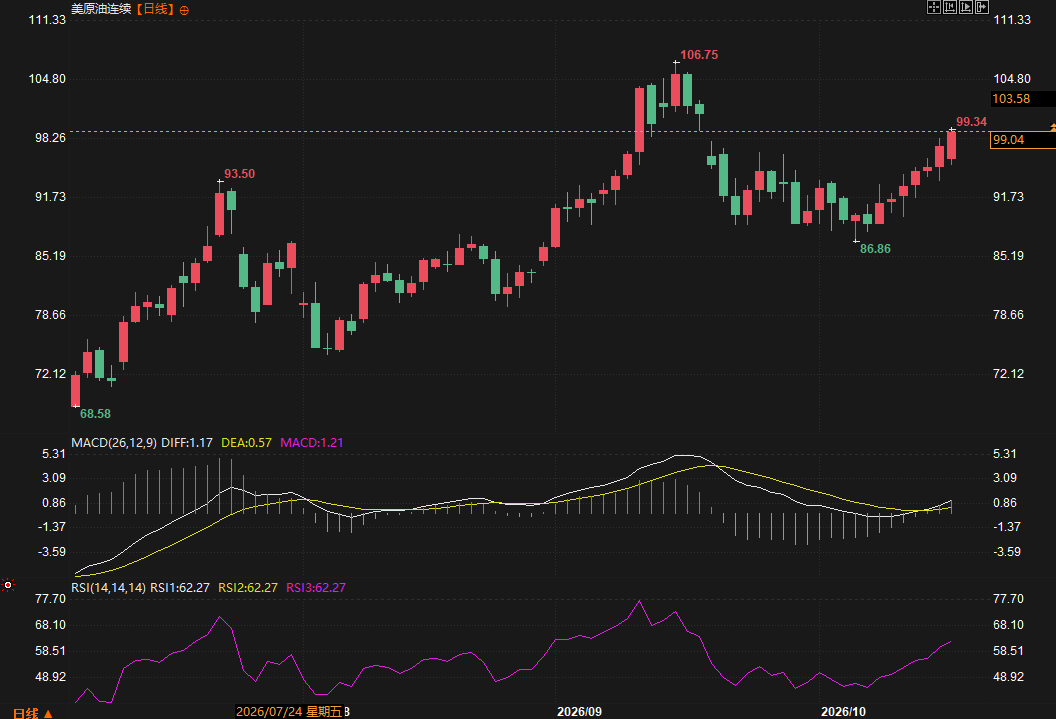
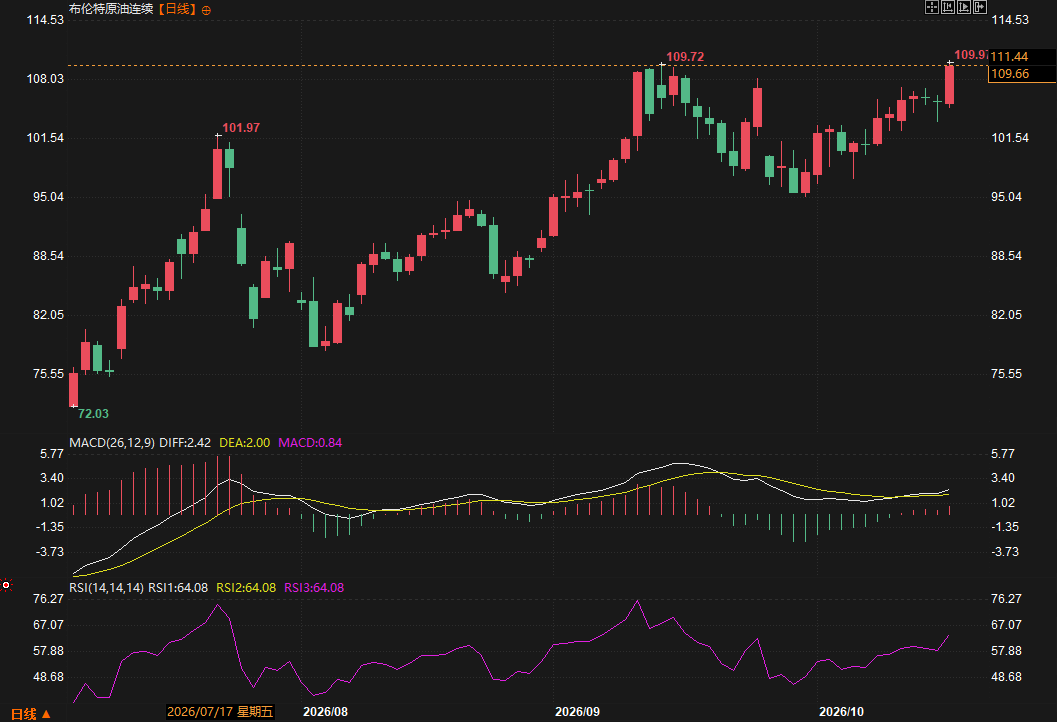 Overall, the strength of oil prices this week was mainly driven by geopolitical supply risk premiums , with official reserve releases and IEA reserve easing not yet altering the bullish trend. In the short term, attention should be paid to Strait of Hormuz traffic data, the progress of Russian refinery recovery, and the battle between bulls and bears around the $110 mark. The interplay between risk premiums and reserve easing hedging may determine the next direction.
US crude oil: After three tests, it broke through with increased volume; supply-side concerns became the main theme.
In this week's price action review, US crude oil followed a "pullback confirmation - breakout with increased volume" pattern on the daily chart: after reaching a high of $106 in mid-September, it consolidated within a range for nearly a month, then fell back to around $93 in early October where it found support, subsequently closing higher for several consecutive days. On Friday, it broke through the previous October support level and approached the previous high, leading the global oil market with a weekly gain of 10.4%. In terms of economic data and events, the escalating situation in the Middle East was the core driver: the Saudi-led coalition intercepted a ballistic missile aimed at Yanbu, a key port for Saudi Arabia to export oil around the Strait of Hormuz; Rapidan Energy reported that initial reports indicated no damage to Yanbu's infrastructure. Meanwhile, attacks around the Strait of Hormuz have surged in the past ten days , with Iran claiming it intensified its attacks due to the US blockade of its ports and increased sanctions. Kpler analysts pointed out that crude oil flows in the Gulf region have declined sharply, and without a comprehensive political agreement, the recovery will be slower and more uneven. There were also hedging actions on the supply side: the International Energy Agency agreed to release more than 20 million barrels of fuel, and the U.S. Department of Energy tendered for the transfer of up to 17 million barrels of crude oil from the Strategic Petroleum Reserve in exchange.Brent crude hits new high since May as attacks on Russian refineries fuel concerns about refined product prices.
In terms of price movement, Brent crude oil prices have been fluctuating upwards since the low of around $72 in August, reaching a high of $109.72 in September before entering a period of high-level consolidation. On Friday, it tested the $110 mark for the first time since May 19th, with a weekly gain of 4.9%. On the event front, Ukraine attacked Russian oil refining facilities on Thursday, and two industry sources revealed that the Ryazan refinery had suspended one primary crude oil distillation unit . This followed Zelensky's announcement that Kyiv would no longer abide by the ceasefire agreement concerning energy facilities. The market is also assessing how much diesel Russia can supply to the global market, and concerns about a refined product shortage are providing additional support for Brent crude. Regarding institutional perspectives, Energy Aspects stated in its report that Israeli media reports of unusual military movements detected by Western intelligence agencies, indicating that Iran might be preparing a preemptive strike, while unconfirmed, reinforced the assessment that "the risk of escalation will continue to support futures prices." Rapidan Energy believes that the Yanbu facility has not been damaged. Dennis Kissler, Senior Vice President of Trading at BOK Financial, stated that the ongoing Middle East conflict coupled with uncertainties surrounding Russian diesel supply is continuously prompting traders to maintain a buying stance. Overall, the strength of oil prices this week was mainly driven by geopolitical supply risk premiums , with official reserve releases and IEA reserve easing not yet altering the bullish trend. In the short term, attention should be paid to Strait of Hormuz traffic data, the progress of Russian refinery recovery, and the battle between bulls and bears around the $110 mark. The interplay between risk premiums and reserve easing hedging may determine the next direction.QA module
Q: Why did Brent crude reach $110 while WTI crude rose more? A: WTI had a deeper correction earlier and a lower base. Supply concerns, coupled with uncertainty about the actual arrival time of the US reserve swap tender, made it more volatile. Q: Why was the Yanbu missile incident crucial? A: Yanbu is Saudi Arabia's export route around the Strait of Hormuz. Damage to it means the alternative export route is invalid, and the risk premium will be reassessed. Q: Why did the release of reserves fail to suppress oil prices? A: The exchange of 20 million barrels from the IEA for 17 million barrels from the US is limited, and arrival time is needed, making it difficult to offset the sharp drop in Strait traffic in the short term. Q: How did the Russian factor affect the market? A: The shutdown of the Ryazan refinery directly impacted diesel supply, while the strengthening of refined oil cracking, in turn, raised expectations for crude oil demand. Q: What are the key variables next week? A: The speed of recovery of Strait of Hormuz traffic, whether Iran escalates its actions, and the extent to which the risk premium above $110 has been digested.- Risk Warning and Disclaimer
- The market involves risk, and trading may not be suitable for all investors. This article is for reference only and does not constitute personal investment advice, nor does it take into account certain users’ specific investment objectives, financial situation, or other needs. Any investment decisions made based on this information are at your own risk.