Trump waives Russian energy sanctions, causing oil prices to fall slightly.
2026-10-19 07:26:20
On Monday (October 19) during Asian trading hours, crude oil futures fell slightly after the start of the week, with the WTI crude oil November contract trading around $101 per barrel. The impact of US President Trump's decision to waive sanctions and tariffs on Russian energy outweighed reports of tanker explosions in the Strait of Hormuz over the weekend, and this was the main reason for the weakness in crude oil prices in early Asian trading. 
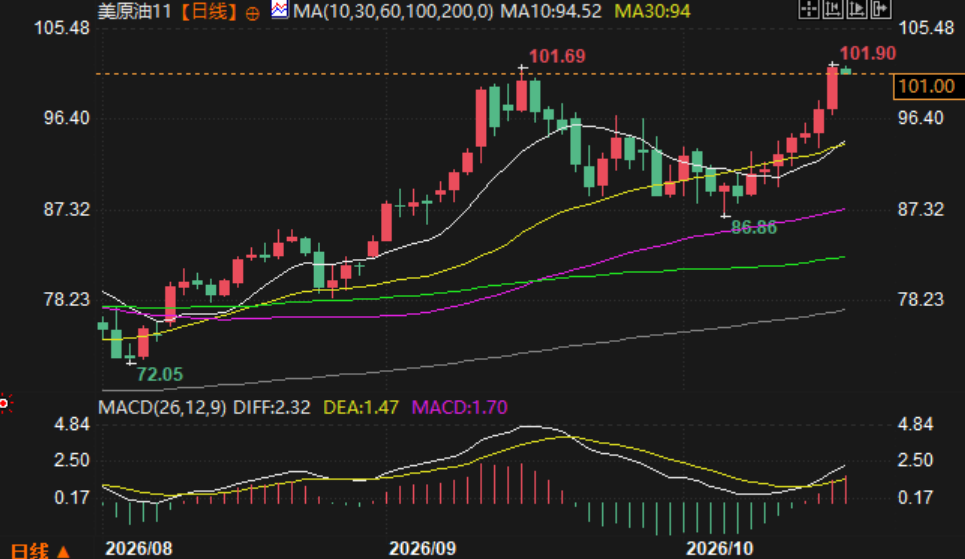 (WTI crude oil November contract daily chart, source: EasyForex) At 7:10 Beijing time, the WTI crude oil November contract was trading at $101 per barrel.
Key driver: Increased supply expectations due to Russian energy exemptions
Trump signed an executive order exempting Russian energy exports from Graham Act sanctions and tariffs. This decision increased the prospect of more Russian fuel entering the world market, a major reason for the weakness in crude oil prices in early Asian trading. The rationale for the exemption was to avoid pushing Moscow out of negotiations to end the Russia-Ukraine conflict, while Trump also believes Russia's assistance to Iran is limited and he wants to maintain that status quo. The implication of this decision is that the US exemption of Russian energy sanctions adds a potential source of supply to the global oil market, especially given the tension in the diesel market caused by the attacks. Diesel is a product the market needs to watch: any sign of increased Russian refined product exports will alleviate pressure on middle distillate crack spreads, which have absorbed much of the tension caused by the refinery attacks.Hormuz tanker explosion: Risk premium still exists
Reports over the weekend indicated that the Iranian Islamic Revolutionary Guard Corps Navy stated that an oil tanker caught fire and exploded after striking a mine in the southern Strait of Hormuz. Details about the vessel and any casualties are unclear, and this claim cannot be independently verified. This incident serves as a reminder to the market that shipping risks in the Strait of Hormuz remain. If confirmed, this incident will quickly rebuild shipping risk premiums, and war risk insurance and freight rates may rise further. While passage through the strait has somewhat resumed, the threat of attack has not been eliminated. Any new reports of explosions or attacks could drive up insurance costs and transportation expenses, thereby supporting oil prices. The market is highly sensitive to such events; once confirmed, they will directly strengthen geopolitical premiums, offsetting some of the negative supply-side factors.Diplomatic Clue: Pakistan's Army Chief of Staff May Visit Tehran
One possible diplomatic clue is that, according to Iran's ISNA news agency, Pakistan's Army Chief of Staff, Asim Munir, may visit Tehran this week. This visit offers a faint clue to de-escalation, but the market is likely to react cautiously until substantial progress is made. In the absence of concrete results, this diplomatic move will have limited impact on oil prices. Contact between Pakistan and Iran may involve regional security coordination, but if it remains merely symbolic, it is unlikely to change the current supply and risk landscape. Traders are more focused on actual negotiation outcomes or signs of a ceasefire than on the visit itself. Only if the visit translates into clear de-escalation measures could it have a more significant easing effect on market sentiment.Market reaction: Initial declines were mild, with traders viewing the exemption as a supply buffer.
The initial decline was mild, indicating that traders viewed the Russian exemption as a supply buffer rather than a game-changer, while the Hormuz risk remained. At the heart of this market reaction was that the Russian exemption increased supply expectations, but the Hormuz risk premium did not dissipate, the two offsetting each other and limiting the price drop. Investors did not interpret the exemption as a signal of a significant oversupply, but rather as a marginal improvement. Meanwhile, the continued presence of shipping risks limited downside, resulting in a cautiously balanced market overall.Market Outlook: Russian Exports and Hormuz Risk are Key
For oil, the near-term balance hinges on two variables: whether the Russian exemption translates into a meaningful increase in fuel exports, and whether the shipping risks in the Strait of Hormuz escalate further. A significant increase in Russian exports would ease tensions in the diesel market, potentially putting further downward pressure on oil prices; conversely, an escalation of the Hormuz risk would rebuild the shipping risk premium, potentially leading to a price rebound. The market is expected to exhibit two-way trading driven by news headlines. Traders must closely monitor actual Russian export data and the dynamics of shipping safety in the Strait, as their relative changes will determine short-term price direction. Unexpected developments on either side could disrupt the current fragile balance. (WTI crude oil November contract daily chart, source: EasyForex) At 7:10 Beijing time, the WTI crude oil November contract was trading at $101 per barrel.- Risk Warning and Disclaimer
- The market involves risk, and trading may not be suitable for all investors. This article is for reference only and does not constitute personal investment advice, nor does it take into account certain users’ specific investment objectives, financial situation, or other needs. Any investment decisions made based on this information are at your own risk.