Gold Trading Alert: AI Bubble Concerns Impact the Dollar, Could Gold Prices Surge This Week?
2026-10-19 07:54:20
Global gold markets closed lower last week after experiencing sharp fluctuations at high levels, with spot gold recording a weekly decline of approximately 0.7%, settling around $4,165 per ounce on Friday (October 16). The market is struggling to weigh the possibility of further interest rate hikes by the Federal Reserve: on the one hand, September inflation data continued to exceed expectations, reinforcing expectations of policy tightening; on the other hand, cautious rhetoric from Fed officials, safe-haven demand triggered by the sell-off in the AI sector, and a weakening dollar have provided some breathing room for gold prices. Entering early Asian trading on Monday (October 19), spot gold rebounded slightly, briefly touching around $4,185, indicating that bulls are still trying to hold key support levels amid falling oil prices and some easing geopolitical tensions. 
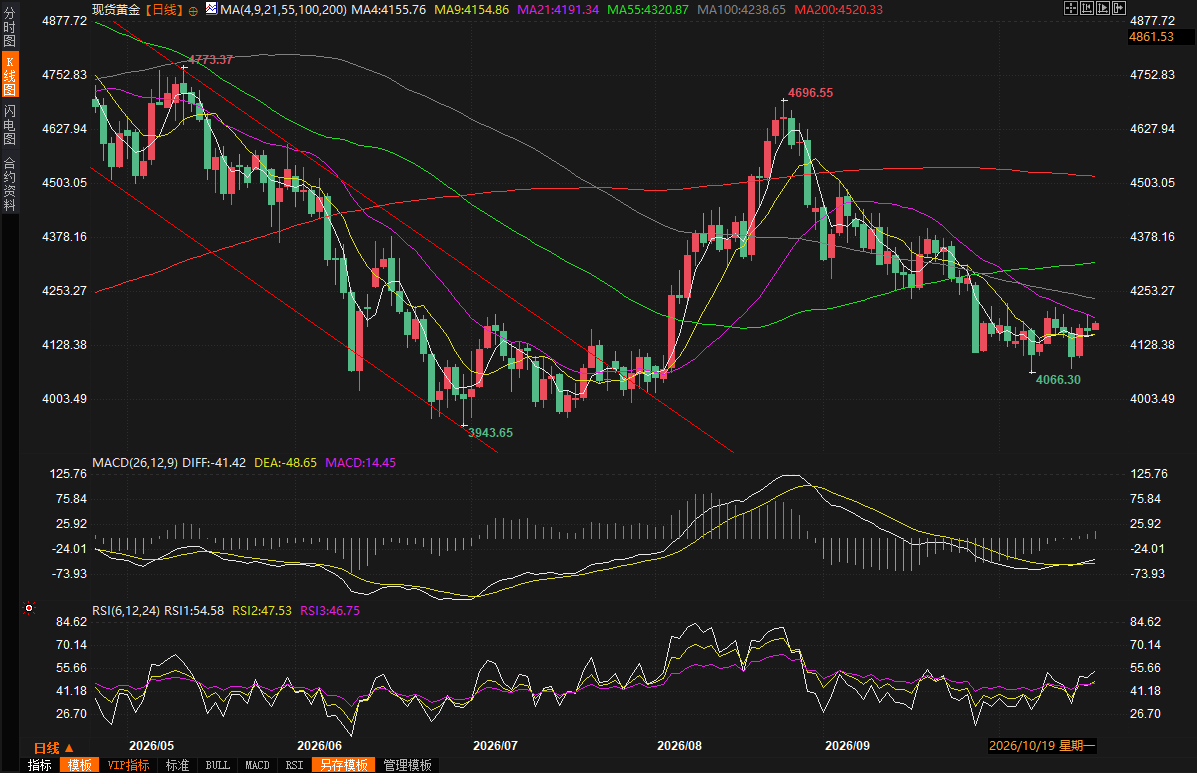 (Spot gold daily chart, source: FX678) At 07:50 Beijing time, spot gold is currently trading at $4182.83 per ounce.
Gold prices traded within a range with a slight downward bias last week, with inflation data being the main drag.
Last week, gold prices fluctuated at high levels with a slight downward shift in the center of gravity. Spot gold oscillated above $4,200 at the beginning of the week, but then came under pressure from inflation data, closing down slightly by 0.1% on Friday at $4,165.12, a cumulative decline of about 0.7% for the week. Bart Melek, global head of commodities strategy at TD Securities, pointed out that gold prices are currently basically in a range-bound pattern, leaning towards the lower end of the support range, mainly due to the significant uncertainty surrounding the Federal Reserve's next move. The key variable driving market sentiment was the continued better-than-expected US inflation data in September. The CPI released last Wednesday showed a faster rate of price increases, and the PPI released last Thursday recorded its largest increase in four and a half years. Chicago Fed President Goolsby bluntly stated that these data were "disappointing," while Cleveland Fed President Hammarck warned that if public inflation expectations deteriorate significantly, the Fed may need to raise interest rates more sharply. Meanwhile, Fed Chairman Warsh expressed optimism about the strong performance of the US economy at the IMF-World Bank annual meeting in Bangkok, but clearly stated that he would not "predetermine" interest rate decisions and did not provide any clues about the path forward. According to the CME FedWatch tool, traders generally expect the probability of keeping interest rates unchanged at the October meeting to rise to around 83%, but the probability of a rate hike in December remains as high as 88% to 90%. Rising interest rates will reduce gold's appeal as a non-yielding asset. Capital Economics economist Hamad Hussain believes that gold prices may decline slightly for the remainder of the year as the Fed continues to raise rates, coupled with concerns about the AI boom proving to be temporary.The sharp fluctuations in the bond market and the weakening dollar provided a limited buffer.
Alongside gold prices, the US Treasury market experienced significant volatility. The 10-year Treasury yield recorded its largest weekly drop in over a year last week, reaching a high of 5.329% on Wednesday before quickly falling to a low of 5.037% on Thursday, and fluctuating between 5.08% and 5.13% on Friday. Michael Reynolds, Vice President of Investment Strategy at Glenmede, described the Treasury market as having numerous undercurrents of competition, pushing and pulling the long end of the yield curve in different directions, resulting in considerable intraday volatility. Risk aversion stemmed from a stock market sell-off triggered by concerns about the debt of AI-related companies, coupled with investors' preference for seeking opportunities in the bond market after yields reached multi-decade highs. The spread between the 2-year and 10-year yields remained positive at approximately 36 basis points, and the breakeven yield on 10-year TIPS was 2.347%, indicating that market expectations for average annual inflation over the next decade remain around 2.3%. The US dollar index fell about 0.45% last week, closing near 101.87 on Friday, marking its first weekly decline in over a month. Inflation data initially unsettled the market, but hints from Federal Reserve officials that they were in no hurry to tighten further helped stabilize Treasury yields and weaken the dollar's support. Notably, the selling pressure from the sharp decline in AI stocks also spread to parts of the credit market, with investors worried that data center operators might not be able to achieve profitability in time to repay debt. Matt Weller, global head of markets research at StoneX, observed an interesting phenomenon: the correlation between the dollar and AI trading has become unusually close. Typically, a sell-off in tech stocks should boost safe-haven buying of the dollar, but last week we saw funds flowing into bonds for safety while the dollar actually fell. This dollar weakness provided some support for gold prices.Soaring oil prices and Middle East conflicts, coupled with divergent sentiments
International oil prices rose significantly last week, with Brent crude closing up 3.7% at $109.86 on Friday, a new high since May 19, and up about 4.9% for the week; WTI rose 10.4% to $101.41. Driving factors included concerns about escalating tensions in the Middle East and uncertainties about Russian supply. A Saudi-led coalition intercepted and destroyed a ballistic missile aimed at Yanbu, a port crucial for oil exports bypassing the Strait of Hormuz; meanwhile, attacks around the Strait of Hormuz have surged in the past 10 days, with Iran intensifying its attacks in response to US sanctions and port blockades. Kpler analysts pointed out that the escalating Iranian attacks have led to a sharp decline in crude oil flows in the Gulf region, and without a comprehensive political agreement, the recovery will be slower and more uneven. Furthermore, Ukraine's attack on the Ryazan refinery in Russia caused a primary distillation unit to shut down, also exacerbating concerns about diesel supply. The International Energy Agency agreed to release more than 20 million barrels of fuel, while the US exchanged up to 17 million barrels from its strategic petroleum reserves to increase supply. Geopolitical tensions continue into this week. The escalating conflict between Saudi Arabia and the Houthi rebels has prompted a landmark building in Riyadh to mandate remote work for all employees. The Houthis claim responsibility for multiple Saudi airstrikes causing casualties, while Saudi Arabia reports attacks on Najran. These factors may continue to support oil prices in the short term and indirectly influence inflation expectations and the Federal Reserve's policy path. On the sentiment front, Wall Street and retail investors are clearly diverging. A Kitco News survey last week showed that among 12 analysts, 50% were neutral, 33% expected an increase, and only 17% were bearish. Meanwhile, in an online poll of 139 votes, retail traders were nearly bearish: 43% expected an increase, 45% predicted a decrease, and 12% expected consolidation. After gold prices again touched the $4200 upper limit, mainstream investors' caution intensified.This week's key data and the logic behind Monday morning's rebound.
This week's US economic data is relatively light, but several key dates are worth watching. Tuesday will see the release of September housing starts and building permits, as well as data on pending home sales; Thursday will see weekly jobless claims; and Friday will feature the S&P Global Manufacturing, Services, and Composite Purchasing Managers' Indices, along with the University of Michigan's October Consumer Sentiment Index. These data will further test the resilience of the labor market and business and consumer confidence, thus influencing market pricing in the Fed's path. On Monday morning in Asian trading, spot gold rose slightly, briefly approaching $4185, mainly benefiting from news of President Trump lifting sanctions and tariffs on Russia. The market anticipates this could lead to increased Russian fuel exports, causing international oil prices to fall in early trading, thus easing some pressure on the Fed to raise interest rates and providing a window for a gold price rebound. Overall, gold is currently caught in a tug-of-war between multiple forces. Last week's inflation data and interest rate hike expectations posed the main pressure, while a weaker dollar, bond market volatility, and geopolitical risks provided a buffer. Monday's slight rebound shows that the bulls have not completely given up, but resistance above $4200 and the high probability of a December rate hike still limit upside potential. If this week's data continues to show economic resilience and sticky inflation, gold prices may remain range-bound and test support levels; conversely, if oil prices fall further or Federal Reserve officials release more dovish signals, gold could retest higher levels. Investors need to closely monitor speeches by Federal Reserve officials, developments in the Middle East, and key economic data this week, looking for directional confirmation signals amidst uncertainty. Overall, gold retains its role as a hedge against inflation and geopolitical risks, but in a high-interest-rate environment, its performance will depend more on marginal changes in policy expectations than on unilateral trends. (Spot gold daily chart, source: FX678) At 07:50 Beijing time, spot gold is currently trading at $4182.83 per ounce.
- Risk Warning and Disclaimer
- The market involves risk, and trading may not be suitable for all investors. This article is for reference only and does not constitute personal investment advice, nor does it take into account certain users’ specific investment objectives, financial situation, or other needs. Any investment decisions made based on this information are at your own risk.