Crude oil trading alert: Supply-side pressures have eased somewhat, and US crude oil prices have fallen slightly.
2026-10-19 09:18:20
WTI crude oil traded around $97.9 per barrel in Asian trading on Monday, down more than 1% from Friday's close of $99.02 per barrel; Brent crude fell to around $108.3 per barrel, down about 1.4% from Friday's close of $109.86 per barrel. After seven consecutive trading days of gains, oil prices encountered concentrated profit-taking, primarily driven by the sudden shift in US sanctions policy towards Russia.  Last Friday, Trump signed an executive order invoking the Graham Act's exemption mechanism to temporarily suspend most new sanctions against Russia and tariffs of up to 500%, with a 60-day assessment period. Secretary of State Rubio stated that the president will assess the impact of this exemption on the US economy during this period. This move was interpreted by the market as a possible marginal recovery in Russian crude oil and refined product exports. Coupled with Turkey's agreement to absorb some Russian diesel into the global market, short-term supply-side pressures are expected to increase. However, geopolitical risk premiums have not subsided substantially. In the Middle East, the conflict between the Houthi rebels and Saudi Arabia continues to escalate. The Houthis attacked Yanbu, a key Saudi oil export hub, and a Saudi armed helicopter crashed near the Yemeni border. Shipping risks in the Strait of Hormuz have intensified, with the Iranian Revolutionary Guard Navy announcing that an unauthorized oil tanker struck a mine and caught fire in the southern part of the strait, and reiterating that the channel is closed to unauthorized vessels. Regarding Russia and Ukraine, Ukraine launched a large-scale drone attack on St. Petersburg, Russia, in the early hours of October 18th. Oil terminals, the Ruch oil depot, and data centers were attacked and caught fire. The St. Petersburg oil terminal has an annual throughput capacity of 12.5 million tons and is a crucial energy hub on Russia's Baltic coast. Zelenskyy also stated that since the US announced an "energy ceasefire," Russia has launched 76 strikes against Ukraine's energy and oil and gas sectors. From a fundamental perspective, the tight supply situation has not fundamentally eased. OPEC's monthly report shows that Saudi Arabia's production increased by about one-third month-on-month in September, but global diesel inventories remain at historically low levels. Vitol Group's CEO warned that the West has no more inventory to consume, and if shipping from the Hormuz is disrupted, oil prices could potentially hit $200 per barrel. EIA data shows that US commercial crude oil inventories fell sharply by 8.6 million barrels to 415.6 million barrels in the week ending October 9th, the largest weekly decline since February. From a technical perspective, WTI crude oil prices fell after ending a seven-day winning streak and entered a short-term high-level consolidation phase. Prices are currently trading within the middle of Friday's large bullish candlestick, with resistance levels at $99.0/barrel, $101.4/barrel, and $102/barrel. Support levels are at $97.0/barrel, $95.5/barrel, and $93.0/barrel. The daily RSI has retreated from its highs but remains in strong territory, while the MACD histogram continues to expand but its slope is slowing, indicating that bullish momentum has weakened but not completely disappeared. A decisive break below $97.0/barrel could weaken the short-term bullish structure, potentially leading to a further pullback to the $95.5-$93.0/barrel range. Conversely, a retest of the $101-$102/barrel resistance zone is possible if prices regain a foothold above $99.0/barrel.
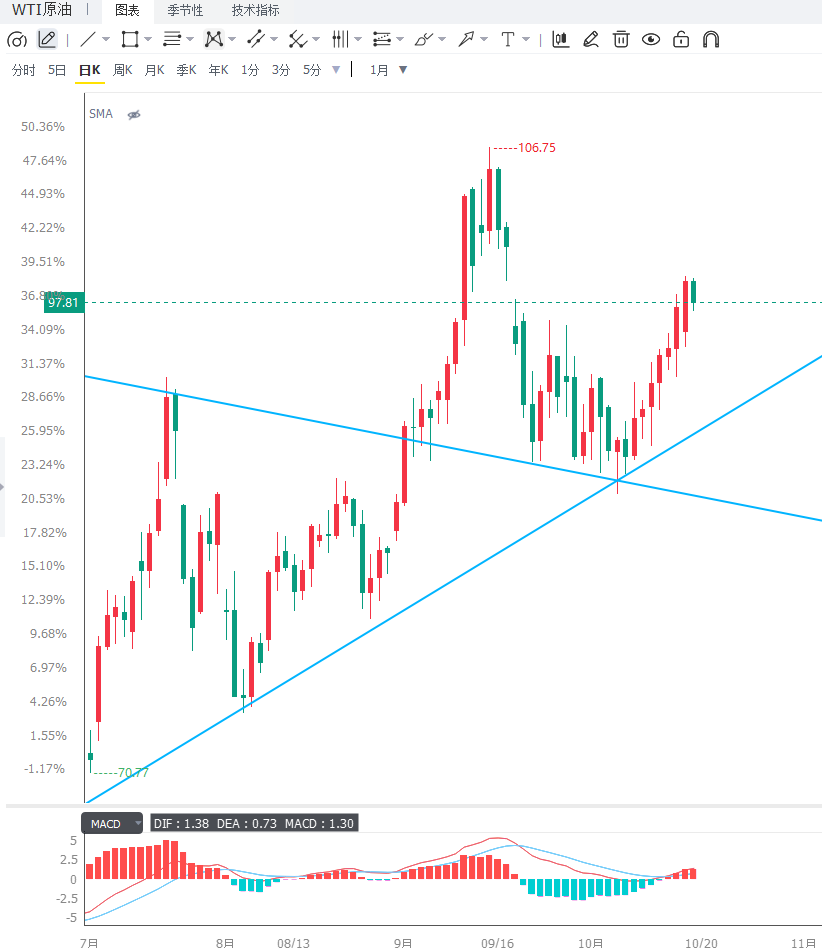 The editor summarizes that WTI crude oil is currently caught in a short-term tug-of-war between "expectations of supply recovery due to the temporary easing of sanctions against Russia" and "the dual geopolitical risk premium of the Middle East and Russia-Ukraine conflict." Profit-taking triggered by Trump's executive order led to a short-term price correction, but fundamental factors such as escalating geopolitical conflicts, low global diesel inventories, and a significant decline in US crude oil inventories continue to provide strong support. Going forward, key attention should be paid to the shipping situation in the Strait of Hormuz, the developments of the attacks on Russian and Ukrainian energy facilities, the future direction of US sanctions against Russia, and the implementation of OPEC+ production targets. Until the $97.0 to $101.4 per barrel range is effectively broken, oil prices are more likely to maintain a wide range of fluctuations at high levels, awaiting new geopolitical and policy catalysts.
Last Friday, Trump signed an executive order invoking the Graham Act's exemption mechanism to temporarily suspend most new sanctions against Russia and tariffs of up to 500%, with a 60-day assessment period. Secretary of State Rubio stated that the president will assess the impact of this exemption on the US economy during this period. This move was interpreted by the market as a possible marginal recovery in Russian crude oil and refined product exports. Coupled with Turkey's agreement to absorb some Russian diesel into the global market, short-term supply-side pressures are expected to increase. However, geopolitical risk premiums have not subsided substantially. In the Middle East, the conflict between the Houthi rebels and Saudi Arabia continues to escalate. The Houthis attacked Yanbu, a key Saudi oil export hub, and a Saudi armed helicopter crashed near the Yemeni border. Shipping risks in the Strait of Hormuz have intensified, with the Iranian Revolutionary Guard Navy announcing that an unauthorized oil tanker struck a mine and caught fire in the southern part of the strait, and reiterating that the channel is closed to unauthorized vessels. Regarding Russia and Ukraine, Ukraine launched a large-scale drone attack on St. Petersburg, Russia, in the early hours of October 18th. Oil terminals, the Ruch oil depot, and data centers were attacked and caught fire. The St. Petersburg oil terminal has an annual throughput capacity of 12.5 million tons and is a crucial energy hub on Russia's Baltic coast. Zelenskyy also stated that since the US announced an "energy ceasefire," Russia has launched 76 strikes against Ukraine's energy and oil and gas sectors. From a fundamental perspective, the tight supply situation has not fundamentally eased. OPEC's monthly report shows that Saudi Arabia's production increased by about one-third month-on-month in September, but global diesel inventories remain at historically low levels. Vitol Group's CEO warned that the West has no more inventory to consume, and if shipping from the Hormuz is disrupted, oil prices could potentially hit $200 per barrel. EIA data shows that US commercial crude oil inventories fell sharply by 8.6 million barrels to 415.6 million barrels in the week ending October 9th, the largest weekly decline since February. From a technical perspective, WTI crude oil prices fell after ending a seven-day winning streak and entered a short-term high-level consolidation phase. Prices are currently trading within the middle of Friday's large bullish candlestick, with resistance levels at $99.0/barrel, $101.4/barrel, and $102/barrel. Support levels are at $97.0/barrel, $95.5/barrel, and $93.0/barrel. The daily RSI has retreated from its highs but remains in strong territory, while the MACD histogram continues to expand but its slope is slowing, indicating that bullish momentum has weakened but not completely disappeared. A decisive break below $97.0/barrel could weaken the short-term bullish structure, potentially leading to a further pullback to the $95.5-$93.0/barrel range. Conversely, a retest of the $101-$102/barrel resistance zone is possible if prices regain a foothold above $99.0/barrel. The editor summarizes that WTI crude oil is currently caught in a short-term tug-of-war between "expectations of supply recovery due to the temporary easing of sanctions against Russia" and "the dual geopolitical risk premium of the Middle East and Russia-Ukraine conflict." Profit-taking triggered by Trump's executive order led to a short-term price correction, but fundamental factors such as escalating geopolitical conflicts, low global diesel inventories, and a significant decline in US crude oil inventories continue to provide strong support. Going forward, key attention should be paid to the shipping situation in the Strait of Hormuz, the developments of the attacks on Russian and Ukrainian energy facilities, the future direction of US sanctions against Russia, and the implementation of OPEC+ production targets. Until the $97.0 to $101.4 per barrel range is effectively broken, oil prices are more likely to maintain a wide range of fluctuations at high levels, awaiting new geopolitical and policy catalysts.
- Risk Warning and Disclaimer
- The market involves risk, and trading may not be suitable for all investors. This article is for reference only and does not constitute personal investment advice, nor does it take into account certain users’ specific investment objectives, financial situation, or other needs. Any investment decisions made based on this information are at your own risk.