This week sees a flurry of US housing, employment, and PMI data releases, with gold prices uncertain ahead of the Federal Reserve meeting.
2026-10-19 12:10:20
Gold is entering a trading week focused on the health of the US economy. Housing, employment, and business activity data could trigger significant volatility in the precious metals market, with several indicators providing key signals for the Federal Reserve's policy decisions ahead of its October 27-28 meeting. Gold prices recovered some ground late last week from pressures of higher-than-expected inflation, high US Treasury yields, and a stronger dollar, rising above $4,150 per ounce.
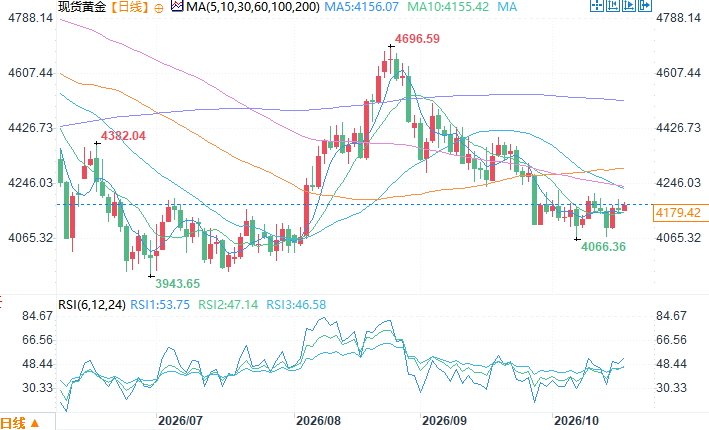 Spot gold daily chart source: FX678. At 12:07 Beijing time on October 19th, spot gold was trading at $4180.42 per ounce.
Gold prices recovered some lost ground, but the market still leans towards a pause in interest rate hikes.
Gold prices rebounded slightly towards the end of last week after being pressured by stronger-than-expected US inflation data, rising US Treasury yields, and a stronger dollar. Gold rose above $4,150 per ounce on Thursday and remained near that level on Friday, while silver traded around $57 per ounce. The market still leans towards a pause in rate hikes at the Fed's October meeting, but persistent inflationary pressures keep expectations for another rate hike this year high.Housing data comes first, with interest rate sensitivity attracting attention.
The U.S. economic calendar was quiet on Monday, with Tuesday's focus shifting to housing starts and building permits, followed by pending home sales. Housing is one of the most interest rate-sensitive sectors of the economy, and these reports provide a useful window into how high borrowing costs are impacting household and construction activity. The previous report showed annualized housing starts falling to 1.275 million units and building permits to 1.403 million units. Further weakness in the data could reinforce concerns about slowing economic growth, supporting gold prices; conversely, signs of improvement could strengthen the case for maintaining restrictive interest rates.Employment data tests the resilience of the labor market
Wednesday's economic calendar was relatively quiet, with Thursday set to release the weekly initial jobless claims figures, one of the most timely indicators of labor market conditions. The latest report showed initial jobless claims at 199,000, suggesting that while hiring has slowed in other sectors of the economy, layoffs remain relatively limited. A significant rise in claims could reinforce expectations that the Federal Reserve will maintain interest rates after weighing the risks of weakening employment against persistent inflation; conversely, persistently low claims would support the assessment that the labor market is resilient enough to withstand tightening policies.PMI and consumer confidence data will be the final indicators, with inflation expectations attracting attention.
Friday brings the week's most important releases, starting with the preliminary S&P Global Composite PMI, providing an early snapshot of private sector business activity in October. The previous composite PMI was 58.4, with manufacturing at 55.9 and services at 58.8, indicating overall economic expansion. Investors will be watching to see if high borrowing costs and persistent inflation begin to drag down business activity. The input and output price sub-items in the survey can also provide additional clues about inflationary pressures. The week concludes with the University of Michigan's final October consumer confidence reading, reflecting American households' reaction to high prices and economic uncertainty. The preliminary reading showed consumer confidence falling to 48.1 from 51.0 in September, reflecting rising pessimism among American households. Inflation expectations in the survey are also under scrutiny, as policymakers are assessing whether recent increases in CPI and PPI are beginning to affect long-term inflation expectations.Conclusion
For precious metals, this week's data releases will primarily be interpreted in terms of their implications for Federal Reserve policy. Weakening housing activity, rising initial jobless claims, and weak PMI readings may reinforce expectations that the Fed will keep interest rates unchanged in October, providing support for gold prices. Conversely, strong economic data or renewed signs of sustained inflation could reignite expectations of further tightening, creating short-term headwinds for gold prices. With the Fed's interest rate meeting approaching, this week's data will determine whether gold prices can continue their rebound or face renewed pressure from high US Treasury yields and a strong dollar. Spot gold daily chart source: FX678. At 12:07 Beijing time on October 19th, spot gold was trading at $4180.42 per ounce.
- Risk Warning and Disclaimer
- The market involves risk, and trading may not be suitable for all investors. This article is for reference only and does not constitute personal investment advice, nor does it take into account certain users’ specific investment objectives, financial situation, or other needs. Any investment decisions made based on this information are at your own risk.