The US dollar index fluctuated at high levels, while the USD/JPY pair continued its range-bound trading, awaiting a directional move.
2026-10-19 13:30:21
The USD/JPY pair traded between 158.00 and 158.10 in Asian trading on Monday, a slight increase from Friday's close of 157.95. It briefly dipped to around 157.80 in the early session before rebounding quickly, with a daily range of approximately 30 pips. The pair remained cautious ahead of a key central bank decision, with both bulls and bears reluctant to make premature bets. The USD/JPY interest rate differential remained the core factor supporting the pair. The US 10-year Treasury yield remained around 5.06%, the 2-year yield was around 4.74%, while the Japanese 10-year government bond yield was only around 1.2%, a spread of over 380 basis points, providing a solid floor for the USD/JPY.  Bank of Japan Governor Kazuo Ueda stated on Monday that inappropriate adjustments to policy rates could push up long-term interest rates due to market concerns about inflation risks. He also pointed out that Japan is experiencing a virtuous cycle of wage growth and price recovery, with core inflation approaching the 2% target. However, the market widely expects the Bank of Japan to maintain its interest rate at its October 29-30 meeting. The "wait-and-see" period following the last rate hike in July has not yet ended, making it difficult for the yen to gain significant appreciation momentum in the short term. Regarding the Federal Reserve, Chairman Warsh's "no-prediction" statement at the IMF's annual meeting in Bangkok last Friday continues to resonate. The market's probability of maintaining the current interest rate at the October 28 meeting has risen to 83.9%, significantly cooling expectations of a rate hike, which marginally weakens the dollar's rate hike premium. However, the probability of a 25 basis point rate hike at the December meeting remains as high as 77% to 88%, indicating that the tightening cycle has not ended, and the dollar is still generally supported. Middle East geopolitical risks provide additional support for the dollar. The Iranian Revolutionary Guard claimed that an oil tanker caught fire and exploded in the Strait of Hormuz on Sunday, and Mohsen Rezaei, secretary of Iran's Supreme National Security Council, warned Tehran that it was prepared for a new round of attacks by the US and Israel. Amid risk aversion, the US dollar rebounded from a two-week low hit on Friday, with the USD/JPY pair rising in tandem. However, the upside potential of the exchange rate remains constrained by multiple factors. On the one hand, US Treasury yields have fallen sharply from multi-year highs, with the 10-year Treasury yield falling more than 20 basis points from its previous high, putting pressure on the dollar due to declining real interest rates. On the other hand, the market remains wary of the possibility of Japanese authorities intervening in the exchange rate again near the 160 level, a "ceiling effect" that limits the willingness of bulls to chase higher prices. From a technical perspective, the USD/JPY 4-hour chart shows a clear range-bound trading pattern, fluctuating around the 100-period simple moving average. Resistance levels are at 158.44, 158.75 to 158.85, and 159.45. The support levels below are 157.60, 157.05, and 156.70. A decisive break above the upper limit of the 158.75-158.85 range could see the exchange rate further challenge the 159.45 level or even the psychological level of 160.00. Conversely, a break below 157.60 could open up further downside potential, potentially leading to a pullback towards the 157.05-156.70 area.
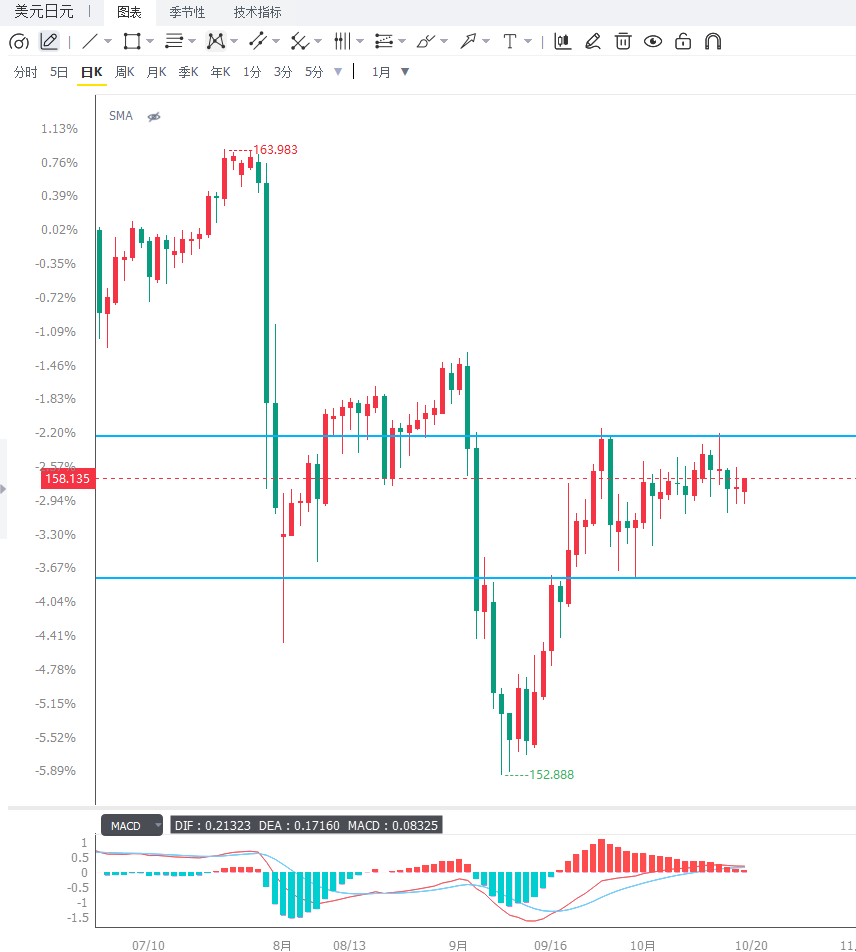 Editor's Summary: The USD/JPY pair is currently caught in a short-term tug-of-war between the "USD/JPY interest rate differential providing support" and "cautious trading ahead of the central bank's decision." Warsh's ambiguous statements have somewhat suppressed the dollar's upward momentum, but the likelihood of a Bank of Japan rate hike in the short term is low, leaving the yen without a basis for significant appreciation. Escalating geopolitical risks in the Middle East provide safe-haven support, but the risk of intervention near the 160 level limits upside potential. Going forward, key events to watch include the Fed's interest rate decision on October 28th, the Bank of Japan's policy meeting on October 29th-30th, the trend of US Treasury yields, and shipping conditions in the Strait of Hormuz.
Bank of Japan Governor Kazuo Ueda stated on Monday that inappropriate adjustments to policy rates could push up long-term interest rates due to market concerns about inflation risks. He also pointed out that Japan is experiencing a virtuous cycle of wage growth and price recovery, with core inflation approaching the 2% target. However, the market widely expects the Bank of Japan to maintain its interest rate at its October 29-30 meeting. The "wait-and-see" period following the last rate hike in July has not yet ended, making it difficult for the yen to gain significant appreciation momentum in the short term. Regarding the Federal Reserve, Chairman Warsh's "no-prediction" statement at the IMF's annual meeting in Bangkok last Friday continues to resonate. The market's probability of maintaining the current interest rate at the October 28 meeting has risen to 83.9%, significantly cooling expectations of a rate hike, which marginally weakens the dollar's rate hike premium. However, the probability of a 25 basis point rate hike at the December meeting remains as high as 77% to 88%, indicating that the tightening cycle has not ended, and the dollar is still generally supported. Middle East geopolitical risks provide additional support for the dollar. The Iranian Revolutionary Guard claimed that an oil tanker caught fire and exploded in the Strait of Hormuz on Sunday, and Mohsen Rezaei, secretary of Iran's Supreme National Security Council, warned Tehran that it was prepared for a new round of attacks by the US and Israel. Amid risk aversion, the US dollar rebounded from a two-week low hit on Friday, with the USD/JPY pair rising in tandem. However, the upside potential of the exchange rate remains constrained by multiple factors. On the one hand, US Treasury yields have fallen sharply from multi-year highs, with the 10-year Treasury yield falling more than 20 basis points from its previous high, putting pressure on the dollar due to declining real interest rates. On the other hand, the market remains wary of the possibility of Japanese authorities intervening in the exchange rate again near the 160 level, a "ceiling effect" that limits the willingness of bulls to chase higher prices. From a technical perspective, the USD/JPY 4-hour chart shows a clear range-bound trading pattern, fluctuating around the 100-period simple moving average. Resistance levels are at 158.44, 158.75 to 158.85, and 159.45. The support levels below are 157.60, 157.05, and 156.70. A decisive break above the upper limit of the 158.75-158.85 range could see the exchange rate further challenge the 159.45 level or even the psychological level of 160.00. Conversely, a break below 157.60 could open up further downside potential, potentially leading to a pullback towards the 157.05-156.70 area. Editor's Summary: The USD/JPY pair is currently caught in a short-term tug-of-war between the "USD/JPY interest rate differential providing support" and "cautious trading ahead of the central bank's decision." Warsh's ambiguous statements have somewhat suppressed the dollar's upward momentum, but the likelihood of a Bank of Japan rate hike in the short term is low, leaving the yen without a basis for significant appreciation. Escalating geopolitical risks in the Middle East provide safe-haven support, but the risk of intervention near the 160 level limits upside potential. Going forward, key events to watch include the Fed's interest rate decision on October 28th, the Bank of Japan's policy meeting on October 29th-30th, the trend of US Treasury yields, and shipping conditions in the Strait of Hormuz.
- Risk Warning and Disclaimer
- The market involves risk, and trading may not be suitable for all investors. This article is for reference only and does not constitute personal investment advice, nor does it take into account certain users’ specific investment objectives, financial situation, or other needs. Any investment decisions made based on this information are at your own risk.