One chart: Baltic Dry Index ends "ten-day losing streak": Stronger Capesize freight rates drive BDI to stop falling and rebound.
2026-10-19 23:36:20
The latest data shows that on October 19, 2026, the Baltic Dry Index (BDI) reached 2546 points, a three-day high, up 1.39% week-on-week (compared to the previous value), marking the largest increase since September 4, 2026. Looking at the short-term charts, the recent 11 BDI data points show: 1 positive increase, 10 negative increases, and 0 zero increases. Specifically, the Panamax Freight Index (BPI) was 2286 points, down 1.21% from the previous value; the Capesize Freight Index (BCI) was 3365 points, up 3.57%; and the Supramax Freight Index (BSI) was 1868 points, up 0.16%. For detailed charts of the latest 720-day and 10-year trends of the Baltic Dry Index and its three main sub-indices, please refer to the charts specially created by FX678. 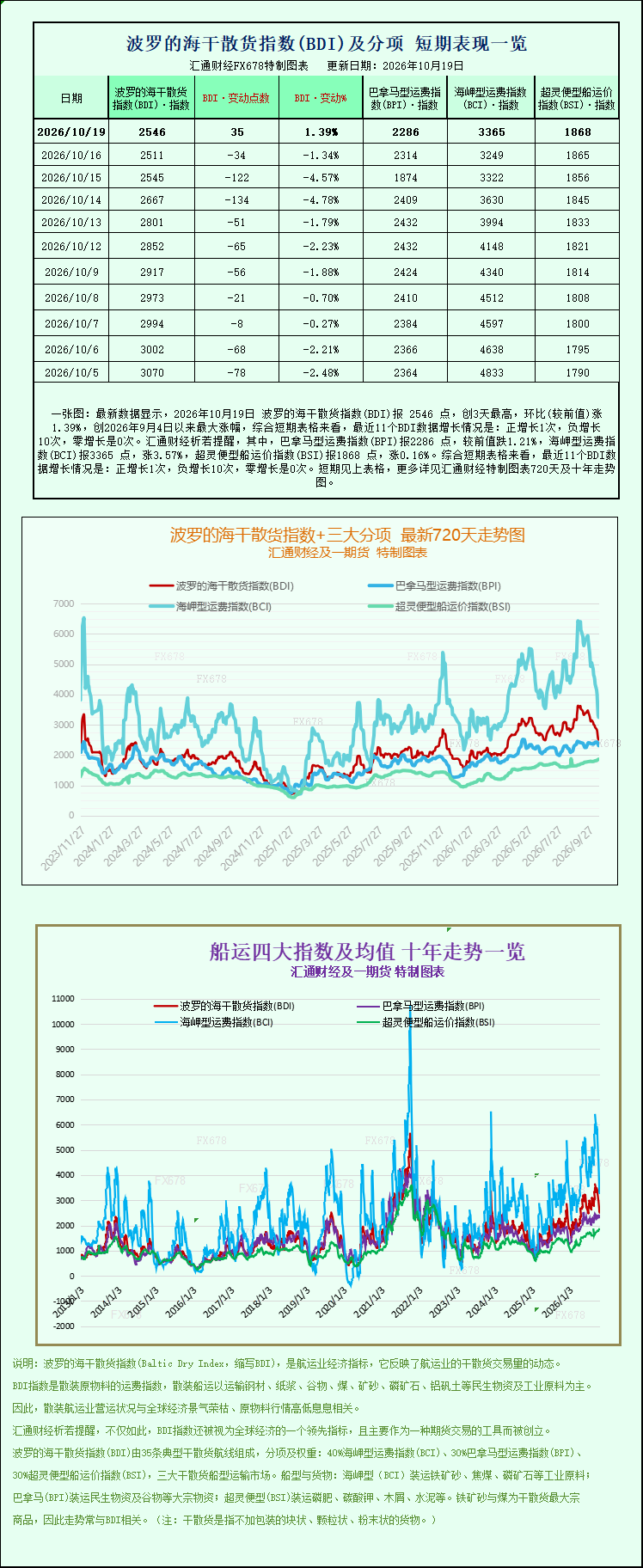 The Baltic Dry Index, the main shipping index tracking dry bulk freight rates, ended a 10-day losing streak, rising on Monday, primarily driven by stronger Capesize rates. The index had fallen approximately 14% the previous week, leading to cautious market sentiment. This rebound at the start of the week has provided a stabilizing signal for the recent correction in the dry bulk market. Key Data: Divergent Trends Across Three Vessel Types The Baltic Dry Index, which tracks Capesize, Panamax, and Supramax vessel freight rates, rose 35 points, or 1.39%, to close at 2546 points. Last week, the index fell approximately 14%. Despite Monday's rebound, the index remains within its recent correction channel on a weekly chart, and the sustainability of this single-day rebound remains to be seen. By vessel type, the Capesize index rose 116 points, or 3.57%, to 3365 points. This index had plunged 25% last week, making Monday's rebound a relatively significant corrective move. In contrast, the Panamax index bucked the trend, falling 28 points, or 1.21%, to close at 2286. Among smaller vessels, the Supramax index rose slightly by 3 points, or 0.16%, to 1868. This divergence in the performance of the three major vessel types indicates that the current rebound in the dry bulk market is not a broad-based rally, but rather exhibits a clear structural characteristic. II. Capesize Vessels: Iron Ore and Steel Demand Provide Major Support As the main driver of this rebound, Capesize vessels typically carry approximately 150,000 tons of cargo, including bulk commodities such as iron ore and coal. Data shows that the average daily earnings of Capesize bulk carriers increased by $1054 to $27015, with a significant rebound in charter rates. The strengthening of Capesize freight rates is closely related to marginal changes in the iron ore market. Recent macroeconomic data shows that China's economic growth exceeded market expectations, leading to a corresponding increase in steel production. This factor boosted iron ore futures prices, thereby supporting the demand for Capesize vessels. However, market participants also pointed out that the overall fundamentals of iron ore remain weak, with supply-side shipping pressures and uncertainties in end-user demand jointly limiting further increases. From a trade structure perspective, Capesize vessels are highly dependent on long-haul ocean shipping of iron ore and coal, and their freight rates are sensitive to changes in demand from major Asian steel-producing countries. As the world's largest importer of iron ore and producer of crude steel, China's macroeconomic data, steel mill operating rates, port inventory changes, and the shipping schedules of major mines often directly impact the charter rates for this vessel type. This rebound in Capesize vessels is a result of the interplay between improved macroeconomic expectations and spot supply and demand. III. Panamax Vessels: Grain and Coal Trade Under Pressure In stark contrast to Capesize vessels, Panamax freight rates continued their downward trend on the day. Average daily earnings for Panamax vessels fell by $254 to $20,573. These vessels typically carry 60,000 to 70,000 tons of coal or grain, and their trade flows are more concentrated in regional grain, coal, and some ore transportation. The weakening of Panamax vessels may reflect changes in demand during the grain harvest season and the pace of coal trade. Generally, the harvest and export schedules of grain crops, as well as the procurement cycles of coal for power generation and industry, have a phased impact on freight rates for this vessel type. Furthermore, regional capacity supply and route reallocation may also cause short-term fluctuations in charter rates. Unlike Capesize vessels, which are mainly driven by macroeconomic expectations, Panamax performance is more influenced by the pace of spot trade and seasonal factors. IV. Supramax Vessels: Slight Stabilization Among smaller vessels, the Supramax vessel index rose slightly by 0.16%, indicating that the overall market for small and medium-sized bulk carriers is operating relatively smoothly. Supramax vessels typically transport various types of bulk cargo, including grain, fertilizer, steel, and some small mineral products. Their trade scope is broad, and the types of cargo are relatively diversified, resulting in relatively mild freight rate fluctuations and limited impact from the market conditions of any single cargo type. V. Market Background and Outlook In summary, the Baltic Dry Index's rebound on Monday was more of a structural recovery driven by a single point of rebound in Capesize vessels, rather than a general market-wide strengthening. The divergence in the performance of the three major vessel types also suggests that the dry bulk market is currently in a "structural adjustment" phase—the supply and demand patterns for different cargo types and vessel types differ significantly, and a single factor cannot comprehensively dominate the market direction. Looking ahead, market participants are generally focusing on the following aspects: First, the further development of China's macroeconomy and its continued driving effect on the demand for steel and iron ore; second, changes on the iron ore supply side, including the shipping plans of major mining companies, the pace of overseas arrivals, and the accumulation of port inventories; third, the seasonal rhythm of global coal and grain trade, and the potential disruptions to shipping routes caused by geopolitical, weather, and shipping route factors. In addition, the deployment and idleness of global shipping capacity, the speed of scrapping older vessels, and the impact of fuel prices on shipowners' operating costs will also jointly determine the medium-term freight rate trend in the dry bulk market. It should be noted that a single day's rebound does not necessarily indicate a trend reversal. The market still faces considerable uncertainty. The sustainability of the Capesize rebound, the potential for a recovery in Panamax vessel weakness, and the subsequent verification of macroeconomic data are all key variables influencing future market direction. Further observation is needed to determine the market's future trajectory.
- Risk Warning and Disclaimer
- The market involves risk, and trading may not be suitable for all investors. This article is for reference only and does not constitute personal investment advice, nor does it take into account certain users’ specific investment objectives, financial situation, or other needs. Any investment decisions made based on this information are at your own risk.